
61348

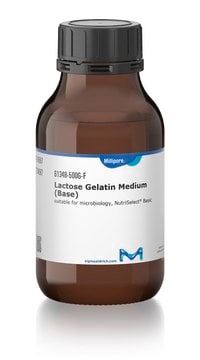
Lactose Gelatin Medium (Base)
suitable for microbiology, NutriSelect® Basic
Select a Size
| Pack Size | SKU | Availability | Price |
|---|---|---|---|
| 500 g | Please contact Customer Service for Availability | PLN 690.00 |
About This Item
PLN 690.00
sterility
non-sterile
Quality Level
form
powder
shelf life
limited shelf life, expiry date on the label
composition
disodium hydrogen phosphate, 5 g/L , lactose, 10 g/L , meat peptone (peptic), 15 g/L , phenol red, 0.05 g/L , yeast extract, 10 g/L
manufacturer/tradename
NutriSelect® Basic
technique(s)
microbe id | specific enzyme detection: suitable, microbiological culture: suitable
final pH
7.5±0.2 (25 °C)
application(s)
agriculture
bioburden testing
environmental
food and beverages, microbiology
suitability
Bacillus spp., Proteus spp., Serratia spp., Staphylococcus spp., nonselective and differential for Clostridium spp.
Application
Preparation Note
Other Notes
The designations basic, plus, or prime are added to indicate the quality control level, from basic quality control to standard QC plus to prime for full regulatory compliance.
Legal Information
1 of 1
This Item | |||
|---|---|---|---|
| technique(s) microbe id | specific enzyme detection: suitable, microbiological culture: suitable | technique(s) microbe id | specific enzyme detection: suitable | technique(s) microbe id | specific enzyme detection: suitable, microbiological culture: suitable | technique(s) microbe id | specific enzyme detection: suitable, microbiological culture: suitable |
| form powder | form powder | form powder | form powder |
| suitability Bacillus spp., Serratia spp., nonselective and differential for Clostridium spp., Proteus spp., Staphylococcus spp. | suitability nonselective and differential for Bacillus spp., nonselective and differential for Clostridium spp., nonselective and differential for Proteus spp., nonselective and differential for Serratia spp., nonselective and differential for Staphylococcus spp., proteolytic bacteria | suitability Enterococcus spp., Haemophilus spp., Pneumococcus spp., nonselective for Bacillus spp., nonselective for Bacteroides spp., nonselective for Campylobacter spp., nonselective for Candida spp., nonselective for Escherichia coli, nonselective for Neisseria spp., nonselective for Staphylococcus spp., nonselective for Streptococcus spp., nonselective for bacteria (Fastidious organisms), nonselective for coliforms | suitability Aeromonas spp., Haemophilus spp., Pneumococcus spp., bacteria (pathogenic and non-pathogenic like Neisseria, Streptococci), nonselective and differential for Bacillus cereus, nonselective and differential for Bacillus spp., nonselective and differential for Bordetella spp., nonselective and differential for Candida spp., nonselective and differential for Clostridium spp., nonselective and differential for Corynebacterium spp., nonselective and differential for Enterococcus spp., nonselective and differential for Escherichia coli, nonselective and differential for Listeria spp., nonselective and differential for Neisseria spp., nonselective and differential for Pseudomonas spp., nonselective and differential for Salmonella spp., nonselective and differential for Shigella spp., nonselective and differential for Staphylococcus spp., nonselective and differential for Streptococcus spp., nonselective and differential for coliforms |
| composition disodium hydrogen phosphate, 5 g/L , meat peptone (peptic), 15 g/L , yeast extract, 10 g/L , lactose, 10 g/L , phenol red, 0.05 g/L | composition gelatine, 120 g/L , meat extract, 3 g/L , peptone, 5 g/L | composition agar, 15 g/L , casein peptone, 15 g/L , sodium chloride, 5 g/L , soy peptone, 5 g/L | composition agar, 15 g/L , meat extract, 10 g/L , peptone, 10 g/L , sodium chloride, 5 g/L |
| sterility non-sterile | sterility non-sterile | sterility non-sterile | sterility non-sterile |
| application(s) agriculture | application(s) agriculture | application(s) bioburden testing | application(s) agriculture |


Storage Class
11 - Combustible Solids
flash_point_f
Not applicable
flash_point_c
Not applicable
Choose from one of the most recent versions:
Already Own This Product?
Find documentation for the products that you have recently purchased in the Document Library.
Articles
Mikrobiologiczna ocena bakterii występujących w przyprawach, będących potencjalnym źródłem patogenów i powodujących psucie się żywności.
Some Bacillus species are crucial for advancing our understanding of bacteria, while others can be harmful, acting as spoilage organisms or pathogens. Nevertheless, all these species are significant in biotechnological research.
Clostridium perfringens can cause contamination in undercooked or improperly sterilized canned foods and water. Learn to detect, identify, and differentiate this pathogen.
Global Trade Item Number
| SKU | GTIN |
|---|---|
| 61348-500G-F | 04061832700014 |