Skip to Content
Merck

Skip To

CBL243

Anti-Glucose Transporter GLUT-4 Antibody

Chemicon®, from rabbit

Sign In to View Organizational & Contract Pricing.

Select a Size

Change View
Pack SizeSKUAvailabilityPrice

About This Item

UNSPSC Code:
12352203
NACRES:
NA.41
eCl@ss:
32160702
Conjugate:
unconjugated
Clone:
polyclonal
Application:
IP, WB
Citations:
7
Pricing and availability is not currently available.
Technical Service
Need help? Our team of experienced scientists is here for you.
Let Us Assist


biological source

rabbit

Quality Level

conjugate

unconjugated

antibody form

affinity isolated antibody

antibody product type

primary antibodies

clone

polyclonal

purified by

affinity chromatography

species reactivity

mouse, human, rat

manufacturer/tradename

Chemicon®

technique(s)

immunoprecipitation (IP): suitable, western blot: suitable

NCBI accession no.

UniProt accession no.

shipped in

wet ice

target post-translational modification

unmodified

Gene Information

human ... SLC2A4(6517)

General description

46 kDa

Immunogen

Partially purified GLUT-4

Application

Research Category
Signaling
Research Sub Category
Insulin/Energy Signaling
This Anti-Glucose Transporter GLUT-4 Antibody is validated for use in IP, WB for the detection of Glucose Transporter GLUT-4.
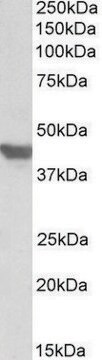
Western blot analysis of GLUT-4 activity in adipose and muscle tissue (5μg/ml)

Immunoprecipitation of GLUT-4 (5μg/ml)

Optimal working dilutions must be determined by the end user.

Biochem/physiol Actions

Specific for human glucose transporter-4 from muscle and adipose tissue. The antisera does not cross-react with GLUT-1. The molecular weight of the glucose transporter precipitated by the serum is approximately 46 kDa.

Physical form

ImmunoAffinity Purified
Purified immunoglobulin in PBS with 0.01% sodium azide.

Preparation Note

For use within 1 month of purchase store at +4°C, for long term storage aliquot antibody into small volumes and store at -20°C.

Analysis Note

Control
Positive Control: 3T3 L1 adipocyte membranes

Other Notes

Concentration: Please refer to the Certificate of Analysis for the lot-specific concentration.

Legal Information

CHEMICON is a registered trademark of Merck KGaA, Darmstadt, Germany

Disclaimer

Unless otherwise stated in our catalog or other company documentation accompanying the product(s), our products are intended for research use only and are not to be used for any other purpose, which includes but is not limited to, unauthorized commercial uses, in vitro diagnostic uses, ex vivo or in vivo therapeutic uses or any type of consumption or application to humans or animals.

Compare Similar Items

View Full Comparison

Show Differences

1 of 1

This Item
400064SAB2501472CBL242
antibody form

affinity isolated antibody

antibody form

affinity isolated antibody

antibody form

affinity isolated antibody

antibody form

affinity isolated antibody

Quality Level

100

Quality Level

100

Quality Level

100

Quality Level

100

biological source

rabbit

biological source

rabbit

biological source

goat

biological source

rabbit

conjugate

unconjugated

conjugate

-

conjugate

unconjugated

conjugate

unconjugated

UniProt accession no.

P14672

UniProt accession no.

-

UniProt accession no.

P14672

UniProt accession no.

P11166

shipped in

wet ice

shipped in

wet ice

shipped in

dry ice

shipped in

wet ice


Still not finding the right product?

Try our Product Selector Tool to narrow your options


wgk

WGK 2

flash_point_f

Not applicable

flash_point_c

Not applicable

Storage Class

12 - Non Combustible Liquids


Certificates of Analysis (COA)

Search for Certificates of Analysis (COA) by entering the products Lot/Batch Number. Lot and Batch Numbers can be found on a product’s label following the words ‘Lot’ or ‘Batch’.

Already Own This Product?

Find documentation for the products that you have recently purchased in the Document Library.

Visit the Document Library


Haiyan Wang et al.
Journal of applied physiology (Bethesda, Md. : 1985), 132(1), 140-153 (2021-12-10)
Previous studies demonstrated that acute exercise can enhance glucose uptake (GU), γ3-AMP-activated protein kinase (AMPK) activity, and Akt substrate of 160 kDa (AS160) phosphorylation in skeletal muscles from low-fat diet (LFD)- and high-fat diet (HFD)-fed male rats. Because little is
Haiyan Wang et al.
Facets (Ottawa), 7, 774-791 (2022-11-17)
Attenuated skeletal muscle glucose uptake (GU) has been observed with advancing age. It is important to elucidate the mechanisms linked to interventions that oppose this detrimental outcome. Earlier research using young rodents and (or) cultured myocytes reported that treatment with
Roberto A Gulli et al.
American journal of physiology. Regulatory, integrative and comparative physiology, 303(10), R1062-R1070 (2012-10-12)
High-fat (HF) diets impair skeletal muscle response to the insulin-sensitizing adipokine adiponectin (Ad) in rodents, preceding the development of insulin resistance. Skeletal muscle insulin response in HF-fed rats can be restored with chronic exercise; whether recovery of skeletal muscle Ad


Global Trade Item Number

SKUGTIN
CBL24304053252322280

Questions

Reviews

No rating value

Active Filters