

This product may be reconstituted in water at 0.1-1.0 mg/mL. Stock solutions are stable for up to 1 week when refrigerated at 2 - 8°C. For extended storage, further dilute the prepared stock solution with working buffer containing a carrier protein such as albumin (0.1 - 1.0%) or trehalose (5%). Dilute solutions may then be stored in working aliquots at -20 or -80°C. Avoid repeated freeze/thaw cycles.
GF306

IGF-I Protein, Human Recombinant Animal Free
The Insulin-like growth factor I protein(or IGF-1 protein), also known as somatomedin C, is the dominant effector of growth hormone & is structurally homologous to proinsulin. Manufactured using all non-animal reagents.
Synonym(e):
IGF-1, IGF1, Insulinlike Growth Factor I, Insulinlike Growth Factor 1, Mechano growth factor, Somatomedin-C, IGFI
Anmelden zur Ansicht der Organisations- und Vertragspreise.
Größe auswählen
Ansicht ändern
| Packungsgröße | SKU | Verfügbarkeit | Preis |
|---|
Über diesen Artikel
UNSPSC Code:
12352202
NACRES:
NA.77
eCl@ss:
32160405
Assay:
>98% (SDS-PAGE and HPLC)
Preise und Verfügbarkeit sind derzeit nicht verfügbar.
Technischer Dienst
Benötigen Sie Hilfe? Unser Team von erfahrenen Wissenschaftlern ist für Sie da.
Unterstützung erhaltenQuality Level
assay
>98% (SDS-PAGE and HPLC)
impurities
<0.1 μg/mg protein endotoxin (<1EU/μg)
NCBI accession no.
UniProt accession no.
shipped in
dry ice
storage temp.
-10 to -25°C
General description
Insulinlike growth factor I, also known as somatomedin C, is the dominant effector of growth hormone and is structurally homologous to proinsulin. The IGFs are mitogenic polypeptide growth factors that stimulate the proliferation and survival of various cell types including muscle, bone, and cartilage tissue in vitro. IGFs are predominantly produced by the liver, although a variety of tissues produce the IGFs at distinctive times. The IGFs belong to the Insulin gene family, which also contains insulin and relaxin. The IGFs are similar by structure and function to insulin, but have a much higher growth-promoting activity than insulin. IGF-II expression is influenced by placenta lactogen, while IGF-I expression is regulated by growth hormone. Both IGF-I and IGF-II signal through the tyrosine kinase type I receptor (IGF-IR), but, IGF-II can also signal through the IGF-II/Mannose-6-phosphate receptor. Mature IGFs are generated by proteolytic processing of inactive precursor proteins, which contain N-terminal and C-terminal propeptide regions. Recombinant human IGF-I and IGF-II are globular proteins containing 70 and 67 amino acids, respectively, and 3 intra-molecular disulfide bonds.
Product Source: E. coli
Application
Research Category
Stem Cell Research
Stem Cell Research
Research Sub Category
Growth Factors & Receptors
Growth Factors & Receptors
Biochem/physiol Actions
Cross Reactivty
Mouse, Rat, Horse, Pig, Cow, Sheep, Monkey, Chicken, Tiger Salamander, Bacteria, Frog
Mouse, Rat, Horse, Pig, Cow, Sheep, Monkey, Chicken, Tiger Salamander, Bacteria, Frog
Physical form
Product is filtered through a 0.2 micron filter before lyophilization.
Recombinant animal free human IGF-I is manufactured using all non-animal reagents
Preparation Note
Store at -20°C for up to 6 months from date of receipt.
Analysis Note
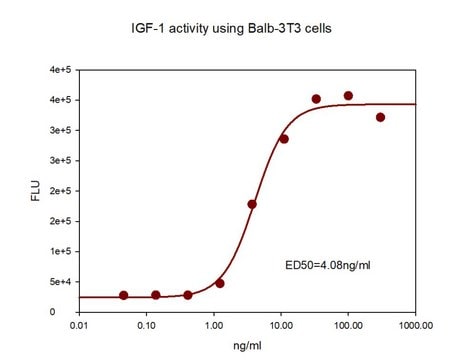
Bioactivity assay: The ED50 was determined by a cell proliferation assay using FDC-P1 cells is ≤ 2.0 ng/ml, corresponding to a specific activity of ≥ 5 x 10⁵ units/mg.
Disclaimer
Unless otherwise stated in our catalog or other company documentation accompanying the product(s), our products are intended for research use only and are not to be used for any other purpose, which includes but is not limited to, unauthorized commercial uses, in vitro diagnostic uses, ex vivo or in vivo therapeutic uses or any type of consumption or application to humans or animals.
1 of 1
Dieser Artikel | |||
|---|---|---|---|
| assay >98% (SDS-PAGE and HPLC) | assay ≥95% (HPLC) | assay ≥98% (HPLC), ≥98% (SDS-PAGE) | assay >98% (SDS-PAGE and HPLC) |
| storage temp. -10 to -25°C | storage temp. −20°C | storage temp. −20°C | storage temp. -10 to -25°C |
| shipped in dry ice | shipped in wet ice | shipped in wet ice | shipped in dry ice |
| impurities <0.1 μg/mg protein endotoxin (<1EU/μg) | impurities ≤1.00 EU/μg endotoxin, tested | impurities <0.1 EU/μg endotoxin, tested | impurities <0.1 μg/mg protein endotoxin (<1EU/μg) |
| UniProt accession no. | UniProt accession no. | UniProt accession no. | UniProt accession no. |
| Quality Level 100 | Quality Level 300 | Quality Level - | Quality Level 100 |
Lagerklasse
11 - Combustible Solids
wgk
WGK 3
flash_point_f
Not applicable
flash_point_c
Not applicable
Analysenzertifikate (COA)
Suchen Sie nach Analysenzertifikate (COA), indem Sie die Lot-/Chargennummer des Produkts eingeben. Lot- und Chargennummern sind auf dem Produktetikett hinter den Wörtern ‘Lot’ oder ‘Batch’ (Lot oder Charge) zu finden.
Besitzen Sie dieses Produkt bereits?
In der Dokumentenbibliothek finden Sie die Dokumentation zu den Produkten, die Sie kürzlich erworben haben.
Verwandter Inhalt
New Products: Antibodies, Assays, Small Molecules, Inhibitors, and Proteins
Yan Li et al.
Journal of ovarian research, 15(1), 94-94 (2022-08-14)
This study intended to clarify the mechanisms by which WISP1-mediated IGF1/αvβ3/Wnt axis might affect the progression of ovarian cancer. Bioinformatics analysis was implemented for pinpointing expression of IGF1 and WISP1 which was verified through expression determination in clinical tissue samples
Ruo-Xu Liu et al.
Neural regeneration research, 15(9), 1709-1715 (2020-03-27)
Microglia, as the resident immune cells in the central nervous system, play important roles in regulating neuronal processes, such as neural excitability, synaptic activity, and apoptotic cell clearance. Growth factors can activate multiple signaling pathways in central nervous system microglia
Jong-Ho Lee et al.
Nature communications, 8(1), 949-949 (2017-10-19)
Phosphofructokinase 1 (PFK1) plays a critical role in glycolysis; however, its role and regulation in tumorigenesis are not well understood. Here, we demonstrate that PFK1 platelet isoform (PFKP) is the predominant PFK1 isoform in human glioblastoma cells and its expression
Global Trade Item Number
| SKU | GTIN |
|---|---|
| GF306 | 04053252691287 |
-
Can you tell me how to dilute the IGF-1 protein?
1 answer-
Helpful?
-