
3013

Transcreener® ADP2 FI Assay
Sinonimo/i:
ADP Assay Kit, Transcreener ADP Assay
Autenticati per visualizzare i prezzi organizzativi e contrattuali.
Scegli un formato
Cambia visualizzazione
| Voi/SKU | Disponibilità | Prezzo |
|---|---|---|
1 ea | Per informazioni sulla disponibilità, contatta il Servizio Clienti. | 449,00 € |
1 ea | Per informazioni sulla disponibilità, contatta il Servizio Clienti. | 905,00 € |
1 ea | Per informazioni sulla disponibilità, contatta il Servizio Clienti. | 5440,00 € |
Informazioni su questo articolo
NACRES:
NA.84
UNSPSC Code:
41122100
449,00 €
Per informazioni sulla disponibilità, contatta il Servizio Clienti.
Servizio Tecnico
Hai bisogno di aiuto? Il nostro team di scienziati qualificati è a tua disposizione.
Permettici di aiutartishipped in
dry ice
storage temp.
−20°C
General description
The Transcreener® HTS Assay platform overcomes the need for time-consuming, one-off assay development for individual members within a group transfer enzyme family by utilizing a single set of assay reagents that detect an invariant product. The generic nature of the Transcreener® HTS Assay platform eliminates delays involved in assay development for new HTS targets, and greatly simplifies compound and inhibitor profiling across multiple target families.
The Transcreener® ADP2 fluorescent intensity (FI) assay extends the Transcreener® platform for ADP detection by utilizing a simple fluorescent intensity output which can be used on both fluorescence readers typically found in academic and therapeutic research labs as well as more complex multimode plate readers more commonly used in core facilities and HTS labs. The Transcreener® ADP2 FI Assay is a red, competitive fluorescence intensity (FI) assay based on the detection of ADP and therefore is compatible with any enzyme class that produces ADP, including protein, lipid, and carbohydrate kinases, ATPases, DNA helicases, carboxylases and glutamine synthetase. The Transcreener® ADP2 Assay is a simple one step homogenous detection assay, and is flexible with regard to ATP concentration (0.1 to 100 μM ATP). The assay provides excellent signal at low substrate conversion, with a Z′ = 0.7 at 2.5% ATP conversion using 1 μM ATP.
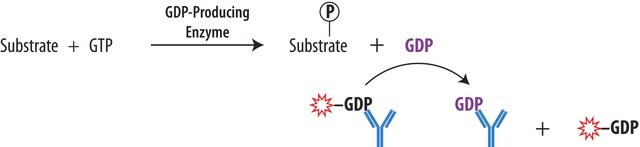
The Transcreener® ADP2 FI Assay was developed to follow the progress of any enzyme that produces ADP. The Transcreener® ADP Detection Mixture comprises a quenched ADP Alexa594 Tracer bound to the ADP2 monoclonal antibody conjugated to an IRDye® QC-1 quencher licensed from LI-COR®. The tracer is displaced by ADP, the invariant product generated during an enzyme reaction. The displaced tracer becomes un-quenched in solution leading to a positive increase in fluorescence intensity. Therefore, ADP production is proportional to an increase in fluorescence. The red tracer minimizes interference from fluorescent compounds and light scattering.
View full Transcreener® product list
The Transcreener® ADP2 fluorescent intensity (FI) assay extends the Transcreener® platform for ADP detection by utilizing a simple fluorescent intensity output which can be used on both fluorescence readers typically found in academic and therapeutic research labs as well as more complex multimode plate readers more commonly used in core facilities and HTS labs. The Transcreener® ADP2 FI Assay is a red, competitive fluorescence intensity (FI) assay based on the detection of ADP and therefore is compatible with any enzyme class that produces ADP, including protein, lipid, and carbohydrate kinases, ATPases, DNA helicases, carboxylases and glutamine synthetase. The Transcreener® ADP2 Assay is a simple one step homogenous detection assay, and is flexible with regard to ATP concentration (0.1 to 100 μM ATP). The assay provides excellent signal at low substrate conversion, with a Z′ = 0.7 at 2.5% ATP conversion using 1 μM ATP.
The Transcreener® ADP2 FI Assay was developed to follow the progress of any enzyme that produces ADP. The Transcreener® ADP Detection Mixture comprises a quenched ADP Alexa594 Tracer bound to the ADP2 monoclonal antibody conjugated to an IRDye® QC-1 quencher licensed from LI-COR®. The tracer is displaced by ADP, the invariant product generated during an enzyme reaction. The displaced tracer becomes un-quenched in solution leading to a positive increase in fluorescence intensity. Therefore, ADP production is proportional to an increase in fluorescence. The red tracer minimizes interference from fluorescent compounds and light scattering.
View full Transcreener® product list
Physical form
Kit with buffered aqueous solutions
Preparation Note
3013-A = 200 assay, 96-well
3013-1K = 1,000 assay, 384-well
3013-10K = 10,000 assay, 384-well
3013-1K = 1,000 assay, 384-well
3013-10K = 10,000 assay, 384-well
Legal Information
IRDye is a registered trademark of LI-COR, Inc.
LI-COR is a registered trademark of LI-COR, Inc.
Transcreener is a registered trademark of BellBrook Labs
1 of 1
Questo articolo | |||
|---|---|---|---|
| description - | description - | description - | description - |
| shipped in dry ice | shipped in dry ice | shipped in dry ice | shipped in dry ice |
| storage temp. −20°C | storage temp. −20°C | storage temp. −20°C | storage temp. −20°C |



signalword
Warning
hcodes
Hazard Classifications
Eye Irrit. 2 - STOT RE 2 Inhalation
Classe di stoccaggio
12 - Non Combustible Liquids
wgk
WGK 3
flash_point_f
Not applicable
flash_point_c
Not applicable
target_organs
Respiratory Tract
Scegli una delle versioni più recenti:
Possiedi già questo prodotto?
I documenti relativi ai prodotti acquistati recentemente sono disponibili nell’Archivio dei documenti.