
MABC522

Anti-MAP17 Antibody, clone 165C
clone 165C, from mouse
Sinónimos:
PDZK1-interacting protein 1, 17 kDa membrane-associated protein, Protein DD96
Seleccione un Tamaño
| Tamaño de envase | SKU | Disponibilidad | Precio |
|---|
Acerca de este artículo
1 of 1
Este artículo | |||
|---|---|---|---|
| clone 165C, monoclonal | clone 3A11, monoclonal | clone 3A1.1, monoclonal | clone 1H8.1, monoclonal |
| biological source mouse | biological source mouse | biological source mouse | biological source mouse |
| conjugate unconjugated | conjugate unconjugated | conjugate unconjugated | conjugate unconjugated |
| species reactivity human | species reactivity human | species reactivity human | species reactivity human, rat |
| Gene Information human ... PDZK1IP1(10158) | Gene Information human ... CDCP1(64866) | Gene Information human ... SAV1(60485) | Gene Information human ... ENC1(8507) |
| antibody form purified antibody | antibody form purified immunoglobulin | antibody form purified antibody | antibody form purified antibody |


General description
Immunogen
Application
Apoptosis & Cancer
Apoptosis - Additional
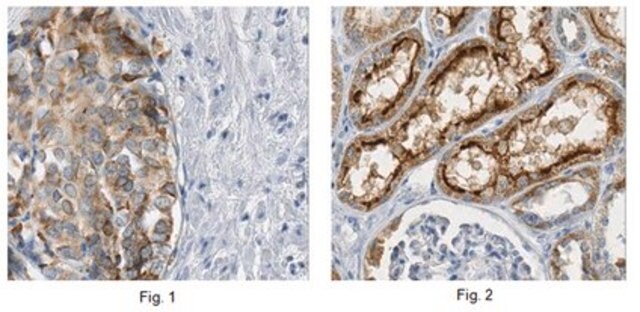
Immunohistochemistry Analysis: A 1:500-2,000 dilution from a representative lot detected MAP17 in human prostate cancer and human kidney tissue.
Physical form
Preparation Note
Analysis Note
Western Blotting Analysis: 1.0 µg/mL of this antibody detected MAP17 in 10 µg of human kidney tissue lysate.
Other Notes
Disclaimer
¿No encuentra el producto adecuado?
Pruebe nuestro Herramienta de selección de productos.
Clase de almacenamiento
12 - Non Combustible Liquids
wgk
WGK 1
flash_point_f
Not applicable
flash_point_c
Not applicable
Certificados de análisis (COA)
Busque Certificados de análisis (COA) introduciendo el número de lote del producto. Los números de lote se encuentran en la etiqueta del producto después de las palabras «Lot» o «Batch»
¿Ya tiene este producto?
Encuentre la documentación para los productos que ha comprado recientemente en la Biblioteca de documentos.
Contenido relacionado
"Apoptosis & Autophagy in Cancer: Cell Survival by Eluding Cell Death The ability of tumor cells to elude programmed cell death, also known as apoptosis, is a hallmark of most types of cancer. Similary, autophagy is a highly regulated, homeostatic degradative process where cells destroy their own components via the lysosomal machinery and recycle them for prolonged cell survival. Via extensive crosstalk with pro-apoptotic signaling pathways, autophagy can also contribute to cell death and greatly influence general cell health. Elucidating the correlation between autophagy and apoptotic cell death has become the focus of a great deal of research, particularly in tumor biology. On one hand, autophagy may induce cell death by degrading essential components; on the other hand, it may facilitate survival of cancer cells under unfavorable metabolic conditions."
Número de artículo de comercio global
| SKU | GTIN |
|---|---|
| MABC522 | 04053252934933 |
Filtros activos
Nuestro equipo de científicos tiene experiencia en todas las áreas de investigación: Ciencias de la vida, Ciencia de los materiales, Síntesis química, Cromatografía, Analítica y muchas otras.
Póngase en contacto con el Servicio técnico