Přejít k obsahu
Merck

Přeskočit na

MAB5280

Anti-Tyrosine Hydroxylase Antibody

CHEMICON®, mouse monoclonal, 2/40/15

Synonyma:

TH, Tyrosine Monooxygenase

Přihlásit pro zobrazení organizačních a smluvních cen.

Vybrat velikost

Změnit zobrazení
Velikost baleníSkladová položkaDostupnostCena
40 μg
Zkontrolujte dostupnost v košíku
14 300,00 Kč

O této položce

UNSPSC Code:
12352203
eCl@ss:
32160702
NACRES:
NA.41
Clone:
2/40/15, monoclonal
Species reactivity:
chicken, bovine, rat, quail
Application:
IHC, WB
Citations:
121

14 300,00 Kč


Zkontrolujte dostupnost v košíku
K vašemu cílovému použití je dostupná rekombinantní protilátka bez obsahu konzervačních látek. Vyzkoušejte ZMS1033

Požádejte o hromadnou objednávku
Technický servis
Potřebujete pomoc? Náš tým zkušených odborníků je vám k dispozici.
Dovolte nám, abychom vám pomohli


Název produktu

Anti-Tyrosine Hydroxylase Antibody, clone 2/40/15, clone 2/40/15, Chemicon®, from mouse

biological source

mouse

Quality Level

antibody form

purified immunoglobulin

antibody product type

primary antibodies

clone

2/40/15, monoclonal

species reactivity

chicken, bovine, rat, quail

manufacturer/tradename

Chemicon®

technique(s)

immunohistochemistry: suitable, western blot: suitable

isotype

IgG2a

NCBI accession no.

UniProt accession no.

shipped in

wet ice

target post-translational modification

unmodified

Gene Information

rat ... Th(25085)

General description

56-60 kDa
Tyrosine hydroxylase plays an important role in the physiology of adrenergic neurons. It is the first and rate-limiting enzyme involved in the biosynthesis of the catecholamines Dopamine and Norepinephrine from tyrosine. TH is, therefore, a useful marker for dopaminergic and noradrenergic neurons. The enzymatic activity of TH requires ferrous ions as cofactors and is believed to be regulated by phosphorylation. At least four isoforms of human TH have been identified which result from alternative splicing.

Immunogen

Purified tyrosine hydroxylase (EC 1.14.16.2) from a rat pheochromocytoma (2).

Application

Immunohistochemistry:
1:100-1:500. A previous lot of this antibody was used in immunohistochemistry.

Western blot:
1:1000-1:2000

Optimal working dilutions must be determined by end user.
Research Category
Neuroscience
Research Sub Category
Neurotransmitters & Receptors

Neuronal & Glial Markers
This Anti-Tyrosine Hydroxylase Antibody, clone 2/40/15 is validated for use in IH, WB for the detection of Tyrosine Hydroxylase.

Biochem/physiol Actions

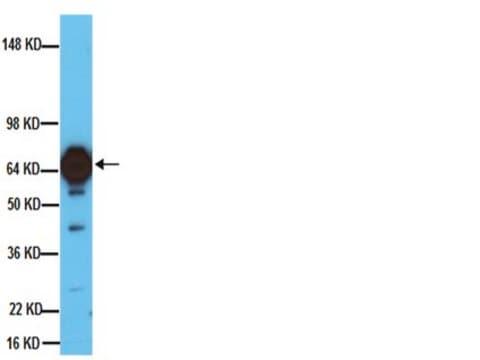
Tyrosine hydroxylase (TH) catalyzes the rate-determining initial step in the biosynthesis of catecholamines such as dopamine, noradrenaline and adrenaline. Therefore the antibody is used to stain dopaminergeous and adrenergeous neurons as well as the chromaffine tissue of the adrenal medulla. Cell lines such as the PC 12 line, which is derived from a rat pheochromocytoma also, show positive reactions. In immunoblots of adrenal medulla tissue, the antibody recognizes a single protein band in the molecular weight range of 56 - 60 kD.

Physical form

Format: Purified
Protein A purified
Purified mouse monoclonal IgG2a in buffer containing 0.02 M Phosphate buffer, 0.25 M NaCl, pH 7.6 with 0.1% sodium azide.

Preparation Note

Stable for 6 months at 2-8ºC in undiluted aliquots from date of receipt.

Analysis Note

Control
Positive Control: Brain (sympathetic nerve terminals) and adrenal gland tissue
Routinely evaluated by Western Blot on PC12 lysates.

Western Blot Analysis:
1:1000 dilution of this lot detected Tyrosine Hydroxylase on 10 μg of PC12 lysates.

Legal Information

CHEMICON is a registered trademark of Merck KGaA, Darmstadt, Germany

Disclaimer

Unless otherwise stated in our catalog or other company documentation accompanying the product(s), our products are intended for research use only and are not to be used for any other purpose, which includes but is not limited to, unauthorized commercial uses, in vitro diagnostic uses, ex vivo or in vivo therapeutic uses or any type of consumption or application to humans or animals.

Porovnat podobné položky

Zobrazit úplné porovnání

Zobrazit rozdíly

1 of 1

Tato položka
AB5986SAB4200699AB1542
biological source

mouse

biological source

rabbit

biological source

mouse

biological source

sheep

antibody form

purified immunoglobulin

antibody form

serum

antibody form

purified immunoglobulin

antibody form

affinity isolated antibody

Gene Information

rat ... Th(25085)

Gene Information

rat ... Th(25085)

Gene Information

human ... TH(7054)

Gene Information

human ... TH(7054)

clone

2/40/15, monoclonal

clone

polyclonal

clone

TH-2, monoclonal

clone

polyclonal

species reactivity

chicken, bovine, rat, quail

species reactivity

rat

species reactivity

rabbit, human, sheep, guinea pig, rat, bovine, mouse

species reactivity

rat, mouse

technique(s)

immunohistochemistry: suitable, western blot: suitable

technique(s)

immunohistochemistry: suitable

technique(s)

immunoblotting: 0.25-0.5 μg/mL using whole extracts of rat PC-12 cells.

technique(s)

immunohistochemistry: suitable, western blot: suitable


Still not finding the right product?

nebo

Vyzkoušejte náš nástroj Nástroj pro výběr produktů a zúžte své možnosti.


Skladovací třída

10 - Combustible liquids

wgk

WGK 2


Osvědčení o analýze (COA)

Vyhledejte osvědčení Osvědčení o analýze (COA) zadáním čísla šarže/dávky těchto produktů. Čísla šarže a dávky lze nalézt na štítku produktu za slovy „Lot“ nebo „Batch“.

Již tento produkt vlastníte?

Dokumenty související s produkty, které jste v minulosti zakoupili, byly za účelem usnadnění shromážděny ve vaší Knihovně dokumentů.

Navštívit knihovnu dokumentů


Javier Blesa et al.
Frontiers in systems neuroscience, 5, 92-92 (2012-01-31)
The onset of Parkinson's disease (PD) is characterized by focal motor features in one body part, which are usually correlated with greater dopaminergic depletion in the contralateral posterior putamen. The role of dopamine (DA) hemispheric differences in the onset and
Boris Mravec et al.
Journal of neuroinflammation, 13, 15-15 (2016-01-23)
Brain norepinephrine (NE) plays an important role in the modulation of stress response and neuroinflammation. Recent studies indicate that in Alzheimer's disease (AD), the tau neuropathology begins in the locus coeruleus (LC) which is the main source of brain NE.
L A McCollum et al.
Neuroscience, 271, 23-34 (2014-04-29)
Many behavioral, physiological, and anatomical studies utilize animal models to investigate human striatal pathologies. Although commonly used, rodent striatum may not present the optimal animal model for certain studies due to a lesser morphological complexity than that of non-human primates


Globální číslo obchodní položky

Skladová položkaGTIN
MAB528004053252398896

Questions

Reviews

No rating value

Active Filters