Přejít k obsahu
Merck

GR32L

Anti-Glucocorticoid Receptor (Ab-2) Mouse mAb (BuGR2)

lyophilized, clone BuGR2, Calbiochem®

Přihlásit pro zobrazení organizačních a smluvních cen.

Vybrat velikost

100 μG

14 900,00 Kč

14 900,00 Kč


Očekávané datum odeslání02. ledna 2026podrobné informace


Požádejte o hromadnou objednávku

O této položce

NACRES:
NA.43
UNSPSC Code:
12352203

Přeskočit na

Technický servis
Potřebujete pomoc? Náš tým zkušených odborníků je vám k dispozici.
Dovolte nám, abychom vám pomohli

Název produktu

Anti-Glucocorticoid Receptor (Ab-2) Mouse mAb (BuGR2), lyophilized, clone BuGR2, Calbiochem®

biological source

mouse

antibody form

purified antibody

antibody product type

primary antibodies

clone

BuGR2, monoclonal

form

lyophilized

contains

≤0.1% sodium azide as preservative

species reactivity

guinea pig, rabbit, rat, mouse, sheep

should not react with

amphibian, primate, avian

manufacturer/tradename

Calbiochem®

storage condition

OK to freeze

dilution

(Frozen Sections (5 µg/mL)
Immunoblotting (5 µg/mL)
Immunocytochemistry (5 µg/mL)
Immunoprecipitation
Paraffin Sections (5 µg/mL))

isotype

IgG2a

shipped in

ambient

storage temp.

−20°C

target post-translational modification

unmodified

Quality Level

Gene Information

mouse ... Nr3C1(14815)

Porovnat podobné položky

Zobrazit úplné porovnání

Zobrazit rozdíly

1 of 4

Tato položka
GR01OP115OP29L
species reactivity

guinea pig, rabbit, rat, mouse, sheep

species reactivity

human

species reactivity

human

species reactivity

hamster, rat, mouse, bovine, chicken, human

antibody form

purified antibody

antibody form

purified antibody

antibody form

purified antibody

antibody form

purified antibody

clone

BuGR2, monoclonal

clone

528, monoclonal

clone

2A10, monoclonal

clone

PAb240, monoclonal

Gene Information

mouse ... Nr3C1(14815)

Gene Information

human ... EGFR(1956)
mouse ... Egfr(13649)
rat ... Egf(25313)

Gene Information

human ... MDM2(4193)

Gene Information

human ... TP53(7157)

biological source

mouse

biological source

mouse

biological source

mouse

biological source

mouse

shipped in

ambient

shipped in

wet ice

shipped in

wet ice

shipped in

ambient

Analysis Note

Positive Control
mouse liver extract

Application


Frozen Sections (5 g/ml)
Immunoblotting (5 g/ml)
Immunocytochemistry (5 g/ml)
Immunoprecipitation (see comments)
Paraffin Sections (5 g/ml)

Disclaimer

Toxicity: Standard Handling (A)

General description

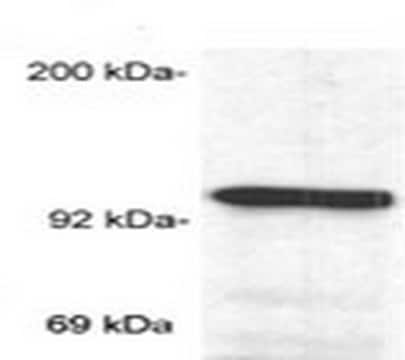
Anti-Glucocorticoid Receptor (Ab-2), mouse monoclonal, clone BuGR2, recognizes ~94-97 kDa glucocorticoid receptor in mouse liver. It is validated for WB, ICC, IP & IHC (Frozen & paraffin sections).
Purified mouse monoclonal antibody generated by immunizing BALB/c mice with the specified immunogen and fusing splenocytes with P3-AgX-653 myeloma cells (see application references). Recognizes the ~94-97 kDa glucocorticoid receptor.
Recognizes the ~94-97 kDa glucocorticoid receptor in mouse liver tissue.

Immunogen

Rat
partially purified, rat glucocorticoid receptor

Other Notes

Does not cross react with androgen, progesterone, estrogen or mineralocorticoid receptors. Enzymatic digestion and immunoblot analysis has shown that this antibody reacts with the undigested 97 kDa glucocorticoid receptor, a 17 kDa DNA-binding trypsin fragment, and a 45 kDa steroid and DNA-binding chymotrypsin fragment. Immunocytochemical localization of the glucocorticoid receptor is observed in the cytoplasm and nucleus, even in the presence of hormone. This antibody has also been reported to work for immunoprecipitation. Antibody should be titrated for optimal results in individual systems.
Hussien, A., et al. 1997. Proc. Natl. Acad. Sci. USA94, 1521.
Pratt, W.B. and Toft, D.O., 1997. Endocrine Rev.18 306.
Schumacher, M., et al. 1996. Dev. Neurosci.18, 6.
Toran-Allerand, C.D. 1996. Dev. Neurosci.18, 36.
Weigel, N.L. 1996. Biochem J.319, 657.
Jones, K.J. 1994. Ann. N.Y. Acad. Sci.743, 141.
Arnold, A.P. 1990. in Hormones, Brain and Behavior in Vertebrates, ed. Balthazart, J. (Karger, Basel), 82.

Physical form

Lyophilized from PBS, pH 7.2.

Preparation Note

Resuspend the lyophilized antibody with 0.1 ml sterile PBS, pH 7.2. Be careful to reconstitute the entire contents of the vial; during shipment and handling, portions of the lyophilized pellet may have become dislodged and may not be in the bottom of the vial. Following reconstitution, aliquot and freeze (-20°C). Avoid freeze/thaw cycles of solutions.

Legal Information

CALBIOCHEM is a registered trademark of Merck KGaA, Darmstadt, Germany

Ještě jste nenalezli správný produkt?  

Vyzkoušejte náš produkt Nástroj pro výběr produktů.

Skladovací třída

11 - Combustible Solids

wgk

WGK 1

flash_point_f

Not applicable

flash_point_c

Not applicable


Osvědčení o analýze (COA)

Vyhledejte osvědčení Osvědčení o analýze (COA) zadáním čísla šarže/dávky těchto produktů. Čísla šarže a dávky lze nalézt na štítku produktu za slovy „Lot“ nebo „Batch“.

Již tento produkt vlastníte?

Dokumenty související s produkty, které jste v minulosti zakoupili, byly za účelem usnadnění shromážděny ve vaší Knihovně dokumentů.

Navštívit knihovnu dokumentů

Mohammad M Khan et al.
Neuroendocrinology, 84(5), 317-329 (2006-12-05)
MNAR/PELP1 (see text) is a newly identified scaffold protein/coactivator initially thought to modulate nongenomic and genomic actions of the estrogen receptor; however, it has been recently shown to interact with multiple steroid receptors, including androgen and glucocorticoid receptors. In the
Nina M Patrick et al.
The Journal of steroid biochemistry and molecular biology, 167, 1-13 (2016-09-21)
Small molecule inhibitors of lysine deacetylases (KDACs) are approved for clinical use in treatment of several diseases. Nuclear receptors, such as the glucocorticoid receptor (GR) use lysine acetyltransferases (KATs or HATs) and KDACs to regulate transcription through acetylation and deacetylation
Biswajyoti Sahu et al.
Cancer research, 73(5), 1570-1580 (2012-12-28)
The forkhead protein FoxA1 has functions other than a pioneer factor, in that its depletion brings about a significant redistribution in the androgen receptor (AR) and glucocorticoid receptor (GR) cistromes. In this study, we found a novel function for FoxA1
Vineela Kadiyala et al.
The Journal of biological chemistry, 288(40), 28900-28912 (2013-08-16)
Nuclear receptors use lysine acetyltransferases and lysine deacetylases (KDACs) in regulating transcription through histone acetylation. Lysine acetyltransferases interact with steroid receptors upon binding of an agonist and are recruited to target genes. KDACs have been shown to interact with steroid

Questions

Reviews

No rating value

Active Filters

Náš tým vědeckých pracovníků má zkušenosti ve všech oblastech výzkumu, včetně přírodních věd, materiálových věd, chemické syntézy, chromatografie, analytiky a mnoha dalších..

Obraťte se na technický servis