Přejít k obsahu
Merck

06-549

Anti-c-Myc Tag Antibody

UPSTATE®, rabbit polyclonal

Synonyma:

Transcription factor p64, avian myelocytomatosis viral oncogene homolog, myc proto-oncogene protein, v-myc avian myelocytomatosis viral oncogene homolog, v-myc myelocytomatosis viral oncogene homolog (avian)

Přihlásit pro zobrazení organizačních a smluvních cen.

Vybrat velikost

200 μG

13 300,00 Kč

13 300,00 Kč


Očekávané datum odeslání02. ledna 2026podrobné informace

K vašemu cílovému použití je dostupná rekombinantní protilátka bez obsahu konzervačních látek. Vyzkoušejte ZMS1008

Požádejte o hromadnou objednávku

O této položce

UNSPSC Code:
12352203
eCl@ss:
32160702
NACRES:
NA.43

Přeskočit na

Technický servis
Potřebujete pomoc? Náš tým zkušených odborníků je vám k dispozici.
Dovolte nám, abychom vám pomohli

Název produktu

Anti-Myc Tag Antibody, Upstate®, from rabbit

biological source

rabbit

antibody form

purified antibody

antibody product type

primary antibodies

clone

polyclonal

species reactivity

human

packaging

antibody small pack of 25 μg

manufacturer/tradename

Upstate®

technique(s)

immunocytochemistry: suitable
western blot: suitable

isotype

IgG

NCBI accession no.

UniProt accession no.

shipped in

dry ice

target post-translational modification

unmodified

Quality Level

Související kategorie

Porovnat podobné položky

Zobrazit úplné porovnání

Zobrazit rozdíly

1 of 4

Tato položka
16-21305-41905-175
biological source

rabbit

biological source

mouse

biological source

mouse

biological source

mouse

clone

polyclonal

clone

4A6, monoclonal

clone

9E10, monoclonal

clone

1-1, monoclonal

species reactivity

human

species reactivity

human

species reactivity

-

species reactivity

mouse, human

antibody form

purified antibody

antibody form

purified immunoglobulin

antibody form

purified immunoglobulin

antibody form

purified immunoglobulin

shipped in

dry ice

shipped in

dry ice

shipped in

dry ice

shipped in

dry ice

technique(s)

immunocytochemistry: suitable, western blot: suitable

technique(s)

western blot: suitable

technique(s)

immunocytochemistry: suitable, immunohistochemistry: suitable (paraffin), immunoprecipitation (IP): suitable, western blot: suitable

technique(s)

immunohistochemistry: suitable, immunoprecipitation (IP): suitable, western blot: suitable

Analysis Note

Control
Positive control for human Myc: widespread expression including A431 cell lysate, ovarian cancer cell lysate, or breast carcinoma tissue. Myc fusion protein expressed in cells.
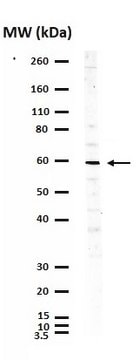
Evaluated by Western Blotting in NIH/3T3 cells transfected with a Myc-tagged PP2A A subunit. Western Blotting Analysis (WB): A 1:500 dilution of this antibody detected the Myc-tag in NIH/3T3 cells transfected with Myc-tagged PP2A A subunit.

Application

Anti-Myc Tag, Cat. No. 06-549, is a rabbit polyclonal antibody that detects Myc-tagged proteins and is tested for use in Western Blotting and Immunocytochemistry.
Research Category
Epitope Tags & General Use
Research Sub Category
Epitope Tags
Tested Applications Immunocytochemistry Analysis: A 1:250 dilution of this antibody detected Myc-tagged PP2A A subunit in NIH/3T3 cells transfected with Myc-tagged PP2A A subunit. Note: Actual optimal working dilutions must be determined by end user as specimens, and experimental conditions may vary with the end user.

Biochem/physiol Actions

Other species cross-reactivity not tested.
This rabbit polyclonal antibody detects human Myc and Myc-tagged recombinant proteins.

Disclaimer

Unless otherwise stated in our catalog or other company documentation accompanying the product(s), our products are intended for research use only and are not to be used for any other purpose, which includes but is not limited to, unauthorized commercial uses, in vitro diagnostic uses, ex vivo or in vivo therapeutic uses or any type of consumption or application to humans or animals.

General description

Myc proto-oncogene protein (UniProt: P01106; also known as Class E basic helix-loop-helix protein 39 (bHLHe39), Proto-oncogene c-Myc, Transcription factor p64) is encoded by the MYC (also known as BHLHE39) gene (Gene ID: 4609) in human. The Myc-tag is a short peptide sequence derived from the c-Myc protein. It is commonly used as an epitope tag in molecular biology. It is composed of 10 amino acids (EQKLISEEDL) and is fused to proteins of interest to facilitate their detection and purification. The Myc-tag functions as a marker that can be recognized by specific antibodies, allowing researchers to track the expression, localization, and interaction of tagged proteins in various experimental contexts.
Predicted molecular weight for human Myc: 49 kDa Obeserved molecular weight may vary.

Immunogen

Epitope: a.a. 409-420
Synthetic peptide corresponding to residues 409-420 of human Myc (MEQKLISEEDLN).

Other Notes

Concentration: Please refer to the Certificate of Analysis for the lot-specific concentration.

Physical form

Format: Purified
Protein A chromatography
Purified rabbit in buffer containing 0.1 M Tris-glycine, pH 7.4, 0.15 M NaCl with 0.05% sodium azide. Frozen solution.

Preparation Note

Store at -10°C to -25°C. Handling Recommendations: Upon receipt and prior to removing the cap, centrifuge the vial and gently mix the solution. Aliquot into microcentrifuge tubes and store at -20°C. Avoid repeated freeze/thaw cycles, which may damage IgG and affect product performance.

Legal Information

UPSTATE is a registered trademark of Merck KGaA, Darmstadt, Germany

Ještě jste nenalezli správný produkt?  

Vyzkoušejte náš produkt Nástroj pro výběr produktů.

related product

Skladovací třída

12 - Non Combustible Liquids

wgk

WGK 1

flash_point_f

Not applicable

flash_point_c

Not applicable


Osvědčení o analýze (COA)

Vyhledejte osvědčení Osvědčení o analýze (COA) zadáním čísla šarže/dávky těchto produktů. Čísla šarže a dávky lze nalézt na štítku produktu za slovy „Lot“ nebo „Batch“.

Již tento produkt vlastníte?

Dokumenty související s produkty, které jste v minulosti zakoupili, byly za účelem usnadnění shromážděny ve vaší Knihovně dokumentů.

Navštívit knihovnu dokumentů

Tubulin-targeting chemotherapy impairs androgen receptor activity in prostate cancer.
Zhu ML, Horbinski CM, Garzotto M, Qian DZ, Beer TM, Kyprianou N
Cancer Research null
Mxi1-SRalpha: a novel Mxi1 isoform with enhanced transcriptional repression potential.
Dugast-Darzacq, C; Pirity, M; Blanck, JK; Scherl, A; Schreiber-Agus, N
Oncogene null
V M Draviam et al.
The Journal of cell biology, 152(5), 945-958 (2001-03-10)
In this paper, we show that substrate specificity is primarily conferred on human mitotic cyclin-dependent kinases (CDKs) by their subcellular localization. The difference in localization of the B-type cyclin-CDKs underlies the ability of cyclin B1-CDK1 to cause chromosome condensation, reorganization
The zebrafish Iroquois gene iro7 positions the r4/r5 boundary and controls neurogenesis in the rostral hindbrain.
Lecaudey, V; Anselme, I; Rosa, F; Schneider-Maunoury, S
Development null
Mi-Hee Jun et al.
Molecular brain, 8, 85-85 (2015-12-15)
Transmembrane protein 106B (TMEM106B) has been identified as a risk factor for frontotemporal lobar degeneration, which is the second most common form of progressive dementia in people under 65 years of age. Mutations in charged multivesicular body protein 2B (CHMP2B), which

Questions

Reviews

No rating value

Active Filters

Náš tým vědeckých pracovníků má zkušenosti ve všech oblastech výzkumu, včetně přírodních věd, materiálových věd, chemické syntézy, chromatografie, analytiky a mnoha dalších..

Obraťte se na technický servis