
![7-Diethylamino-3-[N-(2-maleimidoethyl)carbamoyl]coumarin BioReagent, suitable for fluorescence, ≥97.0% (HPLC)](/deepweb/assets/sigmaaldrich/product/structures/341/038/a7e0c464-8abe-4eb0-b253-6537f649d89c/640/a7e0c464-8abe-4eb0-b253-6537f649d89c.png)
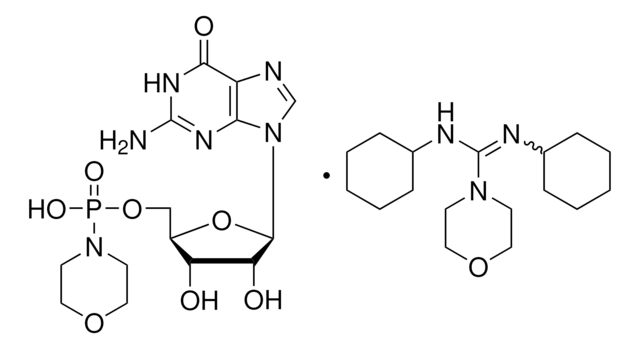


The product specification requires an emission wavelength range of 460-470nm. The product is not screened for excitation wavelength, however it is expected to fall within a range of 416 to 425 nm. The compound is typically used for real-time measurements for the release of inorganic phosphates during enzymatic reaction when MDCC is conjugated to a mutant phosphate-binding protein . Please see the link below to review a publication that may be of interest:
https://pubs.acs.org/doi/10.1021/bi9804277
05019

7-Diethylamino-3-[N-(2-maleimidoethyl)carbamoyl]coumarin
BioReagent, suitable for fluorescence, ≥97.0% (HPLC)
Synonym(s):
MDCC
Sign In to View Organizational & Contract Pricing.
Select a Size
Change View
| Pack Size | SKU | Availability | Price |
|---|---|---|---|
| 5 mg | Check Cart for Availability | CLP 221,000 |
About This Item
Empirical Formula (Hill Notation):
C20H21N3O5
CAS Number:
Molecular Weight:
383.40
UNSPSC Code:
12352116
PubChem Substance ID:
NACRES:
NA.32
MDL number:
product line
BioReagent
Quality Segment
assay
≥97.0% (HPLC)
suitability
suitable for fluorescence
SMILES string
CCN(CC)c1ccc2C=C(C(=O)NCCN3C(=O)C=CC3=O)C(=O)Oc2c1
InChI
1S/C20H21N3O5/c1-3-22(4-2)14-6-5-13-11-15(20(27)28-16(13)12-14)19(26)21-9-10-23-17(24)7-8-18(23)25/h5-8,11-12H,3-4,9-10H2,1-2H3,(H,21,26)
InChI key
IXQPRUQVJIJUEB-UHFFFAOYSA-N
Application
Thiol-reactive probe for protein labelling
7-Diethylamino-3-[N-(2-maleimidoethyl)carbamoyl]coumarin is utilized as a fluoresencent biological sensing device . Used for real-time measurements for the release of inorganic phosphates during enzymatic reaction when MDCC is conjugated to a mutant phosphate-binding protein . Also, utilized for intramolecular fluorescence energy transfer (FRET) experiments .
1 of 1
This Item | |||
|---|---|---|---|
| suitability suitable for fluorescence | suitability - | suitability - | suitability - |
| Quality Level 100 | Quality Level 200 | Quality Level 100 | Quality Level 200 |
| assay ≥97.0% (HPLC) | assay ≥90% | assay - | assay - |
| product line BioReagent | product line - | product line - | product line - |
Choose from one of the most recent versions:
Already Own This Product?
Find documentation for the products that you have recently purchased in the Document Library.
Maria M Martinez-Senac et al.
Biochemistry, 44(51), 16967-16976 (2005-12-21)
RecG is a DNA helicase involved in the repair of damage at a replication fork and catalyzes the reversal of the fork to a point beyond the damage in the template strand. It unwinds duplex DNA in reactions that are
Martin R Webb
Molecular bioSystems, 3(4), 249-256 (2007-03-21)
Biosensors are becoming widely used both in basic research and in screening assays and reagentless sensors with fluorescent reporter groups attached to proteins form one class. This article describes the development of sensors for two small molecules, driven in particular
Lyndon L E Salins et al.
Sensors and actuators. B, Chemical, 97(1), 81-89 (2004-03-06)
This work explores the potential use of a member of the periplasmic family of binding proteins, the phosphate binding protein (PBP), as the biorecognition element in a sensing scheme for the detection of inorganic phosphate (Pi). The selectivity of this
Global Trade Item Number
| SKU | GTIN |
|---|---|
| 150215-5G | 04061831818727 |
| 1483185-10MG | 04061833852651 |
| PHR3071-25MG | 04065266899955 |
| 150215-1G | 04061825583037 |
| 05019-1MG-F | 04061823353243 |
| 05019-5MG-F | 04061833488553 |
-
What do the excitation/emission peaks of this dye look like?
1 answer-
Helpful?
-