Passa al contenuto
Merck

Vai a

77332

Peroxidase from horseradish

lyophilized, powder, ~150 U/mg

Sinonimo/i:

(2R,3S,6S,7R,8R)-3-(3-formamido-2-hydroxybenzamido)-8-hexyl-2,6-dimethyl-4,9-dioxo-1,5-dioxonan-7-yl 3-methylbutanoate, Antimycin A, Horseradish peroxidase

Autenticati per visualizzare i prezzi organizzativi e contrattuali.

Scegli un formato

Cambia visualizzazione
Voi/SKUDisponibilitàPrezzo
100 mg
Per conoscere la disponibilità, visualizza il carrello
CHF 128.00
500 mg
Per conoscere la disponibilità, visualizza il carrello
CHF 544.00

Informazioni su questo articolo

Numero CAS:
NACRES:
NA.54
UNSPSC Code:
12352204
EC Number:
232-668-6
MDL number:
Numero CE:
eCl@ss:
32160410
Specific activity:
~150 U/mg
Biological source:
horseradish

CHF 128.00


Per conoscere la disponibilità, visualizza il carrello

​
Servizio Tecnico
Hai bisogno di aiuto? Il nostro team di scienziati qualificati è a tua disposizione.
Permettici di aiutarti


biological source

horseradish

Quality Segment

form

powder

quality

lyophilized

specific activity

~150 U/mg

technique(s)

protein detection: suitable

solubility

50 mM potassium phosphate buffer, pH 6.0: 5 mg/mL (0.1% BSA)

shipped in

wet ice

storage temp.

2-8°C

SMILES string

[O+H2]O[O-]

InChI

1S/H2O3/c1-3-2/h1-2H

InChI key

JSPLKZUTYZBBKA-UHFFFAOYSA-N

General description

Horseradish peroxidase (HRP) is a vital and a widely studied heme-containing enzyme, isolated from a hardy perennial herb, horse radish. It catalyzes the oxidation of various organic and inorganic compounds by using hydrogen peroxide as substrates. HRP is involved in indole-3-acetic acid metabolism, cross-linking of biological polymers and lignification. This enzyme in combination with indole-3-acetic acid or its derivatives acts as a potential therapeutic for targeted cancer therapies. Commercially HRP is used as a constituent of clinical diagnostic kits and is used in immunoassays.

Application

Horseradish peroxidase is used widely within biochemistry as a detection reagent in a variety of applications including ELISA, immunoblotting, and immunohistochemistry.
Peroxidase from horseradish has been used:
  • for isolation of N-Linked glycans
  • as a constituent of D-amino acid oxidase (DAAO) buffer
  • to decompose hydrogen peroxide (H2O2) into water to demonstrate the performance of the portable oxidative stress sensor (POSS)

Other Notes

1 U corresponds to the amount of enzyme which oxidizes 1 μmol ABTS (Cat. No. 11557) per minute at pH 6.0 and 25°C
Use of chemically modified peroxidase in benzene; Cross-linking of proteins; Enzyme catalyzed polymerization and precipitation of aromatic compounds from wastewater.

Confronta articoli simili

Visualizza il confronto per intero

Mostra le differenze

1 of 1

Questo articolo
P8250P8415SRE0082
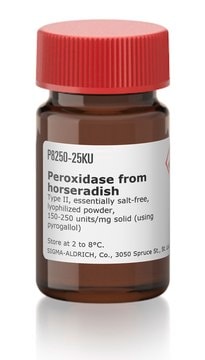
Perossidasi Type II, essentially salt-free, lyophilized powder, 150-250 units/mg solid (using pyrogallol)

Sigma-Aldrich

P8250

Perossidasi

Perossidasi Type XII, essentially salt-free, lyophilized powder, ≥250 units/mg solid (using pyrogallol)

Sigma-Aldrich

P8415

Perossidasi

Perossidasi For research or further manufacturing use only. Not intended for direct use in humans or animals. Non-TSCA use only in US, Type VI, powder, stabilized, ≥250 units/mg solid (using pyrogallol)

Sigma-Aldrich

SRE0082

Perossidasi

description

lyophilized, powder, ~150 U/mg

description

Type II, essentially salt-free, lyophilized powder, 150-250 units/mg solid (using pyrogallol)

description

Type XII, essentially salt-free, lyophilized powder, ≥250 units/mg solid (using pyrogallol)

description

For research or further manufacturing use only. Not intended for direct use in humans or animals. Non-TSCA use only in US, Type VI, powder, stabilized, ≥250 units/mg solid (using pyrogallol)

specific activity

~150 U/mg

specific activity

150-250 units/mg solid (using pyrogallol)

specific activity

≥250 units/mg solid (using pyrogallol)

specific activity

≥250 units/mg solid (using pyrogallol)

biological source

horseradish

biological source

horseradish

biological source

-

biological source

-

form

powder

form

essentially salt-free, lyophilized powder

form

essentially salt-free, lyophilized powder

form

powder, stabilized

solubility

50 mM potassium phosphate buffer, pH 6.0: 5 mg/mL (0.1% BSA)

solubility

0.1 M phosphate buffer: soluble (pH 6.0), H2O: soluble

solubility

H2O: soluble, 0.1 M phosphate buffer: soluble (pH 6.0)

solubility

phosphate buffer: soluble

storage temp.

2-8°C

storage temp.

2-8°C

storage temp.

2-8°C

storage temp.

2-8°C

shipped in

wet ice

shipped in

-

shipped in

-

shipped in

wet ice


Still not finding the right product?

Explore all of our products under Peroxidase from horseradish


Pittogrammi

Health hazard

Parola di avvertenza

Danger

Codici di pericolo

Avvertenze di sicurezza

Hazard Classifications

Resp. Sens. 1

Classe di stoccaggio

13 - Non Combustible Solids

Che succede?

WGK 1

DPI (dispositivi di protezione individuale)

Eyeshields, Gloves, type N95 (US)


Scegli una delle versioni più recenti:

Certificati d'analisi (COA)

Lot/Batch Number

It looks like we've run into a problem, but you can still download Certificates of Analysis from our Documenti section.

Se ti serve aiuto, non esitare a contattarci Servizio Clienti

Possiedi già questo prodotto?

I documenti relativi ai prodotti acquistati recentemente sono disponibili nell’Archivio dei documenti.

Visita l’Archivio dei documenti


Questions

1–2 of 2 Questions  
  1. can we use this as an anterograde tracers to detect neuronal terminations

    1 answer
    1. This product has not been tested as an anterograde tracer to detect neuronal terminations, and no reference was found for this type of application. The products C3741 Cholera Toxin B subunit and L8777 Lectin from Phytolacca americana (pokeweed) had been referenced as neuroanatomical tracers. Below are the references:

      "Unmyelinated fibers of the anterior ethmoidal nerve in the rat co-localize with neurons in the medullary dorsal horn and ventrolateral medulla activated by nasal stimulation" by Hollandsworth MP, et al., Brain Research (2009).

      "An anterograde neuroanatomical tracing method that shows the detailed morphology of neurons, their axons and terminals: immunohistochemical localization of an axonally transported plant lectin, Phaseolus vulgaris leucoagglutinin (PHA-L)" by C R Gerfen, P E Sawchenko, Brain Research (1984-01-09).

      Helpful?

  2. What is the difference between different types of peroxidase? (for instance Type I, Type II, Type IIA)

    1 answer
    1. The type designations for these enzymes are in-house designations and do not represent any kind of biochemical significance.

      Helpful?

Reviews

No rating value

Active Filters