Direkt zum Inhalt
Merck

Fortfahren mit

M9170

Macrophage Colony-Stimulating Factor from mouse

≥98% (SDS-PAGE), recombinant, expressed in E. coli, lyophilized powder, suitable for cell culture

Synonym(e):

mCSF-1, mM-CSF, CSF-1, M-CSF

Anmelden zur Ansicht der Organisations- und Vertragspreise.

Größe auswählen

Ansicht ändern
Ihnen/SKUVerfügbarkeitPreis
10 μg
Warenkorb auf Verfügbarkeit prüfen
CHF 341.00

Über diesen Artikel

CAS-Nummer:
UNSPSC Code:
12352202
eCl@ss:
32190102
EC Number:
214-684-5
NACRES:
NA.77
MDL number:
Biological source:
mouse
Recombinant:
expressed in E. coli
Assay:
≥98% (SDS-PAGE)
Form:
lyophilized powder
Mol wt:
dimer 18.2 kDa (containing 156 amino acid residues)
Impurities:
≤1.000 EU/μg

CHF 341.00


Warenkorb auf Verfügbarkeit prüfen

Großbestellung anfragen
Technischer Dienst
Benötigen Sie Hilfe? Unser Team von erfahrenen Wissenschaftlern ist für Sie da.
Unterstützung erhalten


Produktname

Macrophage Colony-Stimulating Factor from mouse, M-CSF, recombinant, expressed in E. coli, lyophilized powder, suitable for cell culture

biological source

mouse

Quality Segment

recombinant

expressed in E. coli

assay

≥98% (SDS-PAGE)

form

lyophilized powder

potency

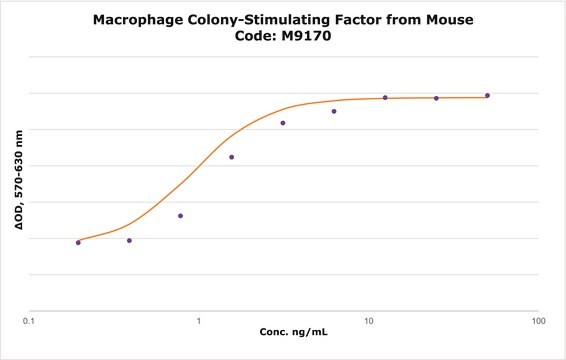
≤3.000 ng/mL Suitability ED50

quality

endotoxin tested

mol wt

dimer 18.2 kDa (containing 156 amino acid residues)

packaging

pkg of 10 μg

technique(s)

cell culture | mammalian: suitable

impurities

≤1.000 EU/μg

color

white

UniProt accession no.

storage temp.

−20°C

Application

Macrophage Colony-Stimulating Factor from mouse has been used:
  • in the initiation of osteoclastogenesis in bone marrow monocyte cells
  • to stimulate osteoclast differentiation in non-adherent hematopoietic cell
  • for the generation of blood-derived stem cells

Biochem/physiol Actions

Macrophage Colony Stimulating Factor (M-CSF), also known as CSF-1, can be produced by a number of cells, including fibroblasts, monocytes, activated macrophages, secretory epithelial cells of the endometrium, endothelial cells activated by LPS or cytokines, and bone marrow stromal cells. In addition to its namesake activity, M-CSF can stimulate the proliferation of isolated macrophages, augment the production and release of cytokines and other inflammatory modulators from macrophages, enhance macrophage antibody-dependent cell-mediated cytotoxicity, prime and enhance macrophages in their ability to kill tumor cells and other microorganisms, stimulate pinocytosis, and support osteoclast differentiation. M-CSF binds and activates a 165 kDa glycoprotein of the receptor tyrosine kinase subclass III or the RTK subfamily. Due to alternative splicing of a single M-CSF gene and due to variations in glycosylation, the molecular weight of natural soluble M-CSF ranges from 44-86 kDa. Human and mouse M-CSF share approximately 80% sequence homology in the conserved N-terminal region of 150 amino acids. Although human M-CSF is active in murine systems, mouse M-CSF appears to be species-specific in its actions.
Macrophage Colony Stimulating Factor (M-CSF), also known as CSF-1, can be produced by fibroblasts, monocytes, activated macrophages, secretory epithelial cells of the endometrium, endothelial cells activated by LPS or cytokines, and bone marrow stromal cells. In addition to its namesake activity, M-CSF augments many of the physiological functions of macrophages, and support osteoclast differentiation. M-CSF binds and activates a 165 kDa glycoprotein of the receptor tyrosine kinase subclass III or the RTK subfamily. Due to alternative splicing and glycosylation the molecular weight of natural soluble M-CSF ranges from 44-86 kDa. Although human M-CSF is active in murine systems, mouse M-CSF appears to be species-specific in its actions.

Physical form

Lyophilized from a sterile filtered buffered aqueous solution.

Analysis Note

The proliferative activity is tested by the dose-dependent stimulation of the murine monocytic cell line, M-NFS-60.

Ähnliche Artikel vergleichen

Vollständigen Vergleich anzeigen

Unterschiede anzeigen

1 of 1

Dieser Artikel
G0282SRP3110SRP3050
technique(s)

cell culture | mammalian: suitable

technique(s)

cell culture | mammalian: suitable

technique(s)

cell culture | mammalian: suitable

technique(s)

cell culture | mammalian: suitable

biological source

mouse

biological source

mouse

biological source

human

biological source

human

recombinant

expressed in E. coli

recombinant

expressed in E. coli

recombinant

expressed in E. coli

recombinant

expressed in E. coli

assay

≥98% (SDS-PAGE)

assay

≥97% (SDS-PAGE)

assay

≥98% (HPLC), ≥98% (SDS-PAGE)

assay

≥98% (SDS-PAGE)

Quality Level

200

Quality Level

200

Quality Level

200

Quality Level

200

form

lyophilized powder

form

lyophilized powder

form

lyophilized

form

lyophilized


pictograms

Exclamation mark

signalword

Warning

Hazard Classifications

Eye Irrit. 2 - Skin Irrit. 2 - STOT SE 3

Lagerklasse

11 - Combustible Solids

wgk

WGK 2

flash_point_f

Not applicable

flash_point_c

Not applicable

ppe

dust mask type N95 (US), Eyeshields, Gloves


Hier finden Sie alle aktuellen Versionen:

Analysenzertifikate (COA)

Lot/Batch Number

It looks like we've run into a problem, but you can still download Certificates of Analysis from our Dokumente section.

Wenn Sie Hilfe benötigen, wenden Sie sich bitte an Kundensupport

Besitzen Sie dieses Produkt bereits?

In der Dokumentenbibliothek finden Sie die Dokumentation zu den Produkten, die Sie kürzlich erworben haben.

Die Dokumentenbibliothek aufrufen


Questions

Reviews

No rating value

Active Filters