Direkt zum Inhalt
Merck

C8271

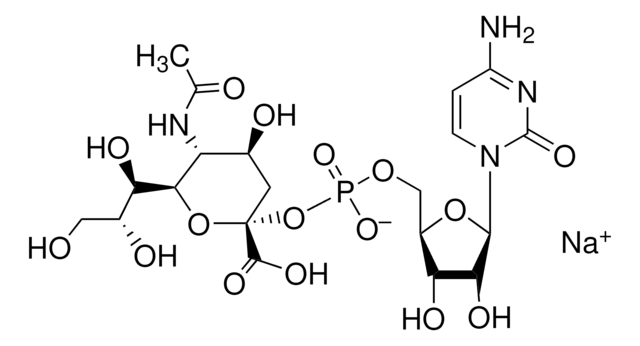
Cytidin-5′-Monophospho-N-Acetylneuraminsäure Natriumsalz

≥85% (HPLC), synthetic (organic), powder

Synonym(e):

CMP-NAN, CMP-NANA, CMP-Neu5Ac, CMP-Sialinsäure

Anmelden zur Ansicht der Organisations- und Vertragspreise.

Größe auswählen

1 MG

CHF 101.00

5 MG

CHF 634.00

25 MG

CHF 2’100.00

CHF 101.00


Warenkorb auf Verfügbarkeit prüfen


Über diesen Artikel

Lineare Formel:
C20H30N4NaO16P
CAS-Nummer:
Molekulargewicht:
636.43
NACRES:
NA.51
PubChem Substance ID:
UNSPSC Code:
41106305
MDL number:
Beilstein/REAXYS Number:
4224251
Assay:
≥85% (HPLC)
Biological source:
synthetic (organic)
Form:
powder
Solubility:
water: 50 mg/mL, clear, colorless
Storage temp.:
−20°C

Fortfahren mit

Technischer Dienst
Benötigen Sie Hilfe? Unser Team von erfahrenen Wissenschaftlern ist für Sie da.
Unterstützung erhalten

Produktname

Cytidin-5′-Monophospho-N-Acetylneuraminsäure Natriumsalz, ≥85% (HPLC)

InChI key

VFRHSOGUONIUOR-CTFMUGKASA-M

SMILES string

[Na+].CC(=O)N[C@@H]1[C@@H](O)C[C@@](O[C@@H]1[C@H](O)[C@H](O)CO)(OP([O-])(=O)OC[C@H]2O[C@H]([C@H](O)[C@@H]2O)N3C=CC(N)=NC3=O)C(O)=O

InChI

1S/C20H31N4O16P.Na/c1-7(26)22-12-8(27)4-20(18(32)33,39-16(12)13(29)9(28)5-25)40-41(35,36)37-6-10-14(30)15(31)17(38-10)24-3-2-11(21)23-19(24)34;/h2-3,8-10,12-17,25,27-31H,4-6H2,1H3,(H,22,26)(H,32,33)(H,35,36)(H2,21,23,34);/q;+1/p-1/t8-,9+,10+,12+,13+,14+,15+,16?,17+,20+;/m0./s1

biological source

synthetic (organic)

assay

≥85% (HPLC)

form

powder

solubility

water: 50 mg/mL, clear, colorless

storage temp.

−20°C

Quality Level

Ähnliche Artikel vergleichen

Vollständigen Vergleich anzeigen

Unterschiede anzeigen

1 of 4

Dieser Artikel
C963030290D0627
biological source

synthetic (organic)

biological source

synthetic

biological source

synthetic

biological source

synthetic (organic)

Quality Level

200

Quality Level

200

Quality Level

100

Quality Level

200

form

powder

form

powder

form

powder

form

powder

assay

≥85% (HPLC)

assay

≥95% (HPLC)

assay

≥99.0% (HPLC)

assay

≥96% (HPLC)

storage temp.

−20°C

storage temp.

−20°C

storage temp.

2-8°C

storage temp.

−20°C

General description

Cytosin-5′-Monophosphat-N-Acetylneuraminsäure (CMP-Neu5Ac) ist ein Zuckernukleotid, das durch CMP-Neu5Ac-Synthetase aus CTP und Neu5Ac gebildet wird.

Application

Cytidin-5′-Monophospho-N-Acetylneuraminsäure wird wie folgt verwendet:
  • als Standard bei der Hochleistungs-Anionenaustauschchromatographie mit gepulstem amperometrischem Nachweis (HPAEC-PAD) für die Analyse von Nukleotidzucker in Zellen von Patienten mit Joubert-Syndrom Typ 10 (JBTS10) und zur Kontrolle von dermalen Fibroblasten[1],
  • als Substrat für die enzymatische Sialylierung von G2-Glykoformen[2], für Resialylierungs-Assays[3][4][5],
  • für In-vitro-Sialyltransferase-Assays[6]

Biochem/physiol Actions

Cytosin-5′-Monophosphat-N-Acetylneuraminsäure (CMP-Neu5Ac) wird als Substrat für Golgi-Sialyltransferasen zur Bildung von Sialinsäure und ihrer Konjugate verwendet.[7]
Cytidin-5′-Monophospho-N-Acetylneuraminsäure (CMP-Sialinsäure) ist ein Substrat für Sialyltransferasen. Sie wird für die enzymatische Sialylierung von Glykanen verwendet.

Preparation Note

Enzymatisch hergestellt mit der Methode von Schauer, R., et al., Hoppe-Seyler′s Zeitschrift für physiologische Chemie, 353, 883 (1972).
CMP-NAN ist sehr säurelabil.

Lagerklasse

11 - Combustible Solids

wgk

WGK 3

flash_point_f

Not applicable

flash_point_c

Not applicable


Hier finden Sie alle aktuellen Versionen:

Analysenzertifikate (COA)

Lot/Batch Number

Die passende Version wird nicht angezeigt?

Wenn Sie eine bestimmte Version benötigen, können Sie anhand der Lot- oder Chargennummer nach einem spezifischen Zertifikat suchen.

Besitzen Sie dieses Produkt bereits?

In der Dokumentenbibliothek finden Sie die Dokumentation zu den Produkten, die Sie kürzlich erworben haben.

Die Dokumentenbibliothek aufrufen

Yanhong Li et al.
Applied microbiology and biotechnology, 94(4), 887-905 (2012-04-25)
Sialic acids are a family of negatively charged monosaccharides which are commonly presented as the terminal residues in glycans of the glycoconjugates on eukaryotic cell surface or as components of capsular polysaccharides or lipooligosaccharides of some pathogenic bacteria. Due to
Francesca Necchi et al.
PloS one, 12(2), e0172163-e0172163 (2017-02-14)
Serum Bactericidal Activity (SBA) assay is the method of choice to evaluate the complement-mediated functional activity of both infection- and vaccine-induced antibodies. To perform a typical SBA assay, serial dilutions of sera are incubated with target bacterial strains and complement.
Christian Lizak et al.
Scientific reports, 7(1), 5842-5842 (2017-07-21)
Polysialic acid (polySia) is a homopolymeric saccharide that is associated with some neuroinvasive pathogens and is found on selective cell types in their eukaryotic host. The presence of a polySia capsule on these bacterial pathogens helps with resistance to phagocytosis
Magali Audry et al.
Glycobiology, 21(6), 716-726 (2010-11-26)
Sialyltransferases (STs) represent an important group of enzymes that transfer N-acetylneuraminic acid (Neu5Ac) from cytidine monophosphate-Neu5Ac to various acceptor substrates. In higher animals, sialylated oligosaccharide structures play crucial roles in many biological processes but also in diseases, notably in microbial
Gillian Dekkers et al.
Frontiers in immunology, 8, 877-877 (2017-08-22)
Glycosylation of the immunoglobulin G (IgG)-Fc tail is required for binding to Fc-gamma receptors (FcγRs) and complement-component C1q. A variety of IgG1-glycoforms is detected in human sera. Several groups have found global or antigen-specific skewing of IgG glycosylation, for example

Artikel

LC-MS/MS method quantifies similar polar nucleotide activated sugars using Supel™ Carbon LC column for simultaneous analysis.

Understand sialic acid structure, function, signaling, and modifications. Easily find products for sialic acid research.

Enzymatic glycosyltransferase specificity challenges the one enzyme-one linkage concept.

Explore tools for glycosyltransferase synthesis and modification of glycans, such as glycosyltransferases and nucleotide sugar donors.

Verwandter Inhalt

Glycobiology and Glycoproteomics Brochure

Questions

Reviews

No rating value

Active Filters

Unser Team von Wissenschaftlern verfügt über Erfahrung in allen Forschungsbereichen einschließlich Life Science, Materialwissenschaften, chemischer Synthese, Chromatographie, Analytik und vielen mehr..

Setzen Sie sich mit dem technischen Dienst in Verbindung