
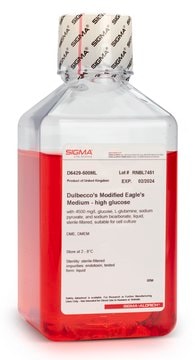


This product is a liquid medium. The density is not reported. The 1L volume weighs approximately 1 kilogram. The total weight of the packaged 1L size is 1.1 kg. The total weight of the packaged 500 mL size is 578 g.
D6429

DMEM - high glucose
With sodium bicarbonate, ʟ-glutamine and sodium pyruvate, liquid, sterile-filtered, suitable for cell culture
Dulbecco’s Modified Eagle’s Medium - high glucose
1 of 5 reviewers received a sample product or took part in a promotion
Synonyme(s) :
DME, DMEM
Se connecter pour consulter les tarifs organisationnels et contractuels.
Sélectionner une taille de conditionnement
Changer de vue
| À vous/Référence | Disponibilité | Prix |
|---|---|---|
500 mL | Veuillez contacter notre Service Clients pour connaître la disponibilité de ce produit. | 32,80 € |
1 L | Veuillez contacter notre Service Clients pour connaître la disponibilité de ce produit. | 62,40 € |
6 x 500 mL | Veuillez contacter notre Service Clients pour connaître la disponibilité de ce produit. | 195,00 € |
24 x 500 mL | Veuillez contacter notre Service Clients pour connaître la disponibilité de ce produit. | 614,00 € |
A propos de cet article
UNSPSC Code:
12352207
NACRES:
NA.71
32,80 €
Veuillez contacter notre Service Clients pour connaître la disponibilité de ce produit.
Service technique
Besoin d'aide ? Notre équipe de scientifiques expérimentés est là pour vous.
Laissez-nous vous aiderNom du produit
Milieu d′Eagle modifié par Dulbecco (DMEM) à teneur élevée en glucose, With 4500 mg/L glucose,
Quality Segment
sterility
sterile-filtered
form
liquid
technique(s)
cell culture | mammalian: suitable
impurities
endotoxin, tested
components
HEPES: no
NaHCO3: yes
phenol red: yes
sodium pyruvate: yes
L-glutamine: yes
glucose: high
shipped in
ambient
storage temp.
2-8°C
General description
Ce milieu DMEM à teneur élevée en glucose ("DMEM-Hi") est un milieu complet 1x additionné de pyruvate de sodium. Il diffère également de la formulation DMEM-Hi d'origine en ce que le pyridoxal a été remplacé par de la pyridoxine. Le pyridoxal est un constituant instable des milieux.
Application
Le Milieu de Eagle modifié par Dulbecco (DMEM) à teneur élevée en glucose est utilisé par la culture de cellules.
Le milieu de Eagle modifié par Dulbecco (DMEM) est une variante du milieu de Eagle de base (BME) qui contient quatre fois plus d'acides aminés et de vitamines. La formulation d'origine contenait 1 000 mg/l de glucose et servait à la culture de cellules embryonnaires de souris. Depuis, le milieu a été modifié à plusieurs reprises pour convenir aux primocultures de cellules de souris et de poulet ainsi que de diverses cellules normales ou transformées. Chacun de ces milieux apporte une combinaison différente de L -glutamine et de pyruvate de sodium. En outre, le taux de glucose a été augmenté à 4 500 mg/l, d'où le nom "DMEM/High" pour DMEM riche en glucose.
1 of 1
Cet article | |||
|---|---|---|---|
| description With 4500 mg/L glucose, | description With 4500 mg/L glucose, sodium pyruvate, and sodium bicarbonate, without | description With 4500 mg/L glucose, | description With 4500 mg/L glucose and sodium bicarbonate, without |
| sterility sterile-filtered | sterility sterile-filtered | sterility sterile-filtered | sterility sterile-filtered |
| form liquid | form liquid | form liquid | form liquid |
| technique(s) cell culture | mammalian: suitable | technique(s) cell culture | mammalian: suitable | technique(s) cell culture | mammalian: suitable | technique(s) cell culture | mammalian: suitable |
| components HEPES: no | components NaHCO3: yes | components NaHCO3: yes | components L-glutamine: no |
| storage temp. 2-8°C | storage temp. 2-8°C | storage temp. 2-8°C | storage temp. 2-8°C |
| shipped in ambient | shipped in ambient | shipped in ambient | shipped in ambient |
Still not finding the right product?
Explore all of our products under Milieu d′Eagle modifié par Dulbecco (DMEM) à teneur élevée en glucose
Classe de stockage
12 - Non Combustible Liquids
Faites votre choix parmi les versions les plus récentes :
Déjà en possession de ce produit ?
Retrouvez la documentation relative aux produits que vous avez récemment achetés dans la Bibliothèque de documents.
-
How much does D6429-1L weigh? Thank you!
1 answer-
Helpful?
-
-
Hi, What is the concentration of endotoxin detected in DMEM high glucose media D6429?
1 answer-
This product has an endotoxin specification of ≤ 1 EU/ml or 0.1 ng/mL. The lot specific values are reported in the Certificate of Analysis. Please see the link below to review a sample or lot specific Certificate:
https://www.sigmaaldrich.com/product/sigma/d6429#product-documentationHelpful?
-
-
What is the concentration of Sodium Bicarbonate and Sodium Pyruvate in it?
1 answer-
This formulation contains 3.7 g/L sodium bicarbonate and 110 mg/L sodium pyruvate. The composition of this product is published on page 3 of the product information sheet. Please see the link below to access this document: https://www.sigmaaldrich.com/deepweb/assets/sigmaaldrich/product/documents/318/256/d6429for.pdf
Helpful?
-
-
After opening a bottle of medium: how long can I use this bottle ?(stored at 4C°)
1 answer-
Provided that the product is handled and stored properly and has not been contaminated, the medium will be stable up to the expiration date. This date is provided on the label and the lot-specific Certificate of Analysis.
Helpful?
-
-
I would like to inquire about the amino acid formulation in DMEM (#6429, #6546). Specifically, could you provide information on the concentration of aspartate and glutamate in these formulations? Thank you very much.
1 answer-
The composition of this product is published on page 3 of the product information sheet. Please see the link below to access this document: https://www.sigmaaldrich.com/deepweb/assets/sigmaaldrich/product/documents/318/256/d6429for.pdf
Helpful?
-