
SCC136

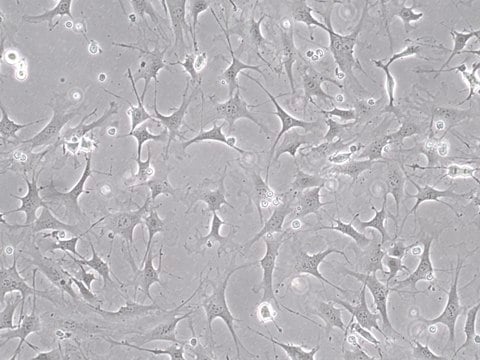
OP9-DL1 hDL-1-Expressing mOP9 Cell Line
Mouse
Synonym(s):
DL1 cell line, Delta-like 1 cell line, Notch ligand cell line, OP9-DL1, OP9-DL1 cell line
Select a Size
| Pack Size | SKU | Availability | Price |
|---|
About This Item
Product Name
OP9-DL1 hDL-1-Expressing mOP9 Cell Line,
biological source
mouse
Quality Level
packaging
vial of ≥1X10⁶ cells/vial vials
manufacturer/tradename
Millipore
technique(s)
cell culture | mammalian: suitable, cell differentiation: suitable
shipped in
liquid nitrogen
storage temp.
−196°C
General description
Notch signaling controls multiple cell fate decisions. It is initiated via engagement of the Notch receptor with its ligands (Jagged or Delta-like family members). This is followed by cleavage of the intracellular domain of Notch and its subsequent translocation into the nucleus, where it binds with the transcription factor CBF-1/RBPJ and activates transcription of various downstream target genes. Upregulation of Notch ligands is a factor in chronic inflammatory diseases including pancreatitis and diabetic nephropathy. Several studies have implicated the role of Notch signaling in early T-cell lineage commitments, as it promotes development of T-cells with αα+ T-Cell Receptors (TCRs) at the expense of αα+ TCRs 3. Bone marrow progenitor cells expressing constitutively active Notch have been shown to develop into CD4 and CD8 double-positive T cells. This signaling pathway also plays an important role in the development of CD4+ or CD8+ single positive cells from CD4 and CD8 double-positive precursor thymocytes.
OP9 bone marrow stromal cells support the differentiation of hematopoietic progenitor cells (HPCs) into multiple lineages including B-cells, but not to T-cells. This is mainly because they do not express Delta-like 1 or Delta-like 4 notch ligands inherently. OP9 cells were therefore infected with a MiGR1 retroviral vector engineered to express the human Delta-like-1 gene and green fluorescent protein (GFP). The OP9-DL1 cells were then sorted for GFP expression.
Source
GMO. OP9-DL1 cells were genetically modified from stromal cells derived from mouse bone marrow.
References
1.Immunity 2002, 17(6): 749-756.
2.J Orthop Sci. 2005, 10(6): 589-594.
3.Curr Opin Immunol. 2007, 19(2): 163-168.
4.Cold Spring Harb Protoc. 2009, 2009(2): pdb.prot5156.
Application
- Each vial contains > 1X10⁶ viable cells.
- Cells are tested negative for infectious diseases by a Mouse Essential CLEAR Panel by Charles River Animal Diagnostic Services.
- Cells are verified to be of mouse origin and negative for interspecies contamination from human, rat, Chinese hamster, Golden Syrian hamster, and nonhuman primate (NHP) as assessed by a Contamination Clear panel by Charles River Animal Diagnostic Services
- Cells are negative for mycoplasma contamination.
Features and Benefits
Preparation Note
Other Notes
Disclaimer
1 of 1
This Item | |||
|---|---|---|---|
| technique(s) cell culture | mammalian: suitable, cell differentiation: suitable | technique(s) cell culture | mammalian: suitable, cell differentiation: suitable | technique(s) cell culture | mammalian: suitable, cell differentiation: suitable | technique(s) cell culture | mammalian: suitable |
| biological source mouse | biological source mouse | biological source human | biological source mouse |
| storage temp. −196°C | storage temp. −196°C | storage temp. −196°C | storage temp. −196°C |
| shipped in liquid nitrogen | shipped in liquid nitrogen | shipped in liquid nitrogen | shipped in liquid nitrogen |
| manufacturer/tradename Millipore | manufacturer/tradename Millipore | manufacturer/tradename Millipore | manufacturer/tradename Millipore |
| Quality Level 100 | Quality Level 100 | Quality Level 100 | Quality Level 100 |



Storage Class
12 - Non Combustible Liquids
wgk
WGK 3
flash_point_f
Not applicable
flash_point_c
Not applicable
Certificates of Analysis (COA)
Search for Certificates of Analysis (COA) by entering the products Lot/Batch Number. Lot and Batch Numbers can be found on a product’s label following the words ‘Lot’ or ‘Batch’.
Already Own This Product?
Find documentation for the products that you have recently purchased in the Document Library.