
ABS102

Anti-AKAP 79 Antibody
from rabbit, purified by affinity chromatography
Synonym(s):
A-kinase anchor protein 5, AKAP-5, A-kinase anchor protein 79 kDa, AKAP 79, H21, cAMP-dependent protein kinase regulatory subunit II high affinity-binding protein
About This Item
biological source
rabbit
Quality Level
conjugate
unconjugated
antibody form
affinity isolated antibody
antibody product type
primary antibodies
clone
polyclonal
purified by
affinity chromatography
species reactivity
human
technique(s)
western blot: suitable
NCBI accession no.
UniProt accession no.
shipped in
wet ice
target post-translational modification
unmodified
Gene Information
human ... AKAP5(9495)
General description
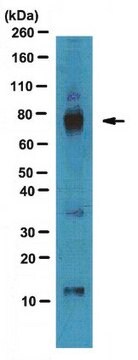
AKAP79 migrates in WB with an apparent molecular weight of ~79 kDa Uncharacterized bands appear at ~35 kDa and ~13 kDa in some lysates.
Immunogen
Application
Biochem/physiol Actions
Analysis Note
HEK293 cell lysate with overexpressed N-terminal Flag-AKAP79
Western Blot Analysis: 1 µg/mL of this antibody detected AKAP 79 on 10 µg of HEK293 cell lysate with overexpressed N-terminal Flag-AKAP79.
Other Notes
1 of 1
This Item | |||
|---|---|---|---|
| Quality Level 100 | Quality Level - | Quality Level - | Quality Level - |
| conjugate unconjugated | conjugate unconjugated | conjugate unconjugated | conjugate unconjugated |
| antibody form affinity isolated antibody | antibody form affinity isolated antibody | antibody form affinity isolated antibody | antibody form IgG fraction of antiserum |
| biological source rabbit | biological source rabbit | biological source rabbit | biological source rabbit |
| shipped in wet ice | shipped in wet ice | shipped in wet ice | shipped in wet ice |
| technique(s) western blot: suitable | technique(s) ELISA: 1:10000, immunofluorescence: 1:100-1:500, western blot: 1:500-1:1000 | technique(s) ELISA: 1:20000, immunofluorescence: 1:100-1:500, immunohistochemistry: 1:50-1:100, western blot: 1:500-1:1000 | technique(s) western blot: suitable |
Still not finding the right product?
Try our Product Selector Tool to narrow your options
Storage Class
12 - Non Combustible Liquids
wgk
WGK 1
flash_point_f
Not applicable
flash_point_c
Not applicable
Certificates of Analysis (COA)
Search for Certificates of Analysis (COA) by entering the products Lot/Batch Number. Lot and Batch Numbers can be found on a product’s label following the words ‘Lot’ or ‘Batch’.
Already Own This Product?
Find documentation for the products that you have recently purchased in the Document Library.
Related Content
Global Trade Item Number
| SKU | GTIN |
|---|---|
| ABS102 | 04053252420306 |