Direkt zum Inhalt
Merck

Fortfahren mit

SRP2026

p75 human

recombinant, expressed in E. coli, ≥70% (SDS-PAGE)

Synonym(e):

DFS70, LEDGF, MGC74712, PAIP, p75

Anmelden zur Ansicht der Organisations- und Vertragspreise.

Größe auswählen

Ansicht ändern
Größe/SKUVerfügbarkeitPreis
10 μg
Versand in der Regel in 2 Wochen.
€ 379,00

Über diesen Artikel

NACRES:
NA.26
UNSPSC Code:
12352200
eCl@ss:
38150101
Form:
frozen liquid
Assay:
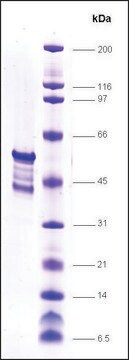
≥70% (SDS-PAGE)
Biological source:
human
Recombinant:
expressed in E. coli
Mol wt:
~61.6 kDa

€ 379,00


Versand in der Regel in 2 Wochen.

​
Sonderanfertigung anfragen
Technischer Dienst
Benötigen Sie Hilfe? Unser Team von erfahrenen Wissenschaftlern ist für Sie da.
Unterstützung erhalten


biological source

human

recombinant

expressed in E. coli

assay

≥70% (SDS-PAGE)

form

frozen liquid

mol wt

~61.6 kDa

packaging

pkg of 10 μg

concentration

500 μg/mL

color

clear colorless

NCBI accession no.

UniProt accession no.

shipped in

dry ice

storage temp.

−70°C

Gene Information

human ... PSIP2(11168)

General description

p75 was first identified during micro-sequencing of a protein that co-purified with positive cofactor 4 (PC4), a general transcriptional coactivator. This is a transcriptional coactivator and has a molecular weight of 75kDa. This protein is also known as LEDGF (lens epithelium-derived growth factor), and belongs to the hepatoma-derived growth factor (HDGF) family. p75 is constitutively expressed in the nucleus. This gene is localized to human chromosome 9p22.3, and is composed of 15 exons and 14 introns. It is transcribed into two splice variants- p52 and p75 both of which contain 325 residues in their N-terminals. They differ in their C-terminal, where p75 contains 205 residues in its C-terminal. Its C-terminal also contains the 83-residue IN binding domain (IBD) from residues 340–417, which is essential for p75′s virological and cellular characteristics.

Application

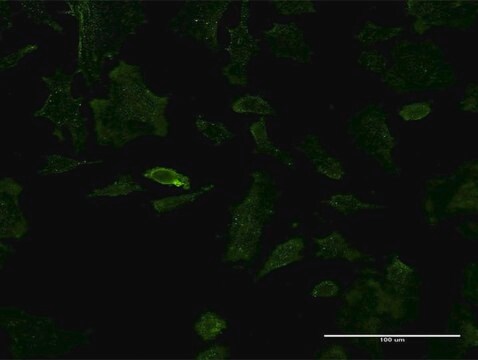
p75 human has been used in immunohistochemistry.

Biochem/physiol Actions

The human p75 protein, similar to p52, is a non-TAF transcription coactivator that mediates activator-dependent transcription by RNA polymerase II in vitro through most tested activators. Although p75 and p52 are derived from alternatively splicing of a single gene and share most coding sequence, they reveal different function in several aspects. In addition to functioning as a transcription coactivator, p75 has been shown to be involved in growth of epithelial cells as a lens epithelial cell-derived growth factor (LEDGF), and in pathogenesis of atopic dermatitis as an autoantigen.
p75 and p52 proteins associate with chromatin tightly and interact with other nuclear proteins, out of which multiple proteins are anchored by p75 to the chromatin fiber. Therefore, these proteins are involved in transcriptional regulation. Lentiviruses utilize the chromatin tethering capacity of this protein to integrate into the host chromosomes. p75 not only anchors HIV (human immunodeficiency virus) integrase to chromatin and prevents its degradation, but also promotes the genome-wide HIV integration. Human papillomavirus (HPV) E6/E7 oncogenes promote the expression of p75 in host cells, which in turn confers protection to HPV-positive cancer cells against different types of cellular stress, such as DNA damage.

Physical form

Clear and colorless frozen liquid solution

Preparation Note

Use a manual defrost freezer and avoid repeated freeze-thaw cycles. While working, please keep sample on ice.

Ähnliche Artikel vergleichen

Vollständigen Vergleich anzeigen

Unterschiede anzeigen

1 of 1

Dieser Artikel
SRP2025SRP3095SAB1404913
description

recombinant, expressed in E. coli, ≥70% (SDS-PAGE)

description

recombinant, expressed in E. coli, ≥70% (SDS-PAGE)

description

recombinant, expressed in E. coli, ≥98% (SDS-PAGE), ≥98% (HPLC), suitable for cell culture

description

clone 1C4, purified immunoglobulin, buffered aqueous solution

assay

≥70% (SDS-PAGE)

assay

≥70% (SDS-PAGE)

assay

≥98% (SDS-PAGE), ≥98% (HPLC)

assay

-

biological source

human

biological source

human

biological source

human

biological source

mouse

recombinant

expressed in E. coli

recombinant

expressed in E. coli

recombinant

expressed in E. coli

recombinant

-

concentration

500 μg/mL

concentration

600 μg/mL

concentration

-

concentration

-

mol wt

~61.6 kDa

mol wt

~39 kDa

mol wt

26.0 kDa

mol wt

antigen ~31.61 kDa

form

frozen liquid

form

frozen liquid

form

lyophilized

form

buffered aqueous solution


Lagerklasse

10 - Combustible liquids

WGK

WGK 1

Flammpunkt (°F)

Not applicable

Flammpunkt (°C)

Not applicable


Hier finden Sie alle aktuellen Versionen:

Analysenzertifikate (COA)

Lot/Batch Number

It looks like we've run into a problem, but you can still download Certificates of Analysis from our Dokumente section.

Wenn Sie Hilfe benötigen, wenden Sie sich bitte an Kundensupport

Besitzen Sie dieses Produkt bereits?

In der Dokumentenbibliothek finden Sie die Dokumentation zu den Produkten, die Sie kürzlich erworben haben.

Die Dokumentenbibliothek aufrufen


Questions

Reviews

No rating value

Active Filters