Direkt zum Inhalt
Merck

S6072

Anti-STIM1 (N-terminal) in Kaninchen hergestellte Antikörper

~1 mg/mL, affinity isolated antibody, buffered aqueous solution

Synonym(e):

Anti-GOK, Anti-Stromal interaction molecule I

Anmelden zur Ansicht der Organisations- und Vertragspreise.

Größe auswählen

100 μL

€ 505,00

200 μL

€ 654,00

€ 505,00


Warenkorb auf Verfügbarkeit prüfen

Großbestellung anfragen

Über diesen Artikel

NACRES:
NA.41
UNSPSC Code:
12352203
Conjugate:
unconjugated
Clone:
polyclonal
Application:
IF, IP, WB
Citations:
17

Fortfahren mit

Technischer Dienst
Benötigen Sie Hilfe? Unser Team von erfahrenen Wissenschaftlern ist für Sie da.
Unterstützung erhalten

biological source

rabbit

conjugate

unconjugated

antibody form

affinity isolated antibody

antibody product type

primary antibodies

clone

polyclonal

form

buffered aqueous solution

mol wt

antigen 90 kDa

species reactivity

rat, mouse, human

enhanced validation

independent
Learn more about Antibody Enhanced Validation

concentration

~1 mg/mL

technique(s)

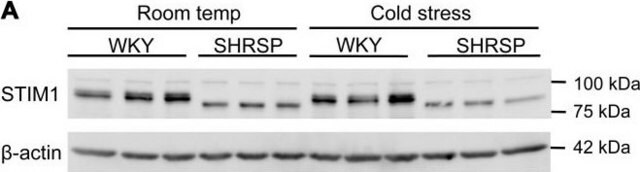
immunoprecipitation (IP): 2.5-5 μg using extracts of rat PC12 cells., indirect immunofluorescence: 5-10 μg/mL using human HeLa cells., western blot: 2-4 μg/mL using whole extract of mouse 3T3 cells.

UniProt accession no.

shipped in

dry ice

storage temp.

−20°C

target post-translational modification

unmodified

Quality Level

Gene Information

human ... STIM1(6786)
mouse ... Stim1(20866)
rat ... Stim1(117086)

Ähnliche Artikel vergleichen

Vollständigen Vergleich anzeigen

Unterschiede anzeigen

1 of 4

Dieser Artikel
SAB3500365HPA011088SAB4200534
conjugate

unconjugated

conjugate

unconjugated

conjugate

unconjugated

conjugate

unconjugated

antibody form

affinity isolated antibody

antibody form

affinity isolated antibody

antibody form

affinity isolated antibody

antibody form

affinity isolated antibody

Quality Level

200

Quality Level

100

Quality Level

100

Quality Level

200

biological source

rabbit

biological source

rabbit

biological source

rabbit

biological source

rabbit

mol wt

antigen 90 kDa

mol wt

-

mol wt

-

mol wt

antigen ~23 kDa

technique(s)

immunoprecipitation (IP): 2.5-5 μg using extracts of rat PC12 cells., western blot: 2-4 μg/mL using whole extract of mouse 3T3 cells., indirect immunofluorescence: 5-10 μg/mL using human HeLa cells.

technique(s)

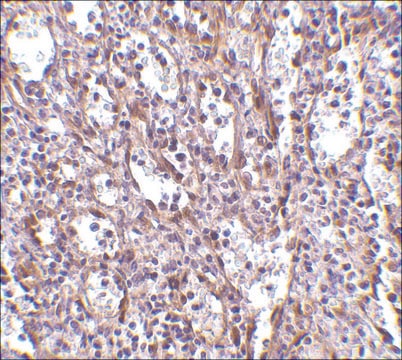
immunohistochemistry: suitable, indirect ELISA: suitable, western blot: suitable

technique(s)

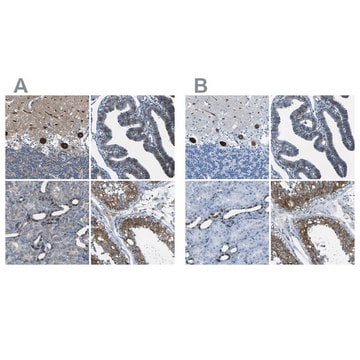
immunoblotting: 0.04-0.4 μg/mL, immunofluorescence: 0.25-2 μg/mL, immunohistochemistry: 1:500-1:1000

technique(s)

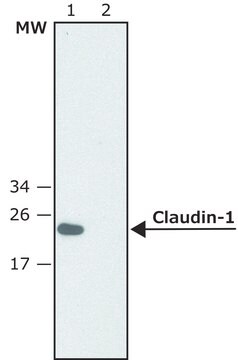
immunohistochemistry: 20 μg/mL using formalin-fixed, paraffin-embedded human colon., indirect immunofluorescence: 1.0-2.0 μg/mL using MDCK cells., western blot: 0.5-1.0 μg/mL using extracts of HEK-293T cells overexpressing human claudin-1.

General description

STIM1 (stromal interaction molecule 1) is a conserved single-pass transmembrane protein, which is expressed ubiquitously in a wide variety of human primary and transformed cell types. STIM1 is modified by phosphorylation and N-linked glycosylation. STIM1 localized predominantly in the membrane of the endoplasmic reticulum (ER). It contains an N-terminal EF hand motif located in the ER lumen and appears to function as a sensor of ER Ca2+ levels.

Immunogen

synthetic peptide corresponding to amino acids 61-74 of human STIM1, conjugated to KLH via a C-terminal cysteine residue. The corresponding sequence is identical in rat and mouse.

Application

Anti-STIM1 (N-terminal) antibody produced in rabbit has been used in:
  • western blotting
  • immunoprecipitation
  • immunofluorescence

Biochem/physiol Actions

STIM1 (stromal interaction molecule 1) is required for the activation of store-operated Ca2+ influx. Overexpression of STIM1 and Orai1 markedly increases the calcium release-activated calcium (CRAC) current (I-CRAC).

Physical form

Solution in 0.01 M phosphate buffered saline, 7.4 pH, containing 15 mM sodium azide.

Disclaimer

Unless otherwise stated in our catalog or other company documentation accompanying the product(s), our products are intended for research use only and are not to be used for any other purpose, which includes but is not limited to, unauthorized commercial uses, in vitro diagnostic uses, ex vivo or in vivo therapeutic uses or any type of consumption or application to humans or animals.

Sie haben nicht das passende Produkt gefunden?  

Probieren Sie unser Produkt-Auswahlhilfe. aus.

Ähnliches Produkt

Lagerklasse

10 - Combustible liquids

flash_point_f

Not applicable

flash_point_c

Not applicable

ppe

Eyeshields, Gloves, multi-purpose combination respirator cartridge (US)


Hier finden Sie alle aktuellen Versionen:

Analysenzertifikate (COA)

Lot/Batch Number

Die passende Version wird nicht angezeigt?

Wenn Sie eine bestimmte Version benötigen, können Sie anhand der Lot- oder Chargennummer nach einem spezifischen Zertifikat suchen.

Besitzen Sie dieses Produkt bereits?

In der Dokumentenbibliothek finden Sie die Dokumentation zu den Produkten, die Sie kürzlich erworben haben.

Die Dokumentenbibliothek aufrufen

STIM1 is a Ca 2+ sensor that activates CRAC channels and migrates from the Ca 2+ store to the plasma membrane
Zhang SL, et al.
Nature, 437(7060), 902-902 (2005)
Inhibition of store-operated calcium entry attenuates MPP+-induced oxidative stress via preservation of mitochondrial function in PC12 cells: involvement of Homer1a
Li X, et al.
PLoS ONE, 8(12), e83638-e83638 (2013)
Vivek Krishnan et al.
eLife, 11 (2022-02-12)
Peripheral coupling between the sarcoplasmic reticulum (SR) and plasma membrane (PM) forms signaling complexes that regulate the membrane potential and contractility of vascular smooth muscle cells (VSMCs). The mechanisms responsible for these membrane interactions are poorly understood. In many cells
Identification and characterization of the STIM (stromal interaction molecule) gene family: coding for a novel class of transmembrane proteins
Williams RT, et al.
The Biochemical Journal, 357(3), 673-685 (2001)
Stephen Baine et al.
Journal of cellular and molecular medicine, 25(10), 4637-4648 (2021-03-24)
Heart failure (HF) is characterized by asymmetrical autonomic balance. Treatments to restore parasympathetic activity in human heart failure trials have shown beneficial effects. However, mechanisms of parasympathetic-mediated improvement in cardiac function remain unclear. The present study examined the effects and

Verwandter Inhalt

Instructions

Questions

Reviews

No rating value

Active Filters

Unser Team von Wissenschaftlern verfügt über Erfahrung in allen Forschungsbereichen einschließlich Life Science, Materialwissenschaften, chemischer Synthese, Chromatographie, Analytik und vielen mehr..

Setzen Sie sich mit dem technischen Dienst in Verbindung