Direkt zum Inhalt
Merck

P8874

Monoclonal Anti-Phosphocan in Maus hergestellte Antikörper

~2 mg/mL, clone 122.2, purified immunoglobulin, buffered aqueous solution

Synonym(e):

Anti-PTPRB, Anti-Receptor-type Protein-tyrosine phosphatase β

Anmelden zur Ansicht der Organisations- und Vertragspreise.

Über diesen Artikel

UNSPSC Code:
12352203
NACRES:
NA.41
MDL number:
Conjugate:
unconjugated
Clone:
122.2, monoclonal
Application:
ICC, IHC, WB
Citations:
9

Fortfahren mit

Technischer Dienst
Benötigen Sie Hilfe? Unser Team von erfahrenen Wissenschaftlern ist für Sie da.
Unterstützung erhalten

biological source

mouse

conjugate

unconjugated

antibody form

purified immunoglobulin

antibody product type

primary antibodies

clone

122.2, monoclonal

form

buffered aqueous solution

mol wt

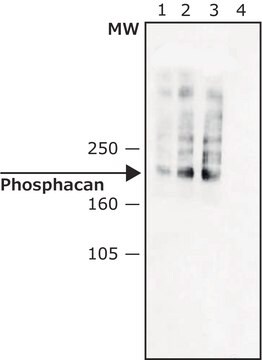
antigen ~180 kDa (higher band may be present)

species reactivity

rat

packaging

antibody small pack of 25 μL

concentration

~2 mg/mL

technique(s)

immunocytochemistry: suitable, immunohistochemistry: suitable, western blot: 0.2-0.4 μg/mL using total extract of rat brain

isotype

IgM

UniProt accession no.

shipped in

dry ice

storage temp.

−20°C

target post-translational modification

unmodified

Gene Information

rat ... Ptprz1(25613)

Ähnliche Artikel vergleichen

Vollständigen Vergleich anzeigen

Unterschiede anzeigen

1 of 4

Dieser Artikel
P3118G9295ABN2246
species reactivity

rat

species reactivity

rat

species reactivity

rabbit, canine, rat, hamster, monkey, mouse, turkey, bovine, mink, human, chicken

species reactivity

rat

conjugate

unconjugated

conjugate

unconjugated

conjugate

peroxidase conjugate

conjugate

-

antibody form

purified immunoglobulin

antibody form

purified immunoglobulin

antibody form

purified immunoglobulin

antibody form

unpurified

clone

122.2, monoclonal

clone

5D6, monoclonal

clone

GAPDH-71.1, monoclonal

clone

polyclonal

biological source

mouse

biological source

mouse

biological source

mouse

biological source

rabbit

Gene Information

rat ... Ptprz1(25613)

Gene Information

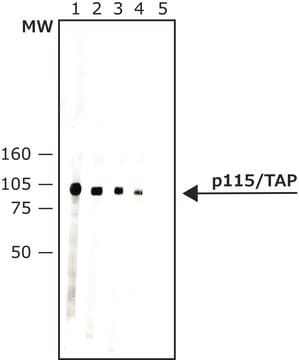
rat ... Uso1(56042)

Gene Information

human ... GAPDH(2597)
mouse ... Gapdh(14433)
rat ... Gapdh(24383)

Gene Information

rat ... Ptprz1(25613)

General description

Monoclonal Anti-Phosphacan (mouse IgM isotype) is derived from the hybridoma 122.2 produced by the fusion of mouse myeloma cells (P3X cells) and splenocytes from BALB/c mice immunized with rat brain proteoglycans. Chondroitin sulfate proteoglycans are neural cell adhesion molecules (NCAM) ligands present in the brain extracellular matrix (ECM). Phosphacan protein is expressed mainly in astrocytes and is a ligand for NCAM. Phosphacan is the soluble extracellular domain of the receptor-type transmembrane protein tyrosine phosphatase (RPTPb).

Immunogen

rat brain proteoglycans.

Application

Monoclonal Anti-Phosphacan antibody produced in mouse has been used in:
  • immunoblotting
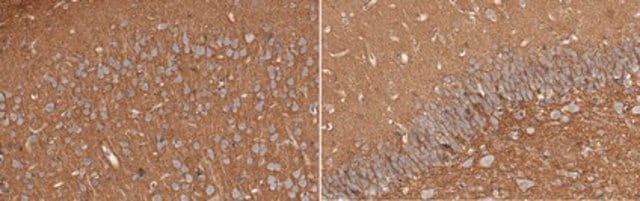
  • immunohistochemistry
  • immunocytochemistry.

Biochem/physiol Actions

Phosphacan levels elevates during late embryogenesis. It reaches a plateau two weeks postnatal before reaching stable. Receptor-type transmembrane protein tyrosine phosphatase (RPTPb) functions to promote primary tecal neurons neurite growth, neural migration and also induces cell adhesion. Both phosphacan and RPTPb can bind to NCAM and tenascin-C and −R. Phosphacan can oppose RPTPb by competing for its binding sites. Both in hippocampal and spinal cord neurons, phosphacan can affect neuronal adhesion and neurite outgrowth.

Physical form

Solution in 0.01 M phosphate buffered saline, pH 7.4, containing 15 mM sodium azide.

Disclaimer

Unless otherwise stated in our catalog or other company documentation accompanying the product(s), our products are intended for research use only and are not to be used for any other purpose, which includes but is not limited to, unauthorized commercial uses, in vitro diagnostic uses, ex vivo or in vivo therapeutic uses or any type of consumption or application to humans or animals.

Sie haben nicht das passende Produkt gefunden?  

Probieren Sie unser Produkt-Auswahlhilfe. aus.

Lagerklasse

10 - Combustible liquids

wgk

WGK 3

flash_point_f

Not applicable

flash_point_c

Not applicable

ppe

Eyeshields, Gloves, multi-purpose combination respirator cartridge (US)


Hier finden Sie alle aktuellen Versionen:

Analysenzertifikate (COA)

Lot/Batch Number

Die passende Version wird nicht angezeigt?

Wenn Sie eine bestimmte Version benötigen, können Sie anhand der Lot- oder Chargennummer nach einem spezifischen Zertifikat suchen.

Besitzen Sie dieses Produkt bereits?

In der Dokumentenbibliothek finden Sie die Dokumentation zu den Produkten, die Sie kürzlich erworben haben.

Die Dokumentenbibliothek aufrufen

Receptor protein tyrosine phosphatases in nervous system development
Johnson KG and Van Vactor D
Physiological Reviews, 83(1), 1-24 (2003)
The tissue plasminogen activator (tPA/Plasmin) extracellular proteolytic system regulates seizure-induced hippocampal mossy fiber outgrowth through a proteoglycan substrate
Wu YP, et al.
The Journal of cell biology, 148(6), 1295-1304 (2000)
RGMa mediates reactive astrogliosis and glial scar formation through TGFbeta1/Smad2/3 signaling after stroke
Zhang R, et al.
Cell Death and Differentiation, 25(8), 1503-1503 (2018)
Rongrong Zhang et al.
Cell death and differentiation, 25(8), 1503-1516 (2018-02-06)
In response to stroke, astrocytes become reactive astrogliosis and are a major component of a glial scar. This results in the formation of both a physical and chemical (production of chondroitin sulfate proteoglycans) barrier, which prevent neurite regeneration that, in
Yuan Qin et al.
Acta pharmacologica Sinica, 40(6), 724-736 (2018-10-14)
Increasing evidence suggests that Ras-related in brain 7 (Rab7), an endosome-localized small GTPase contributes to cerebral ischemic brain injury. In the present study, we investigated the role of Rab7 in ischemic stroke-induced formation of astrogliosis and glial scar. Rats were

Verwandter Inhalt

Instructions

Questions

Reviews

No rating value

Active Filters

Unser Team von Wissenschaftlern verfügt über Erfahrung in allen Forschungsbereichen einschließlich Life Science, Materialwissenschaften, chemischer Synthese, Chromatographie, Analytik und vielen mehr..

Setzen Sie sich mit dem technischen Dienst in Verbindung