Direkt zum Inhalt
Merck

P5367

Anti-Par-4 (Prostate Apoptosis Response-4) antibody produced in rabbit

IgG fraction of antiserum, buffered aqueous solution

Anmelden zur Ansicht der Organisations- und Vertragspreise.

Größe auswählen

Preise und Verfügbarkeit sind derzeit nicht verfügbar.

Über diesen Artikel

UNSPSC Code:
12352203
NACRES:
NA.46
MDL number:
Conjugate:
unconjugated
Clone:
polyclonal
Application:
ARR, WB
Citations:
10

Fortfahren mit

Technischer Dienst
Benötigen Sie Hilfe? Unser Team von erfahrenen Wissenschaftlern ist für Sie da.
Unterstützung erhalten

biological source

rabbit

conjugate

unconjugated

antibody form

IgG fraction of antiserum

antibody product type

primary antibodies

clone

polyclonal

form

buffered aqueous solution

mol wt

antigen 38 kDa

species reactivity

human, rat, mouse

technique(s)

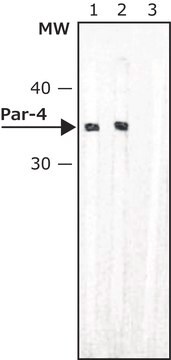
microarray: suitable, western blot: 1:1,000 using whole cell extract of the mouse fibroblast NIH3T3 cell line, western blot: 1:5,000 using whole cell extract of the human HeLa cell line

UniProt accession no.

shipped in

dry ice

storage temp.

−20°C

target post-translational modification

unmodified

Quality Level

Gene Information

human ... PAWR(5074)
mouse ... Pawr(114774)
rat ... Pawr(64513)

Ähnliche Artikel vergleichen

Vollständigen Vergleich anzeigen

Unterschiede anzeigen

1 of 4

Dieser Artikel
A1226B3428M8194
conjugate

unconjugated

conjugate

unconjugated

conjugate

unconjugated

conjugate

unconjugated

Quality Level

200

Quality Level

200

Quality Level

200

Quality Level

200

antibody form

IgG fraction of antiserum

antibody form

IgG fraction of antiserum

antibody form

IgG fraction of antiserum

antibody form

IgG fraction of antiserum

biological source

rabbit

biological source

rabbit

biological source

rabbit

biological source

rabbit

Gene Information

human ... PAWR(5074)
mouse ... Pawr(114774)
rat ... Pawr(64513)

Gene Information

human ... PARVA(55742)
mouse ... Parva(57342)

Gene Information

human ... BAX(581)
mouse ... Bax(12028)
rat ... Bax(24887)

Gene Information

human ... MAFF(23764)

technique(s)

microarray: suitable, western blot: 1:5,000 using whole cell extract of the human HeLa cell line, western blot: 1:1,000 using whole cell extract of the mouse fibroblast NIH3T3 cell line

technique(s)

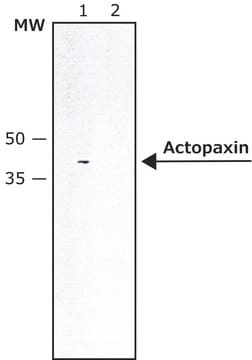
microarray: suitable, western blot: 1:3,000 using whole cell extract of the human endothelial ECV304 cell line.

technique(s)

microarray: suitable, western blot: 1:2,000 using whole cell extract of MCF7 human breast adenocarcinoma cell line

technique(s)

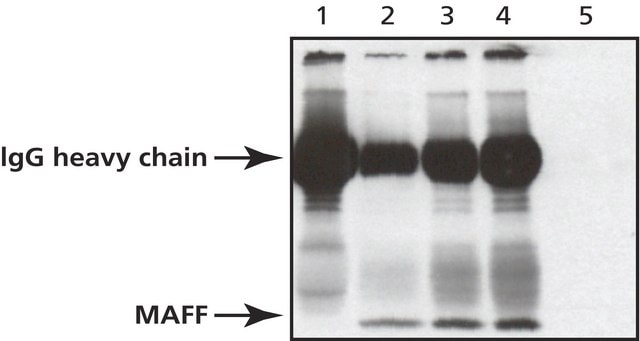
immunoprecipitation (IP): 2-4 μL using A431 cell line, microarray: suitable, western blot: 1:2,000-1:4,000 using whole extracts of the A431 cell line

General description

PRKC apoptosis WT1 regulator protein (PAWR) is also known as prostate apoptosis response 4 protein (Par-4). The PAWR gene is mapped to human chromosome 12q21.2. It is a 40 kDa protein expressed ubiquitously in mammals. It was first identified in prostate tumors.It has a leucine zipper domain and nuclear localization sequences. A core domain comprising of region 137-195 amino acids is critical for the apoptotic function of PAR-4. It interacts and modulates the activity of protein kinase C.

Immunogen

synthetic peptide corresponding to the C-terminus of human Par-4 (amino acids 324-342) conjugated to KLH.

Application

Anti-Par-4 (Prostate Apoptosis Response-4) antibody produced in rabbit may be used in immunoblotting.

Biochem/physiol Actions

Par-4 protein interacts with Wilm′s tumor suppressor WT1 and modulates its transcription and growth suppression function. The gene for Par-4 is down-regulated by oncogenic Ras via the Raf-1- mitogen-activated protein kinase/extracellular signal-regulated kinase (MEK-ERK) pathway in immortalized fibroblasts. Overexpression of the PAR4 gene causes down-regulation of B-cell lymphoma-2 (Bcl-2) in fibroblasts and prostate cancer cells. Par-4 protein plays an important role in neuronal apoptosis. This gene is upregulated in neuronal degeneration and is observed in Alzheimer′s disease.
The primary function of prostate apoptosis response 4 protein (Par-4) is to mediate apoptosis. In neuronal progenitor cells, ceramide and PAR-4 contribute to rapid apoptosis. PAR-4 activates the tumor necrosis factor receptor superfamily member (FAS)-based death signalling caspase cascade to accomplish apoptosis in prostate tumor cells. PAR-4 is considered as a potential drug for treatment of cancer and neurodegenerative disorders.

Physical form

Solution in 0.01 M phosphate buffered saline, pH 7.4, containing 15 mM sodium azide.

Preparation Note

For continuous use, store at 2-8 °C for up to one month.For prolonged storage, freeze in working aliquots at −20 °C. Repeated freezing and thawing is not recom-mended. Storage in frost-free freezers is also notrecommended. If slight turbidity occurs upon prolongedstorage, clarify the solution by centrifugation beforeuse. Working dilutions should be discarded if not usedwithin 12 hours.

Disclaimer

Unless otherwise stated in our catalog or other company documentation accompanying the product(s), our products are intended for research use only and are not to be used for any other purpose, which includes but is not limited to, unauthorized commercial uses, in vitro diagnostic uses, ex vivo or in vivo therapeutic uses or any type of consumption or application to humans or animals.

Sie haben nicht das passende Produkt gefunden?  

Probieren Sie unser Produkt-Auswahlhilfe. aus.


Hier finden Sie alle aktuellen Versionen:

Analysenzertifikate (COA)

Lot/Batch Number

Die passende Version wird nicht angezeigt?

Wenn Sie eine bestimmte Version benötigen, können Sie anhand der Lot- oder Chargennummer nach einem spezifischen Zertifikat suchen.

Besitzen Sie dieses Produkt bereits?

In der Dokumentenbibliothek finden Sie die Dokumentation zu den Produkten, die Sie kürzlich erworben haben.

Die Dokumentenbibliothek aufrufen

Identification of a unique core domain of par-4 sufficient for selective apoptosis induction in cancer cells
El-Guendy N, et al.
Molecular and Cellular Biology, 23(16), 5516-5525 (2003)
S G Qiu et al.
Oncogene, 18(50), 7115-7123 (1999-12-22)
Oncogenic variants of the cellular Ras protein are often associated with different types of human cancers. However, the mechanisms by which oncogenic Ras induces transformation are not fully established. Expression of the transcriptional repressor Par-4 was down-regulated by oncogenic Ras
Regulation of cell death in mitotic neural progenitor cells by asymmetric distribution of prostate apoptosis response 4 (PAR-4) and simultaneous elevation of endogenous ceramide
Bieberich E, et al.
The Journal of Cell Biology, 162(3), 469-479 (2003)
M Barradas et al.
The EMBO journal, 18(22), 6362-6369 (1999-11-24)
Inhibition of apoptosis is an important characteristic of oncogenic transformation. The Par-4 gene product has recently been shown to be upregulated in cells undergoing apoptotic cell death, and its ectopic expression was shown to be critical in apoptosis. We demonstrate
Structural and functional characterization of the upstream regulatory region of the human gene encoding prostate apoptosis response factor-4
Hsu SC, et al.
Gene, 295(1), 109-116 (2002)

Verwandter Inhalt

Questions

Reviews

No rating value

Active Filters

Unser Team von Wissenschaftlern verfügt über Erfahrung in allen Forschungsbereichen einschließlich Life Science, Materialwissenschaften, chemischer Synthese, Chromatographie, Analytik und vielen mehr..

Setzen Sie sich mit dem technischen Dienst in Verbindung