


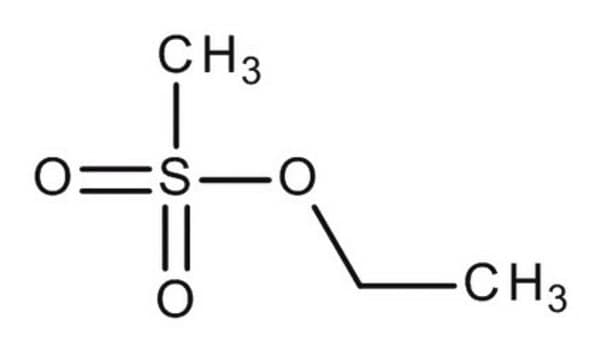


If this product has an expiration or retest date, it will be shown on the Certificate of Analysis (COA, CofA). If there is no retest or expiration date listed on the product's COA, we do not have suitable stability data to determine a shelf life. For these products, the only date on the COA will be the release date; a retest, expiration, or use-by-date will not be displayed.
For all products, we recommend handling per defined conditions as printed in our product literature and website product descriptions. We recommend that products should be routinely inspected by customers to ensure they perform as expected.
For products without retest or expiration dates, our standard warranty of 1 year from the date of shipment is applicable.
For more information, please refer to the Product Dating Information document: https://www.sigmaaldrich.com/deepweb/assets/sigmaaldrich/marketing/global/documents/418/501/product-dating-information-06-25-mk.pdf
Fortfahren mit
M0880

Ethylmethansulfonat
liquid
Synonym(e):
Ethyl-mesylat, Ethyl-methansulfonat
Größe auswählen
| Ihnen/SKU | Verfügbarkeit | Preis |
|---|---|---|
1 g | Warenkorb auf Verfügbarkeit prüfen | € 37,60 |
5 g | Warenkorb auf Verfügbarkeit prüfen | € 54,20 |
10 g | Warenkorb auf Verfügbarkeit prüfen | € 101,00 |
25 g | Warenkorb auf Verfügbarkeit prüfen | € 177,00 |
100 g | Warenkorb auf Verfügbarkeit prüfen | € 561,00 |
Über diesen Artikel
form
liquid
Quality Segment
refractive index
n
bp
85-86 °C/10 mmHg (lit.)
density
1.206 g/mL at 20 °C
SMILES string
CCOS(C)(=O)=O
InChI
1S/C3H8O3S/c1-3-6-7(2,4)5/h3H2,1-2H3
InChI key
PLUBXMRUUVWRLT-UHFFFAOYSA-N
Application
Biochem/physiol Actions
1 of 1
Dieser Artikel | |||
|---|---|---|---|
| description liquid | description 99% | description for synthesis | description 98% |
| form liquid | form liquid | form liquid | form liquid |
| Quality Level 200 | Quality Level 100 | Quality Level 200 | Quality Level 100 |
| density 1.206 g/mL at 20 °C | density 1.3 g/mL at 25 °C (lit.) | density 1.206 g/cm3 at 20 °C | density - |
| bp 85-86 °C/10 mmHg (lit.) | bp 202-203 °C (lit.) | bp 213-214 °C/1013 hPa | bp - |
| refractive index n | refractive index n | refractive index - | refractive index - |
Still not finding the right product?
Explore all of our products under Ethylmethansulfonat
signalword
Danger
Hazard Classifications
Acute Tox. 4 Oral - Carc. 1B - Eye Irrit. 2 - Muta. 1B - Repr. 2 - Skin Irrit. 2 - Skin Sens. 1
Lagerklasse
6.1C - Combustible acute toxic Cat.3 / toxic compounds or compounds which causing chronic effects
wgk
WGK 3
flash_point_f
212.0 °F
flash_point_c
100 °C
ppe
Eyeshields, Faceshields, Gloves, type ABEK (EN14387) respirator filter
Hier finden Sie alle aktuellen Versionen:
Besitzen Sie dieses Produkt bereits?
In der Dokumentenbibliothek finden Sie die Dokumentation zu den Produkten, die Sie kürzlich erworben haben.
-
How can I determine the shelf life / expiration / retest date of this product?
1 answer-
Helpful?
-
-
How is shipping temperature determined? And how is it related to the product storage temperature?
1 answer-
Products may be shipped at a different temperature than the recommended long-term storage temperature. If the product quality is sensitive to short-term exposure to conditions other than the recommended long-term storage, it will be shipped on wet or dry-ice. If the product quality is NOT affected by short-term exposure to conditions other than the recommended long-term storage, it will be shipped at ambient temperature. As shipping routes are configured for minimum transit times, shipping at ambient temperature helps control shipping costs for our customers. For more information, please refer to the Storage and Transport Conditions document: https://www.sigmaaldrich.com/deepweb/assets/sigmaaldrich/marketing/global/documents/316/622/storage-transport-conditions-mk.pdf
Helpful?
-
-
Does opening a bottle of EMS and thus exposing it to the air accelerates its decomposition? How much time after the first opening can we assume same efficiency? The bottle we got did have a screw cap but no plastic plug. Is that ok?
1 answer-
This product is packaged under argon in an amber glass bottle with a screw cap. This is the standard packaging for this item. The item is indicated as being moisture sensitive and care should be taken to prevent exposure to air to prevent hydrolysis. There is no specific stability study to determine a decomposition timeline, but water from the humidity from air could lead to hydrolysis. Therefore, it is recommended to store the reagent under a dried inert gas such as argon as directed in section 7.2 of the SDS.
https://www.sigmaaldrich.com/sds/sigma/m0880?userType=anonymous
Helpful?
-
-
How mM have the EMS solution (5G)?
1 answer-
This product is a neat or pure liquid and has not been diluted in a solvent. This material has a density of 1.206 g/mL and a molecular weight of 124.16 g/mol, with a calculated molarity of 9.71 M. The concentration may be determined as follows:
M = 1.206 g/mL/124.16 g/mol *1000 = 9.71MHelpful?
-
-
Is it suitable to store item M0880, Ethyl methanesulfonate, at 4°C?
1 answer-
The recommended storage condition for item M0880, Ethyl methanesulfonate, is at ambient temperature (>5°C).
Helpful?
-
-
The bottle has 10g of EMS. How much volume of EMS is present in the bottle? How to make a stock concentration and what are the suggested working concentrations?
1 answer-
Volume =Mass/Density = 10g/1.206 g/ml = 8.29 ml. This product is over-filled up to 5%, so the volume and mass will not necessarily be the exact volume calculated.
Further, EMS is miscible in chloroform (200 mg/ml). EMS can be diluted to a concentration of 1% in water or serum-free medium and then added to a culture at a final concentration in the range of 200-300 mg/ml:
https://b2b.sigmaaldrich.com/deepweb/assets/sigmaaldrich/product/documents/830/111/m0880pis.pdfHelpful?
-
-
Can I make the stock solution 1% in chloroform as the data sheet mentions that the EMS is immiscible in chloroform?
1 answer-
Yes, this product may be prepared as a 1% solution. The 1% solution would be the equivalent of 1g/100mL or 10mg/mL This product is miscible in chloroform at 200 mg/ml. Please see the link below to review the product datasheet for additional information:
https://www.sigmaaldrich.com/deepweb/assets/sigmaaldrich/product/documents/830/111/m0880pis.pdfHelpful?
-
-
I am using M0880, what should be its dissolving solution, like simply double distilled water or other, for preparing various percentage solution of EMS?
1 answer-
As per the product datasheet, a 1% EMS stock solution can be prepared by diluting in water, serum-free medium, or buffer. The typical working concentration is 200-300 ug/mL. This product is not sterile. Stock solutions should be filter sterilized prior to adding to cultures. Please see the link below to review the product datasheet:
https://www.sigmaaldrich.com/deepweb/assets/sigmaaldrich/product/documents/830/111/m0880pis.pdfHelpful?
-
-
How does Product M0880, Ethyl methanesulfonate (EMS), compare to Product 64292, which is the same chemical?
1 answer-
Product No. 64292 is tested for purity by a titration assay. Although M0880 is likely to be of similar quality, there is no purity assay performed on it.
Helpful?
-
-
What is the Department of Transportation shipping information for this product?
1 answer-
Transportation information can be found in Section 14 of the product's (M)SDS.To access the shipping information for this material, use the link on the product detail page for the product.
Helpful?
-