Direkt zum Inhalt
Merck

C5366

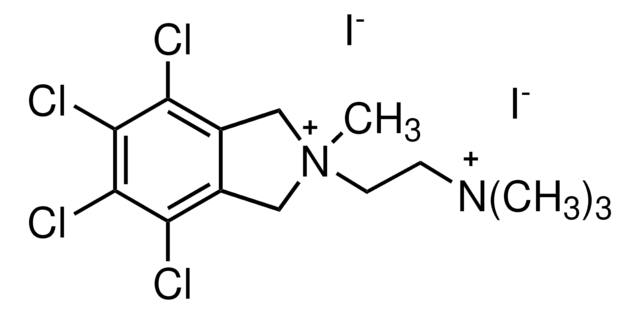
Chlorisondamine diiodide

≥98% (HPLC), nicotinic acetylcholine receptor antagonist, solid

Synonym(e):

4,5,6,7-Tetrachloro-2,3-dihydro-2-methyl-2-[2-(trimethylammonio)ethyl]-2H-isoindolium diiodide

Anmelden zur Ansicht der Organisations- und Vertragspreise.

Größe auswählen

10 MG

€ 170,00

50 MG

€ 670,00

€ 170,00


Warenkorb auf Verfügbarkeit prüfen

Großbestellung anfragen

Über diesen Artikel

Empirische Formel (Hill-System):
C14H20Cl4I2N2
CAS-Nummer:
Molekulargewicht:
611.94
UNSPSC Code:
12352116
PubChem Substance ID:
NACRES:
NA.77
MDL number:
Assay:
≥98% (HPLC)
Form:
solid
Quality level:
Storage condition:
protect from light

Fortfahren mit

Technischer Dienst
Benötigen Sie Hilfe? Unser Team von erfahrenen Wissenschaftlern ist für Sie da.
Unterstützung erhalten

Produktname

Chlorisondamine diiodide, ≥98% (HPLC), white, solid

SMILES string

[I-].[I-].C[N+](C)(C)CC[N+]1(C)Cc2c(Cl)c(Cl)c(Cl)c(Cl)c2C1

InChI key

FPNVAOZHQUJJJQ-UHFFFAOYSA-L

InChI

1S/C14H20Cl4N2.2HI/c1-19(2,3)5-6-20(4)7-9-10(8-20)12(16)14(18)13(17)11(9)15;;/h5-8H2,1-4H3;2*1H/q+2;;/p-2

assay

≥98% (HPLC)

form

solid

storage condition

protect from light

color

white

solubility

H2O: ≥2 mg/mL, DMSO: >20 mg/mL

storage temp.

2-8°C

Quality Level

Verwandte Kategorien

Ähnliche Artikel vergleichen

Vollständigen Vergleich anzeigen

Unterschiede anzeigen

1 of 4

Dieser Artikel
SML1402A9605N8914
form

solid

form

powder

form

solid

form

powder

assay

≥98% (HPLC)

assay

≥98% (HPLC)

assay

≥98% (HPLC)

assay

≥98% (HPLC)

storage temp.

2-8°C

storage temp.

2-8°C

storage temp.

2-8°C

storage temp.

2-8°C

solubility

H2O: ≥2 mg/mL, DMSO: >20 mg/mL

solubility

DMSO: 5 mg/mL, clear

solubility

DMSO: >10 mg/mL, H2O: insoluble

solubility

DMSO: >20 mg/mL

storage condition

protect from light

storage condition

-

storage condition

desiccated

storage condition

protect from light

color

white

color

white to light brown

color

dark purple

color

yellow

Application

Chlorisondamine diiodide has been used:
  • as a nicotinic receptor antagonist to test its effect on trinitrobenzene sulfonic acid (TNBS)-induced colitis[1]
  • as an irreversible nicotinic acetylcholine(nAChR) blocker to pre-treat brain samples to test its effect on cytochrome P450 2B (CYP2B) induction[2]
  • as a ganglionic blocker to test its effect on regulating corticosterone levels in rat with chronic stress[3]

Biochem/physiol Actions

Chlorisondamine diiodide mediates ganglionic and central blockade.[4]
Irreversible, long-lasting nicotinic acetylcholine receptor antagonist.

Features and Benefits

This compound is a featured product for Neuroscience research. Click here to discover more featured Neuroscience products. Learn more about bioactive small molecules for other areas of research at sigma.com/discover-bsm.
This compound is featured on the Acetylcholine Receptors (Nicotinic) page of the Handbook of Receptor Classification and Signal Transduction. To browse other handbook pages, click here.

pictograms

Exclamation markEnvironment

signalword

Warning

hcodes

Hazard Classifications

Acute Tox. 4 Oral - Aquatic Acute 1

Lagerklasse

11 - Combustible Solids

wgk

WGK 2

flash_point_f

Not applicable

flash_point_c

Not applicable

ppe

dust mask type N95 (US), Eyeshields, Gloves


Hier finden Sie alle aktuellen Versionen:

Analysenzertifikate (COA)

Lot/Batch Number

Die passende Version wird nicht angezeigt?

Wenn Sie eine bestimmte Version benötigen, können Sie anhand der Lot- oder Chargennummer nach einem spezifischen Zertifikat suchen.

Besitzen Sie dieses Produkt bereits?

In der Dokumentenbibliothek finden Sie die Dokumentation zu den Produkten, die Sie kürzlich erworben haben.

Die Dokumentenbibliothek aufrufen

A Bai et al.
Scandinavian journal of immunology, 66(5), 538-545 (2007-10-24)
Inflammatory bowel diseases (IBD) are characterized by proinflammatory cytokines, tissue damage and loss of neuron in inflamed mucosa, which implies the cholinergic anti-inflammatory pathway may be destroyed during the process of inflammatory response. In the study, we identified the effect
Colin S Cunningham et al.
Pharmacology, biochemistry, and behavior, 179, 27-33 (2019-02-10)
Mecamylamine is a non-competitive nicotinic acetylcholine receptor (nAChR) antagonist that has been prescribed for hypertension and as an off-label smoking cessation aid. Here, we examined pharmacological mechanisms underlying the interoceptive effects (i.e., discriminative stimulus effects) of mecamylamine (5.6 mg/kg s.c.)
T Mori et al.
Molecular pharmacology, 59(4), 732-743 (2001-03-22)
Inhalational general anesthetics have recently been shown to inhibit neuronal nicotinic acetylcholine (ACh) receptors (nnAChRs) expressed in Xenopus laevis oocytes and in molluscan neurons. However, drug actions on these systems are not necessarily the same as those seen on native
T Marenco et al.
British journal of pharmacology, 129(1), 147-155 (2000-02-29)
Chlorisondamine blocks central nicotinic receptors for many weeks via an unknown mechanism. Intracerebroventricular administration of [(3)H]-chlorisondamine in rats results in an anatomically restricted and persistent intracellular accumulation of radioactivity. The initial aim of the present study was to test whether
G Costa et al.
Brain research, 888(2), 336-342 (2001-01-11)
While the work of several groups has shown the neuroprotective effects of nicotine in vitro, evidences for the same effects in vivo are controversial, mainly regarding neuroprotection in experimental models of Parkinson's disease. In this context, we investigated the capability

Artikel

DISCOVER Bioactive Small Molecules for Neuroscience

Questions

Reviews

No rating value

Active Filters

Unser Team von Wissenschaftlern verfügt über Erfahrung in allen Forschungsbereichen einschließlich Life Science, Materialwissenschaften, chemischer Synthese, Chromatographie, Analytik und vielen mehr..

Setzen Sie sich mit dem technischen Dienst in Verbindung