Direkt zum Inhalt
Merck

Fortfahren mit

34232

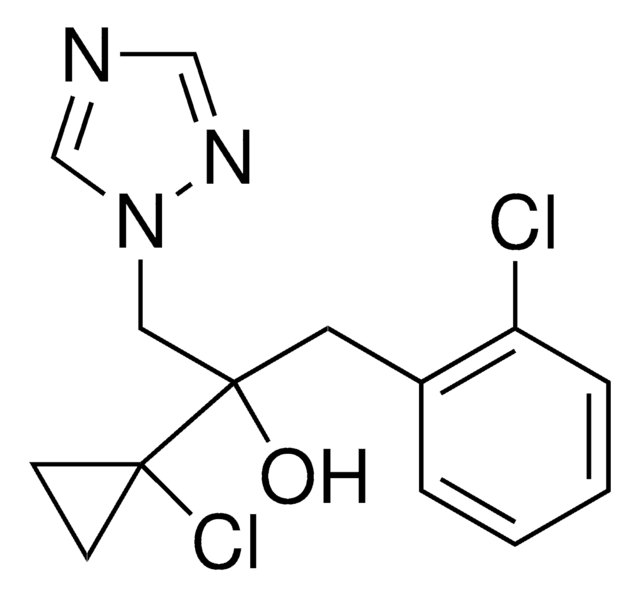
Prothioconazol

PESTANAL®, analytical standard

Synonym(e):

2-[2-(1-Chlorcyclopropyl)-3-(2-chlorphenyl)-2-hydroxypropyl]-1,2-dihydro-3H-1,2,4-triazol-3-thion

Anmelden zur Ansicht der Organisations- und Vertragspreise.

Größe auswählen

Ansicht ändern
PackungsgrößeSKUVerfügbarkeitPreis
100 mg
Warenkorb auf Verfügbarkeit prüfen
€ 269,00

Über diesen Artikel

Empirische Formel (Hill-System):
C14H15Cl2N3OS
CAS-Nummer:
Molekulargewicht:
344.26
MDL number:
UNSPSC Code:
41116107
NACRES:
NA.24

€ 269,00


Warenkorb auf Verfügbarkeit prüfen

Großbestellung anfragen
Technischer Dienst
Benötigen Sie Hilfe? Unser Team von erfahrenen Wissenschaftlern ist für Sie da.
Unterstützung erhalten


grade

analytical standard

Quality Segment

product line

PESTANAL®

shelf life

limited shelf life, expiry date on the label

technique(s)

HPLC: suitable, gas chromatography (GC): suitable

application(s)

agriculture
environmental

format

neat

SMILES string

OC(CN1N=CNC1=S)(Cc2ccccc2Cl)C3(Cl)CC3

InChI

1S/C14H15Cl2N3OS/c15-11-4-2-1-3-10(11)7-14(20,13(16)5-6-13)8-19-12(21)17-9-18-19/h1-4,9,20H,5-8H2,(H,17,18,21)

InChI key

MNHVNIJQQRJYDH-UHFFFAOYSA-N

General description

Prothioconazol ist ein Triazolinethion-Derivat, das als Fungizid zur Hemmung der Aktivität des Demethylase-Enzyms verwendet werden kann.(1) Es eignet sich zur Behandlung von Infektionen in Nutzpflanzen wie Weizen, die von Mycosphaerella graminicola, einem pflanzenpathogenen Pilz, verursacht werden.

Application

Weitere Informationen zur geeigneten Instrumententechnik finden Sie im Analysenzertifikat des Produkts′. Weitere Unterstützung erhalten Sie vom technischen Kundendienst.

Legal Information

PESTANAL is a registered trademark of Merck KGaA, Darmstadt, Germany

Ähnliche Artikel vergleichen

Vollständigen Vergleich anzeigen

Unterschiede anzeigen

1 of 1

Dieser Artikel
382733242946301
format

neat

format

-

format

neat

format

neat

technique(s)

HPLC: suitable, gas chromatography (GC): suitable

technique(s)

-

technique(s)

HPLC: suitable, gas chromatography (GC): suitable

technique(s)

HPLC: suitable, gas chromatography (GC): suitable

grade

analytical standard

grade

certified reference material, TraceCERT®

grade

analytical standard

grade

analytical standard

product line

PESTANAL®

product line

TraceCERT®

product line

PESTANAL®

product line

PESTANAL®

Quality Level

100

Quality Level

300

Quality Level

100

Quality Level

100

application(s)

agriculture
environmental

application(s)

-

application(s)

agriculture
environmental

application(s)

agriculture
environmental


Still not finding the right product?

Explore all of our products under Prothioconazol


pictograms

Environment

signalword

Warning

hcodes

Hazard Classifications

Aquatic Acute 1 - Aquatic Chronic 1

Lagerklasse

11 - Combustible Solids

wgk

WGK 2

flash_point_f

Not applicable

flash_point_c

Not applicable

ppe

Eyeshields, Gloves


Hier finden Sie alle aktuellen Versionen:

Analysenzertifikate (COA)

Lot/Batch Number

Die passende Version wird nicht angezeigt?

Wenn Sie eine bestimmte Version benötigen, können Sie anhand der Lot- oder Chargennummer nach einem spezifischen Zertifikat suchen.

Besitzen Sie dieses Produkt bereits?

In der Dokumentenbibliothek finden Sie die Dokumentation zu den Produkten, die Sie kürzlich erworben haben.

Die Dokumentenbibliothek aufrufen


Joel D A Tyndall et al.
PloS one, 11(12), e0167485-e0167485 (2016-12-03)
Azole antifungals, known as demethylase inhibitors (DMIs), target sterol 14α-demethylase (CYP51) in the ergosterol biosynthetic pathway of fungal pathogens of both plants and humans. DMIs remain the treatment of choice in crop protection against a wide range of fungal phytopathogens
Priscila Tessmer Scaglioni et al.
Journal of agricultural and food chemistry, 66(19), 4835-4841 (2018-04-28)
Fungicides and, for the first time, microalgal phenolic extracts (MPE) from Spirulina sp. and Nannochloropsis sp. were applied on maize culture media under field conditions to evaluate their ability to minimize Fusarium species development and fumonisin production. An in vitro
Carsten Albrecht Brühl et al.
Environmental science and pollution research international, 18(1), 31-37 (2010-06-15)
Seed treatments are widely used on cereals and other annual crops throughout Europe. Most of the formulated pesticide is found on the outside of the seed, the husk. Risk assessments of seed treatments are especially needed for granivorous mice living


Global Trade Item Number

SKUGTIN
34232-100MG04061826757154

Questions

Reviews

No rating value

Active Filters