Direkt zum Inhalt
Merck

OP15

Anti-c-ErbB2/c-Neu (Ab-3) Mouse mAb (3B5)

liquid, clone 3B5, Calbiochem®

Synonym(e):

Anti-HER2, Anti-c-Neu, Anti-ErbB2, Anti-Erythroblastosis Virus

Anmelden zur Ansicht der Organisations- und Vertragspreise.

Größe auswählen

100 μG

€ 517,00

€ 517,00


Warenkorb auf Verfügbarkeit prüfen

Großbestellung anfragen

Über diesen Artikel

NACRES:
NA.43
UNSPSC Code:
12352203
Clone:
3B5, monoclonal
Species reactivity:
human, mouse
Application:
Citations:
38

Fortfahren mit

Technischer Dienst
Benötigen Sie Hilfe? Unser Team von erfahrenen Wissenschaftlern ist für Sie da.
Unterstützung erhalten

biological source

mouse

antibody form

purified antibody

antibody product type

primary antibodies

clone

3B5, monoclonal

form

liquid

contains

≤0.1% sodium azide as preservative

species reactivity

human, mouse

manufacturer/tradename

Calbiochem®

storage condition

do not freeze

dilution

(Frozen Sections (2.5 µg/mL)
Immunoblotting (2-3 µg/mL,
Immunofluorescence (2.5 µg/mL)
Immunoprecipitation (1 µg/sample,
Paraffin Sections (2.5 µg/mL, pressure cooker, heat or trypsin pre-treatment required, )

isotype

IgG1

shipped in

wet ice

Quality Level

Gene Information

human ... ERBB2(2064)

storage temp.

2-8°C

target post-translational modification

unmodified

Suchen Sie nach ähnlichen Produkten? Aufrufen Leitfaden zum Produktvergleich

Ähnliche Artikel vergleichen

Vollständigen Vergleich anzeigen

Unterschiede anzeigen

1 of 4

Dieser Artikel
OP15LE5900OP20
species reactivity

human, mouse

species reactivity

mouse, human

species reactivity

human

species reactivity

mouse, human

antibody form

purified antibody

antibody form

purified antibody

antibody form

purified immunoglobulin

antibody form

purified antibody

Gene Information

human ... ERBB2(2064)

Gene Information

human ... ERBB2(2064)

Gene Information

human ... ERBB4(2066)

Gene Information

human ... ABL1(25)

biological source

mouse

biological source

mouse

biological source

mouse

biological source

mouse

clone

3B5, monoclonal

clone

3B5, monoclonal

clone

HER4-36, monoclonal

clone

24-21, monoclonal

storage temp.

2-8°C

storage temp.

2-8°C

storage temp.

−20°C

storage temp.

2-8°C

General description

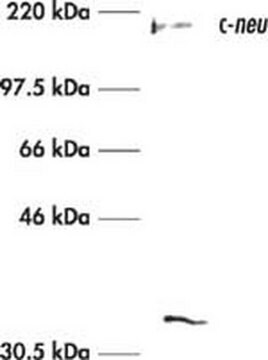
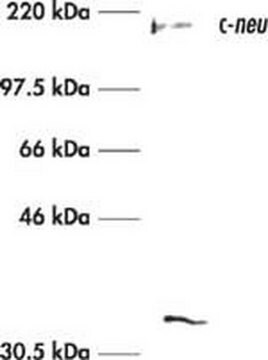
Anti-c-ErbB2/c-Neu (Ab-3), mouse monoclonal, clone 3B5, recognizes the ~185 kDa c-ErbB2/c-Neu protein in HEK293 cells. It is validated for WB, IF, IP, and IHC on frozen and paraffin sections.
Purified mouse monoclonal antibody generated by immunizing BALB/c mice with the specified immunogen and fusing splenocytes with Sp2/0.Ag14 cells (see application references). Recognizes the ~185 kDa c-Erb2/c-Neu protein.
Recognizes the ~185 kDa c-ErbB2/c-Neu protein in HEK293 cells.

Immunogen

Human
a synthetic peptide (TAENPEYLGLDVPV) corresponding to amino acids 1242-1255 from the C-terminal domain of human c-ErbB2/c-Neu

Application


Frozen Sections (2.5 g/ml)
Immunoblotting (2-3 g/ml, see application references)
Immunofluorescence (2.5 g/ml)
Immunoprecipitation (1 g/sample, see application references)
Paraffin Sections (2.5 g/ml, pressure cooker, heat or trypsin pre-treatment required, see application references)

Packaging

Please refer to vial label for lot-specific concentration.

Physical form

In 0.05 M sodium phosphate buffer, 0.2% gelatin.

Analysis Note

Negative Control
HepG2 cells or normal skin
Positive Control
SK-BR-3 cells or breast carcinoma tissue

Other Notes

For paraffin sections, we recommend pre-treating with a pressure cooker, but trypsin and heat will also work well. Including 0.05% saponin during staining of paraffin sections may help reduce background. In one study ductal carcinomas in situ displaying large-cell, comedo growth type, were stained while none of 16 ductal carcinomas in situ of small-cell, papillary, or cribriform growth type were stained by this antibody. Antibody should be titrated for optimal results in individual systems.
Mamcs, J.R., et al. 1994. Ann. Surg.219, 332.
Tetu, B., et al. 1994. Cancer73, 2359.
DiFiore, P.P., et al. 1987. Science237, 178.
Slamon, D.J., et al. 1987. Science235, 177.
Varley, J.M., et al. 1987. Oncogene1, 423.
Bargmann, C.I., et al. 1986. Nature319, 226.
Yamamoto, T., et al. 1986. Nature319, 230.
Blick, M., et al. 1984. Blood64, 1234.
Schwab, M., et al. 1984. Cold Spring Harbor Laboratory 2, 215.

Legal Information

CALBIOCHEM is a registered trademark of Merck KGaA, Darmstadt, Germany

Disclaimer

Toxicity: Standard Handling (A)

Sie haben nicht das passende Produkt gefunden?  

Probieren Sie unser Produkt-Auswahlhilfe. aus.

Lagerklasse

10 - Combustible liquids

wgk

nwg

flash_point_f

Not applicable

flash_point_c

Not applicable


Analysenzertifikate (COA)

Suchen Sie nach Analysenzertifikate (COA), indem Sie die Lot-/Chargennummer des Produkts eingeben. Lot- und Chargennummern sind auf dem Produktetikett hinter den Wörtern ‘Lot’ oder ‘Batch’ (Lot oder Charge) zu finden.

Besitzen Sie dieses Produkt bereits?

In der Dokumentenbibliothek finden Sie die Dokumentation zu den Produkten, die Sie kürzlich erworben haben.

Die Dokumentenbibliothek aufrufen

Peter Nagy et al.
Journal of cell science, 115(Pt 22), 4251-4262 (2002-10-12)
The ErbB family of transmembrane receptor tyrosine kinases plays an important role in the pathogenesis of many cancers. The four members of the family, ErbB1-4, form various homo- and heterodimers during the course of signal transduction. A second hierarchical level
Zongming Liu et al.
Scientific reports, 9(1), 622-622 (2019-01-27)
Breast cancer brain metastasis (BCBM) remains a major clinical problem. Approximately 10-16% of patients with breast cancer develop brain metastases (BCBM). However, no systemic therapy has gained regulatory approval for the specific treatment of BCBM and this remains an area
Edwin W Lai et al.
Cell cycle (Georgetown, Tex.), 6(15), 1946-1950 (2007-08-03)
Pheochromocytoma (PCC) is a rare catecholamine-producing tumor that arises from the adrenal medulla and is often familial. The genetic basis for familial PCC involves mutations of RET, VHL, SHDx or NF-1 in more than 20% of cases. Additional genes may
Henriette O'Geen et al.
Epigenetics & chromatin, 12(1), 26-26 (2019-05-06)
Rewriting of the epigenome has risen as a promising alternative to gene editing for precision medicine. In nature, epigenetic silencing can result in complete attenuation of target gene expression over multiple mitotic divisions. However, persistent repression has been difficult to
Silvio Bandini et al.
Oncoimmunology, 2(9), e26137-e26137 (2013-11-15)
Aside from its classical role in fighting infections, complement is an important, although poorly understood, component of the tumor microenvironment. In particular, the tumor growth-regulatory activities of complement remain under debate. To assess the role of the complement system in

Questions

Reviews

No rating value

Active Filters

Unser Team von Wissenschaftlern verfügt über Erfahrung in allen Forschungsbereichen einschließlich Life Science, Materialwissenschaften, chemischer Synthese, Chromatographie, Analytik und vielen mehr..

Setzen Sie sich mit dem technischen Dienst in Verbindung