Direkt zum Inhalt
Merck

OP09

Anti-p53 (Ab-2) (Pantropic) Mouse mAb (PAb1801)

liquid, clone PAb1801, Calbiochem®

Anmelden zur Ansicht der Organisations- und Vertragspreise.

Größe auswählen

100 μG

€ 424,00

200 μG

€ 529,00

€ 424,00


Warenkorb auf Verfügbarkeit prüfen

Großbestellung anfragen

Über diesen Artikel

NACRES:
NA.43
UNSPSC Code:
12352203
Clone:
PAb1801, monoclonal
Species reactivity:
human
Application:
Citations:
20

Fortfahren mit

Technischer Dienst
Benötigen Sie Hilfe? Unser Team von erfahrenen Wissenschaftlern ist für Sie da.
Unterstützung erhalten

biological source

mouse

antibody form

purified antibody

antibody product type

primary antibodies

clone

PAb1801, monoclonal

form

liquid

contains

≤0.1% sodium azide as preservative

species reactivity

human

should not react with

mouse, rat

manufacturer/tradename

Calbiochem®

storage condition

do not freeze

dilution

(Frozen Sections (5 µg/mL)
Gel Shift
Immunoblotting (2.5 µg/mL)
Immunoprecipitation (1 µg/sample)
Paraffin Sections (5 µg/mL, pepsin, trypsin, or heat pre-treatment required))

isotype

IgG1

shipped in

wet ice

Quality Level

Gene Information

human ... TP53(7157)

storage temp.

2-8°C

target post-translational modification

unmodified

Verwandte Kategorien

Ähnliche Artikel vergleichen

Vollständigen Vergleich anzeigen

Unterschiede anzeigen

1 of 4

Dieser Artikel
OP03OP140OP29
biological source

mouse

biological source

mouse

biological source

mouse

biological source

mouse

clone

PAb1801, monoclonal

clone

PAb421, monoclonal

clone

DO-7, monoclonal

clone

PAb240, monoclonal

Gene Information

human ... TP53(7157)

Gene Information

human ... TP53(7157)

Gene Information

human ... TP53(7157)

Gene Information

human ... TP53(7157)

species reactivity

human

species reactivity

rabbit, monkey, human, mouse, rat

species reactivity

bovine, monkey, human

species reactivity

mouse, rat, human, chicken, hamster, bovine

antibody form

purified antibody

antibody form

purified antibody

antibody form

purified antibody

antibody form

purified antibody

isotype

IgG1

isotype

IgG2a

isotype

IgG2b

isotype

IgG1

General description

Purified mouse monoclonal antibody generated by immunizing BALB/c mice with the specified immunogen and fusing splenocytes with SP2/0 Ag14 mouse myeloma cells (see application references). Recognizes the ~53 kDa mutant and wild-type forms of p53.
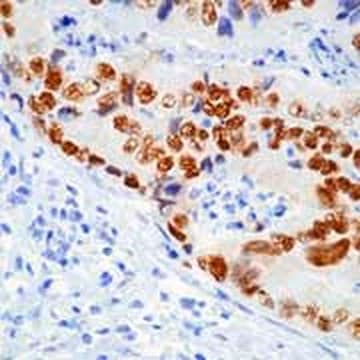
Recognizes the ~53 kDa wild-type and mutant p53 protein in A-431 cells and breast carcinoma tissue.
This Anti-p53 (Ab-2) (Pantropic) Mouse mAb (PAb1801) is validated for use in Frozen Sections, Gel Shift, Immunoblotting, IP, Paraffin Sections for the detection of p53 (Ab-2) (Pantropic).

Immunogen

Epitope: within amino acids 46-55 of human p53
Human
a human p53 fusion protein

Application

Frozen Sections (5 µg/ml)

Gel Shift (see comments)

Immunoblotting (2.5 µg/ml)

Immunoprecipitation (1 µg/sample)

Paraffin Sections (5 µg/ml, pepsin, trypsin, or heat pre-treatment required)

Packaging

Please refer to vial label for lot-specific concentration.

Physical form

In 50 mM sodium phosphate buffer, 0.2% gelatin, pH 7.5.

Analysis Note

Negative Control
SK-OV-3 cells or normal skin
Positive Control
A431 cells or breast carcinoma tissue

Other Notes

El-Deiry, W.S., et al. 1994. Cancer Res.54, 1169.
Greenblatt, M.S., et al. 1994. Cancer Res.54, 4855.
Barak, Y., et al. 1993. EMBO J.12, 461.
Kastan, M.B., et al. 1992. Cell71, 587.
Kuerbitz, S.J. 1992. Proc. Natl. Acad. Sci. USA89, 7491.
Lane, D.P. 1992. Nature358, 15.
Kastan, M.B., et al. 1991. Cancer Res.51, 6304.
Wild-type p53 has a short half-life and is present in low amounts in cells. For immunoprecipitation, increasing the amount of sample to be immunoprecipitated and applied to the gel may help visualize wild-type p53; short incubation times with 35S-Met (≤ 1 h) will help reduce background. For immunoblots of wild-type p53, maximize sensitivity by preconcentrating samples by immunoprecipitation with Cat. No. OP09, then immunoblot using Cat. No. PC35 and chemiluminescent detection. For a gel shift assay, use Cat. No. OP09L and resuspend in 100 µl buffer. Antibody should be titrated for optimal results in individual systems.

Legal Information

CALBIOCHEM is a registered trademark of Merck KGaA, Darmstadt, Germany

Disclaimer

Toxicity: Standard Handling (A)

Sie haben nicht das passende Produkt gefunden?  

Probieren Sie unser Produkt-Auswahlhilfe. aus.

Lagerklasse

10 - Combustible liquids

wgk

nwg

flash_point_f

Not applicable

flash_point_c

Not applicable


Analysenzertifikate (COA)

Suchen Sie nach Analysenzertifikate (COA), indem Sie die Lot-/Chargennummer des Produkts eingeben. Lot- und Chargennummern sind auf dem Produktetikett hinter den Wörtern ‘Lot’ oder ‘Batch’ (Lot oder Charge) zu finden.

Besitzen Sie dieses Produkt bereits?

In der Dokumentenbibliothek finden Sie die Dokumentation zu den Produkten, die Sie kürzlich erworben haben.

Die Dokumentenbibliothek aufrufen

Shou-Ching Tang et al.
Breast cancer research and treatment, 84(3), 203-213 (2004-03-18)
BAG-1, a recently identified anti-apoptotic protein, is overexpressed in the majority of invasive breast carcinomas. Overexpression of BAG-1 is important for both multi-step oncogenesis and resistance of cancer cells to apoptosis induced by DNA-damaging alkylating agents. BAG-1 protein species are
N Shinoura et al.
British journal of cancer, 86(4), 587-595 (2002-03-01)
Mutation of the p53 gene plays a critical role in the development of cancer and response to cancer therapy. To analyze the mechanism of cancer development and to improve cancer therapy, it is important to assess which genes are downstream
Timothy Budden et al.
Oncotarget, 7(38), 60940-60953 (2016-08-04)
UVB exposure leads to DNA damage, which when unrepaired induces C>T transitions. These mutations are found throughout the melanoma genome, particularly in non-transcribed regions. The global genome repair (GGR) branch of nucleotide excision repair (NER) is responsible for repairing UV-induced
Giovanna Ferrari-Amorotti et al.
Cancer research, 73(1), 235-245 (2012-10-12)
The process of epithelial-mesenchymal transition (EMT) which is required for cancer cell invasion is regulated by a family of E-box-binding transcription repressors, which include Snail (SNAIL1) and Slug (SNAI2). Snail appears to repress the expression of the EMT marker E-cadherin
James G Jackson et al.
Cancer cell, 21(6), 793-806 (2012-06-16)
Studies on the role of TP53 mutation in breast cancer response to chemotherapy are conflicting. Here, we show that, contrary to dogma, MMTV-Wnt1 mammary tumors with mutant p53 exhibited a superior clinical response compared to tumors with wild-type p53. Doxorubicin-treated

Questions

Reviews

No rating value

Active Filters

Unser Team von Wissenschaftlern verfügt über Erfahrung in allen Forschungsbereichen einschließlich Life Science, Materialwissenschaften, chemischer Synthese, Chromatographie, Analytik und vielen mehr..

Setzen Sie sich mit dem technischen Dienst in Verbindung