
MABE263-S

Anti- Histone H3c1 Antibody
mouse monoclonal, 9B1-2G6
Synonym(e):
Histone H3.1
Über diesen Artikel
Fortfahren mit
Produktname
Anti-unmethylated-Histone H3 (Lys9) Antibody, clone 9B1-2G6, Trial Size, clone 9B1-2G6, from mouse
biological source
mouse
antibody form
purified immunoglobulin
antibody product type
primary antibodies
clone
9B1-2G6, monoclonal
species reactivity
human
technique(s)
dot blot: suitable, western blot: suitable
isotype
IgG1κ
NCBI accession no.
UniProt accession no.
shipped in
wet ice
Quality Level
Gene Information
human ... H3C1(8350)
Suchen Sie nach ähnlichen Produkten? Aufrufen Leitfaden zum Produktvergleich
1 of 4
Dieser Artikel | ABE435-S | 04-790-S | ABE250-S |
|---|---|---|---|
| antibody form purified immunoglobulin | antibody form affinity isolated antibody | antibody form culture supernatant | antibody form affinity isolated antibody |
| biological source mouse | biological source rabbit | biological source rabbit | biological source rabbit |
| Gene Information human ... H3C1(8350) | Gene Information human ... HIST1H3F(8968) | Gene Information human ... H3C1(8350) | Gene Information human ... HIST1H3F(8968) |
| species reactivity human | species reactivity mouse, human | species reactivity human, chicken | species reactivity rat, chicken, human, mouse |
| clone 9B1-2G6, monoclonal | clone polyclonal | clone AW30, monoclonal | clone polyclonal |
| Quality Level 100 | Quality Level 100 | Quality Level 100 | Quality Level 100 |
General description
Immunogen
Application
Epigenetics & Nuclear Function
Histones
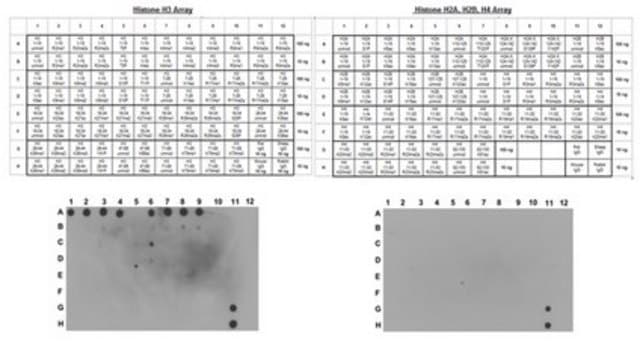
Dot Blot Analysis: Absurance Histone H3 Antibody Specificity Array (Cat. No. 16-667) and Absurance Histone H2A, H2B, H4 Antibody Specificity Array (Cat. No. 16-665), which contain histone peptides with various modifications were probed with Cat. No MABE263-S, unmethylated-Histone H3 (Lys9), clone 9B1-2G6 at 0.5 µg/mL (1:2,000) dilution. Proteins were visualized using a Donkey anti-rabbit IgG conjugated to HRP and a chemiluminescence detection system.
Dot Blot (Specificity) Analysis: A representative lot detected non-methylated Histone H3 (Lys9) in Dot Blot. This antibody detects non-methylated Histone H3 (Lys9) when Ser10 is phosphorylated. It also detects mono-/di-methyl-Histone H3(Lys4), and Acetyl-Histone H3 (Lys14). (Prof. E. Ogris, Department of Medical Biochemistry, Medical University of Vienna).
Biochem/physiol Actions
Physical form
Preparation Note
Analysis Note
Recombinant Histone H3
Western Blot Analysis: 0.5 µg/mL of this antibody detected unmethylated Histone H3 (Lys9) in 10 µg of recombinant Histone H3.
Other Notes
Disclaimer
Sie haben nicht das passende Produkt gefunden?
Probieren Sie unser Produkt-Auswahlhilfe. aus.
Lagerklasse
12 - Non Combustible Liquids
wgk
WGK 1
flash_point_f
Not applicable
flash_point_c
Not applicable
Analysenzertifikate (COA)
Suchen Sie nach Analysenzertifikate (COA), indem Sie die Lot-/Chargennummer des Produkts eingeben. Lot- und Chargennummern sind auf dem Produktetikett hinter den Wörtern ‘Lot’ oder ‘Batch’ (Lot oder Charge) zu finden.
Besitzen Sie dieses Produkt bereits?
In der Dokumentenbibliothek finden Sie die Dokumentation zu den Produkten, die Sie kürzlich erworben haben.
Active Filters
Unser Team von Wissenschaftlern verfügt über Erfahrung in allen Forschungsbereichen einschließlich Life Science, Materialwissenschaften, chemischer Synthese, Chromatographie, Analytik und vielen mehr..
Setzen Sie sich mit dem technischen Dienst in Verbindung