Direkt zum Inhalt
Merck

Fortfahren mit

MABE1152M

Anti-Cryptochrome-1 Antibody, clone D46-3361

clone D46-3361, from rat

Synonym(e):

Cry1, cryptochrome 1 (photolyase-like), Cryptochrome-1, Phll1, Cry-1

Anmelden zur Ansicht der Organisations- und Vertragspreise.

Über diesen Artikel

UNSPSC Code:
12352203
NACRES:
NA.41
eCl@ss:
32160702
Conjugate:
unconjugated
Clone:
D46-3361, monoclonal
Application:
ChIP, WB
Citations:
-


biological source

rat

Quality Segment

conjugate

unconjugated

antibody form

purified immunoglobulin

antibody product type

primary antibodies

clone

D46-3361, monoclonal

species reactivity

mouse

packaging

antibody small pack of 25 μL

technique(s)

ChIP: suitable, western blot: suitable

isotype

IgMκ

NCBI accession no.

UniProt accession no.

target post-translational modification

unmodified

Gene Information

mouse ... Cry1(12952)

General description

Cryptochrome-1 (UniProt: P97784) is encoded by the Cry1 gene (Gene ID: 12952) in murine species. Cryptochrome-1 is an evolutionarily conserved member of the flavoprotein superfamily that acts as a transcriptional repressor and forms a core component of the circadian clock. It has a photolyase domain at its N-terminal (aa 3-132). Cryptochrome-1 has three FAD biding sites (aa 252, 289, and 355). However, only a minority of the protein molecules contain bound FAD. Transcription and translation of core clock components (CLOCK, NPAS2, ARNTL/BMAL1, ARNTL2/BMAL2, PER1, PER2, PER3, CRY1 and CRY2) play a critical role in rhythm generation, whereas delays imposed by post-translational modifications (PTMs) are important for determining the period (tau) of the rhythms. Disruptions in the circadian rhythms contribute to the pathology of cardiovascular diseases, cancer, metabolic syndrome, and aging. Crytopchrome-1 translocates to the nucleus through interaction with other clock proteins such as PER2 or ARNTL/BMAL1. The core clock genes: PER1/2/3 and CRY1/2, which are transcriptional repressors form the negative limb of the feedback loop and interact with the CLOCK|NPAS2-ARNTL/BMAL1|ARNTL2/BMAL2 heterodimer inhibiting its activity and thereby negatively regulating their own expression. Transcription factors, CLOCK or NPAS2 and ARNTL/BMAL1 or ARNTL2/BMAL2, form the positive limb of the feedback loop and act in the form of a heterodimer and activate the transcription of core clock genes and clock-controlled genes. It has been suggested that cryptochrome may act as a molecular gatekeeper to maintain CLOCK-ARNTL/BMAL1 in a poised and repressed state until the proper time for transcriptional activation. Animals with defective cryptochrome-1 display disruption in their glucose homeostasis with elevated blood glucose in response to acute feeding after an overnight fast and severely impaired glucose clearance in a glucose tolerance test.
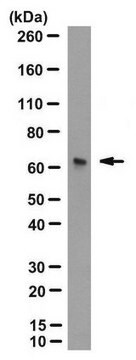
~68 kDa observed; 68.0 kDa calculated. Uncharacterized bands may be observed in some lysate(s).

Immunogen

KLH-conjugated linear peptide corresponding to 20 amino acids from the C-terminal region of murine Cryptochrome-1.

Application

Anti-Cryptochrome-1, clone D46-3361 Antibody, Cat. No. MABE1152, is a highly specific rat monoclonal antibody that targets Cryptochrome-1 and has been tested for use in Chromatin Immunoprecipitation (ChIP) and Western Blotting.
Western Blotting Analysis: A representative lot detected Cryptochrome-1 in Western Blotting applications (Partch, C.L., et. al. (2006). Proc Natl Acad Sci USA. 103(27):10467-72; Ye, R., et. al. (2011). J Biol Chem. 286(29):25891-902; Ozturk, N., et. al. (2009). Proc Natl Acad Sci USA. 106(8):2841-6; Chiou, Y.Y., et. al. (2016). Proc Natl Acad Sci USA. 113(41):E6072-E6079).

Chromatin Immunoprecipitation (ChIP) Analysis: A representative lot detected Cryptochrome-1 in Chromatin Immunoprecipitation applications (Ye, R., et. al. (2011). J Biol Chem. 286(29):25891-902).

Biochem/physiol Actions

Clone D46-3361 is a rat monoclonal antibody that specifically detects Cryptochrome-1 in murine species. it targets an epitope within 20 amino acids from the C-terminal region.

Physical form

Format: Purified
Purified rat monoclonal antibody IgM in PBS with 0.05% sodium azide.

Analysis Note

Evaluated by Western Blotting in NIH/3T3 cell lysate.

Western Blotting Analysis: A 1:500 dilution of this antibody detected Cryptochrome-1 in 10 µg of NIH/3T3 cell lysate.

Other Notes

Concentration: Please refer to lot specific datasheet.

Ähnliche Artikel vergleichen

Vollständigen Vergleich anzeigen

Unterschiede anzeigen

1 of 1

Dieser Artikel
SAB4300613ZRB1413HPA037577
description

clone D46-3361, from rat

description

affinity isolated antibody

description

recombinant, expressed in HEK 293 cells

description

Prestige Antibodies® Powered by Atlas Antibodies, affinity isolated antibody, buffered aqueous glycerol solution

antibody form

purified immunoglobulin

antibody form

affinity isolated antibody

antibody form

purified antibody

antibody form

affinity isolated antibody

biological source

rat

biological source

rabbit

biological source

rabbit

biological source

rabbit

clone

D46-3361, monoclonal

clone

polyclonal

clone

recombinant monoclonal

clone

polyclonal

Gene Information

mouse ... Cry1(12952)

Gene Information

mouse ... Cry1(12952)

Gene Information

human ... CRY1(1407)

Gene Information

human ... CRY2(1408)

conjugate

unconjugated

conjugate

unconjugated

conjugate

unconjugated

conjugate

unconjugated

species reactivity

mouse

species reactivity

mouse

species reactivity

human

species reactivity

human


Still not finding the right product?

Probieren Sie unser Produkt-Auswahlhilfe, um Ihre Auswahl einzugrenzen


Lagerklasse

10 - Combustible liquids

Was ist los?

WGK 2


Hier finden Sie alle aktuellen Versionen:

Analysenzertifikate (COA)

Lot/Batch Number

It looks like we've run into a problem, but you can still download Certificates of Analysis from our Dokumente section.

Wenn Sie Hilfe benötigen, wenden Sie sich bitte an Kundensupport

Besitzen Sie dieses Produkt bereits?

In der Dokumentenbibliothek finden Sie die Dokumentation zu den Produkten, die Sie kürzlich erworben haben.

Die Dokumentenbibliothek aufrufen


Questions

Reviews

No rating value

Active Filters