
17-650

ChIPAb+ Ubiquityl-Histone H2B - ChIP Validated Antibody and Primer Set
clone 56, from mouse, purified by using protein G
Synonym(e):
H2BUb, Histone H2B (ubiquityl), H2B histone family, member L, H2B.1 A, histone 1, H2bc, histone cluster 1, H2bc
Über diesen Artikel
Fortfahren mit
biological source
mouse
Quality Level
clone
56, monoclonal
purified by
using protein G
species reactivity
mouse, rat, vertebrates, human, plant
manufacturer/tradename
ChIPAb+, Upstate®
technique(s)
ChIP: suitable, immunofluorescence: suitable, immunoprecipitation (IP): suitable, western blot: suitable
isotype
IgG2aκ
NCBI accession no.
UniProt accession no.
shipped in
dry ice
1 of 4
Dieser Artikel | |||
|---|---|---|---|
| biological source mouse | biological source rabbit | biological source mouse | biological source rabbit |
| clone 56, monoclonal | clone polyclonal | clone CMA301, monoclonal | clone polyclonal |
| species reactivity mouse, rat, vertebrates, human, plant | species reactivity yeast, chicken, Saccharomyces cerevisiae, Xenopus, human | species reactivity human, vertebrates | species reactivity human, vertebrates, plant |
| UniProt accession no. | UniProt accession no. | UniProt accession no. | UniProt accession no. |
| shipped in dry ice | shipped in dry ice | shipped in dry ice | shipped in dry ice |
| technique(s) ChIP: suitable, immunoprecipitation (IP): suitable, immunofluorescence: suitable, western blot: suitable | technique(s) ChIP: suitable, immunoprecipitation (IP): suitable, western blot: suitable | technique(s) ChIP: suitable, western blot: suitable | technique(s) ChIP: suitable, western blot: suitable |


General description
The ChIPAb+ Ubiquityl-Histone H2B, (clone 56) set includes the Ubiquityl-Histone H2B, (clone 56) antibody, a negative control antibody (purified Mouse IgG), and qPCR primers which amplify a 213 bp region within the coding region of the human GAPDH gene.
The ubiquityl-Histone H2B and negative control antibodies are supplied in a scalable "per ChIP" reaction size and can be used to functionally validate the precipitation of Ubiquityl-Histone H2B associated chromatin.
Immunogen
Application
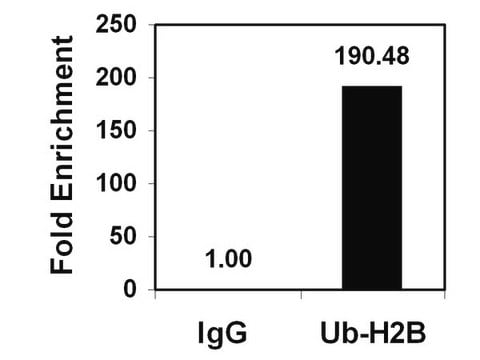
Sonicated chromatin prepared from HeLa S3 cells (1 X 10⁶ cell equivalents per IP) was subjected to chromatin immunoprecipitation using 1 μg of either a normal mouse IgG or Anti-Ubiquityl-Histone H2B antibody and the Magna ChIP G Kit (Cat. # 17-611).
Successful immunoprecipitation of ubiquityl-Histone H2B associated DNA fragments was verified by qPCR using GAPDH promoter (negative) and GAPDH coding (positive) Primers (Please see figures). Data is presented as percent input of each IP sample relative to input chromatin for each amplicon and ChIP sample as indicated.
Please refer to the EZ-Magna G ChIP (Cat. # 17-409) or EZ-ChIP (Cat. # 17-371) protocol for experimental details.
Western Blot Analysis:
HeLa cell lysate was resolved by electrophoresis, transferred to PVDF and probed with anti-Ubiquityl-histone H2B at a dilution of 1:4000 (Please see figures).
Epigenetics & Nuclear Function
Chromatin Biology
Histones
Biochem/physiol Actions
Packaging
Physical form
Normal Mouse IgG. One vial containing 25 μg purified mouse IgG in 25 μL storage buffer containing 0.1% sodium azide. Store at -20°C.
ChIP Primers GAPDH Coding Region. One vial containing 75 μL of 5 μM of each primer specific for the coding region of human GAPDH. Store at -20°C.
FOR: GGC TCC CAC CTT TCT CAT CC
REV: GGC CAT CCA CAG TCT TCT GG
Preparation Note
Analysis Note
Sonicated chromatin prepared from HeLa S3 cells (1X 10⁶ cell equivalents per IP) were subjected to chromatin immuno-precipitation using 1 µg of either a normal mouse IgG or Anti-ubiquityl-Histone H2B, clone 56 antibody and the Magna ChIP® G Kit (Cat. # 17-611). Successful immunoprecipitation of ubiquityl-Histone H2B-associated DNA fragments was verified by qPCR using Control Primers.
Please refer to the EZ-Magna ChIP G (Cat. # 17-409) or EZ-ChIP (Cat. # 17-371) protocol for experimental details.
Includes negative control mouse IgG antibody and primers specific for human GAPDH coding region.
Legal Information
Disclaimer
Lagerklasse
10 - Combustible liquids
wgk
WGK 2
Analysenzertifikate (COA)
Suchen Sie nach Analysenzertifikate (COA), indem Sie die Lot-/Chargennummer des Produkts eingeben. Lot- und Chargennummern sind auf dem Produktetikett hinter den Wörtern ‘Lot’ oder ‘Batch’ (Lot oder Charge) zu finden.
Besitzen Sie dieses Produkt bereits?
In der Dokumentenbibliothek finden Sie die Dokumentation zu den Produkten, die Sie kürzlich erworben haben.
Global Trade Item Number
| SKU | GTIN |
|---|---|
| 17-650 | 04053252321535 |
Active Filters
Unser Team von Wissenschaftlern verfügt über Erfahrung in allen Forschungsbereichen einschließlich Life Science, Materialwissenschaften, chemischer Synthese, Chromatographie, Analytik und vielen mehr..
Setzen Sie sich mit dem technischen Dienst in Verbindung