
Fortfahren mit
936014

Sodium bis(trifluoromethanesulfonyl)imide solution
in ethylene carbonate, dimethylcarbonate, and ethylmethylcarbonate, 1.0 M NaTFSI in EC/DMC/EMC=1:1:1 (v/v/v), battery grade
Nachhaltigkeitsmerkmale
Synonym(e):
1.0 M NaTFSI in EC/DMC/EMC electrolyte
Größe auswählen
| Größe/SKU | Verfügbarkeit | Preis |
|---|
Über diesen Artikel
grade
battery grade
Quality Segment
form
solution
sustainability
Sustainability features
concentration
0.95-1.10 M (NaPF6)
impurities
≤100 ppm H2O
application(s)
battery manufacturing
General description
Application
1 of 1
Dieser Artikel | |||
|---|---|---|---|
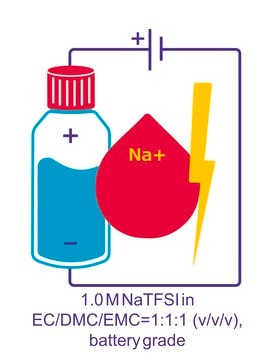
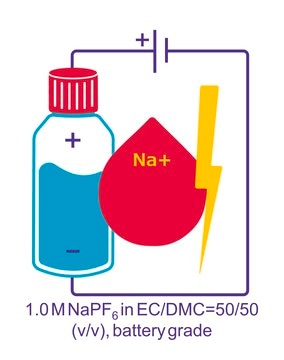
| description in ethylene carbonate, dimethylcarbonate, and ethylmethylcarbonate, 1.0 M NaTFSI in EC/DMC/EMC=1:1:1 (v/v/v), battery grade | description in ethylene carbonate, dimethyl carbonate, 1.0 M NaTFSI in EC/DMC=50/50 (v/v), battery grade | description in ethylene carbonate and dimethylcarbonate, 1.0 M NaPF6 in EC/DMC=50/50 (v/v), battery grade | description in ethylene carbonate and diethylcarbonate, 1.0 M NaPF6 in EC/DEC=50/50 (v/v), battery grade |
| Quality Level 100 | Quality Level 100 | Quality Level 100 | Quality Level 100 |
| grade battery grade | grade battery grade | grade battery grade | grade battery grade |
| form solution | form solution | form solution | form solution |
| application(s) battery manufacturing | application(s) battery manufacturing | application(s) battery manufacturing | application(s) battery manufacturing |
| impurities ≤100 ppm H2O | impurities ≤100 ppm H2O | impurities ≤100.0 ppm H2O , ≤100 ppm Acid | impurities ≤100 ppm Acid, ≤100.0 ppm H2O |
| sustainability Sustainability features | sustainability Sustainability features | sustainability Sustainability features | sustainability Sustainability features |


Still not finding the right product?
Explore all of our products under Sodium bis(trifluoromethanesulfonyl)imide solution
Signalwort
Danger
Zielorgane
Kidney
WGK
WGK 3
Flammpunkt (°F)
60.8 °F - closed cup
Flammpunkt (°C)
16 °C - closed cup


Gefahrencodes
Sicherheitshinweise
Hazard Classifications
Eye Dam. 1 - Flam. Liq. 2 - Skin Corr. 1B - STOT RE 2 Oral
Lagerklasse
3 - Flammable liquids
Hier finden Sie alle aktuellen Versionen:
Besitzen Sie dieses Produkt bereits?
In der Dokumentenbibliothek finden Sie die Dokumentation zu den Produkten, die Sie kürzlich erworben haben.