
915580

Bioactive glass
powder, S53P4, ≥98%, 50-250 μm particle size
Synonym(e):
Bioglass ceramics, Silica glass
Anmelden zur Ansicht der Organisations- und Vertragspreise.
Über diesen Artikel
Lineare Formel:
CaO:SiO2:P2O5
NACRES:
NA.23
UNSPSC Code:
12352103
Fortfahren mit
Technischer Dienst
Benötigen Sie Hilfe? Unser Team von erfahrenen Wissenschaftlern ist für Sie da.
Unterstützung erhaltenSuchen Sie nach ähnlichen Produkten? Aufrufen Leitfaden zum Produktvergleich
Verwandte Kategorien
1 of 4
Dieser Artikel | |||
|---|---|---|---|
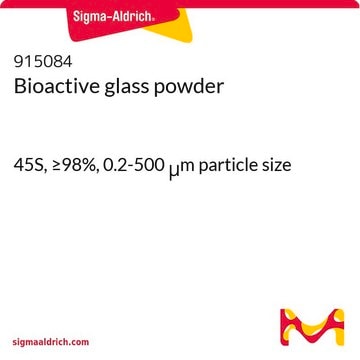
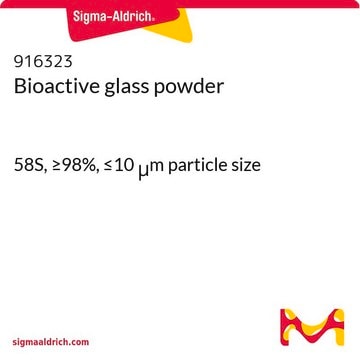
| particle size 50-250 μm | particle size 50-250 μm | particle size 0.2-500 μm | particle size ≤10 μm |
| form powder | form powder | form powder | form powder |
| assay ≥98% | assay ≥98% | assay ≥98% | assay ≥98% |
| Quality Level 100 | Quality Level 100 | Quality Level 100 | Quality Level 100 |

Application
Bioactive glass is able to form a hydroxyapatite-like surface layer thus providing a stable bond to bone cells. In addition, bioactive glass has been shown to stimulate bone cells regeneration. Due to its biocompatability and osteogenic capacity applications include tissue engineering, enamel reconstruction, bio-coatings, and high temperature adhesives.[1][2] Furthermore, S53P4 has displayed antimicrobial activity.[3]


signalword
Danger
hcodes
Hazard Classifications
Eye Dam. 1 - Skin Corr. 1B - STOT RE 2 Inhalation - STOT SE 3
target_organs
Lungs, Respiratory system
Lagerklasse
8A - Combustible corrosive hazardous materials
wgk
WGK 3
Hier finden Sie alle aktuellen Versionen:
Besitzen Sie dieses Produkt bereits?
In der Dokumentenbibliothek finden Sie die Dokumentation zu den Produkten, die Sie kürzlich erworben haben.
Lorenzo Drago et al.
Materials (Basel, Switzerland), 11(2) (2018-03-03)
Bone defects caused by trauma or pathological events are major clinical and socioeconomic burdens. Thus, the efforts of regenerative medicine have been focused on the development of non-biodegradable materials resembling bone features. Consequently, the use of bioactive glass as a
Francesco Baino et al.
Journal of functional biomaterials, 9(1) (2018-03-23)
Bioactive glasses caused a revolution in healthcare and paved the way for modern biomaterial-driven regenerative medicine. The first 45S5 glass composition, invented by Larry Hench fifty years ago, was able to bond to living bone and to stimulate osteogenesis through
Julian R Jones
Acta biomaterialia, 9(1), 4457-4486 (2012-08-28)
Bioactive glasses are reported to be able to stimulate more bone regeneration than other bioactive ceramics but they lag behind other bioactive ceramics in terms of commercial success. Bioactive glass has not yet reached its potential but research activity is
Unser Team von Wissenschaftlern verfügt über Erfahrung in allen Forschungsbereichen einschließlich Life Science, Materialwissenschaften, chemischer Synthese, Chromatographie, Analytik und vielen mehr..
Setzen Sie sich mit dem technischen Dienst in Verbindung