
G3512

Glycerol Dehydrogenase from Cellulomonas sp.
lyophilized powder, ≥50 units/mg protein
Synonym(s):
Glycerol:NAD+ 2-oxidoreductase
Sign In to View Organizational & Contract Pricing.
Select a Size
Change View
| Size/SKU | Availability | Price |
|---|
About This Item
UNSPSC Code:
12352204
NACRES:
NA.54
EC Number:
232-824-3
MDL number:
Specific activity:
≥50 units/mg protein
Biological source:
bacterial (Cellulomonas spp.)
Pricing and availability is not currently available.
biological source
bacterial (Cellulomonas spp.)
Quality Segment
form
lyophilized powder
specific activity
≥50 units/mg protein
mol wt
~390 kDa
composition
Protein, ≥60% biuret
storage temp.
−20°C
General description
Glycerol Dehydrogenase belongs to iron-containing alcohol dehydrogenase family. It is made up of eight identical subunits which are about 42,000 Da each. The C-terminal has histidine and the N-terminal has serine amino acid.
Isoelectric point : 4.4 ± 0.1
Michaelis constants : 1.1 x 10¯2M (Glycerol), 8.9 x 10¯5M (NAD+)
Structure : 10 subunits (42,000) per mol of enzyme
Inhibitors : p-Chloromercuribenzoate, o-phenanthroline, monoiodoacetate, heavy metal
ions (Co++, Ni++, Cu++, Zn++, Cd++)
Optimum pH : 10.0 – 10.5
Optimum temperature : 50°C
pH Stability : pH 7.5 – 10.5 (25°C, 20hr)
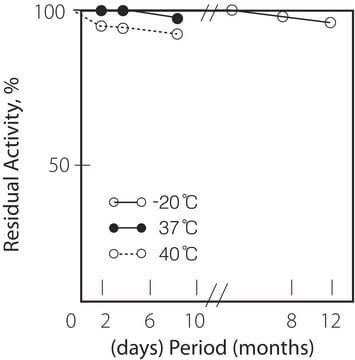
Thermal stability : below 55°C (pH 7.5, 15min)
Substrate specificity : This enzyme has the highest specificity for glycerol and 1,2-propanediol, and also oxidizes glycerol-α-monochlorohydrin, ethylene
glycol and 2,3-butanediol. The oxidative reaction is stimulated by K+, NH+4 and Rb+.
Michaelis constants : 1.1 x 10¯2M (Glycerol), 8.9 x 10¯5M (NAD+)
Structure : 10 subunits (42,000) per mol of enzyme
Inhibitors : p-Chloromercuribenzoate, o-phenanthroline, monoiodoacetate, heavy metal
ions (Co++, Ni++, Cu++, Zn++, Cd++)
Optimum pH : 10.0 – 10.5
Optimum temperature : 50°C
pH Stability : pH 7.5 – 10.5 (25°C, 20hr)
Thermal stability : below 55°C (pH 7.5, 15min)
Substrate specificity : This enzyme has the highest specificity for glycerol and 1,2-propanediol, and also oxidizes glycerol-α-monochlorohydrin, ethylene
glycol and 2,3-butanediol. The oxidative reaction is stimulated by K+, NH+4 and Rb+.
Application
Glycerol Dehydrogenase (GDH) from Cellulomonas sp. has been used in the determination of glycerol by sequential injection analysis (SIA) method. It has also been used in the preparation of pyrroloquinoline quinone (PQQ) based biosensor for the determination of glycerol.
This enzyme is useful for enzymatic determination of glycerol and of triglyceride when coupled with lipoprotein lipase in clinical analysis. Formation of NADH from the reaction of glycerol and NAD+ was catalyzed by the enzyme glycerol dehydrogenase.[1]
Biochem/physiol Actions
Glycerol dehydrogenase catalyzes the conversion of glycerol to glycerone.
Physical form
Lyophilized powder containing bovine serum albumin
Other Notes
One unit will oxidize 1.0 μmole of glycerol to dihydroxyacetone per min at 25 °C at pH 10.0.
1 of 1
This Item | |||
|---|---|---|---|
| specific activity ≥50 units/mg protein | specific activity 40-80 units/mg solid, pH 8.1 | specific activity 25-75 units/mg protein | specific activity ≥60 units/mg protein |
| biological source bacterial (Cellulomonas spp.) | biological source bacterial (Pediococcus spp.) | biological source - | biological source - |
| form lyophilized powder | form lyophilized powder | form lyophilized powder | form lyophilized powder |
| storage temp. −20°C | storage temp. 2-8°C | storage temp. −20°C | storage temp. −20°C |
| mol wt ~390 kDa | mol wt ~76 kDa (gel filtration) | mol wt ~128 kDa (by gel filtration) | mol wt 136 kDa |
| Quality Level 200 | Quality Level 200 | Quality Level 200 | Quality Level 200 |




signalword
Danger
hcodes
pcodes
Hazard Classifications
Resp. Sens. 1
Storage Class
11 - Combustible Solids
wgk
WGK 3
flash_point_f
Not applicable
flash_point_c
Not applicable
ppe
Eyeshields, Gloves, type N95 (US)
Choose from one of the most recent versions:
Already Own This Product?
Find documentation for the products that you have recently purchased in the Document Library.