
The stability of this product when suspended in DMSO or other solvents has not been determined.
Przejdź do
SML2601

dTAG-13
≥98% (HPLC), powder, degradation tag (dTAG) system
Synonim(y):
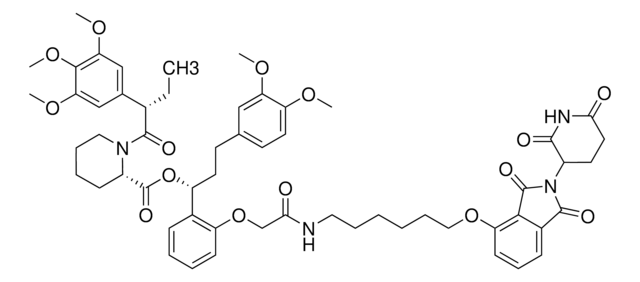
(2S)-(1R)-3-(3,4-Dimethoxyphenyl)-1-(2-(2-((6-((2-(2,6-dioxopiperidin-3-yl)-1,3-dioxoisoindolin-4-yl)oxy)hexyl)amino)-2-oxoethoxy)phenyl)propyl 1-((S)-2-(3,4,5-trimethoxyphenyl)butanoyl)piperidine-2-carboxylate, d-TAG-13
Zaloguj się, aby wyświetlić ceny organizacyjne i kontraktowe.
Wybierz wielkość
Zmień widok
| Do Państwa/SKU | Dostępność | Cena netto |
|---|---|---|
1 mg | Skontaktuj się z Obsługą Klienta, aby uzyskać informacje na temat dostępności | 743,00 zł |
5 mg | Skontaktuj się z Obsługą Klienta, aby uzyskać informacje na temat dostępności | 2950,00 zł |
Informacje o tej pozycji
Wzór empiryczny (zapis Hilla):
C57H68N4O15
Numer CAS:
Masa cząsteczkowa:
1049.17
UNSPSC Code:
12352200
NACRES:
NA.77
Assay:
≥98% (HPLC)
Form:
powder
743,00 zł
Skontaktuj się z Obsługą Klienta, aby uzyskać informacje na temat dostępności
Pomoc techniczna
Potrzebujesz pomocy? Nasz zespół doświadczonych naukowców chętnie Ci pomoże.
Pozwól nam pomócNazwa produktu
dTAG-13, ≥98% (HPLC)
ligand
thalidomide
Quality Segment
assay
≥98% (HPLC)
form
powder
color
white to beige
solubility
DMSO: 2 mg/mL, clear
storage temp.
−20°C
SMILES string
O=C(O[C@@H](C1=C(C=CC=C1)OCC(NCCCCCCOC2=C(C3=CC=C2)C(N(C3=O)C4CCC(NC4=O)=O)=O)=O)CCC5=CC=C(C(OC)=C5)OC)[C@@H]6CCCCN6C([C@H](C7=CC(OC)=C(C(OC)=C7)OC)CC)=O
InChI
1S/C57H68N4O15/c1-7-37(36-32-47(71-4)52(73-6)48(33-36)72-5)54(65)60-29-14-12-19-41(60)57(68)76-43(25-22-35-23-26-44(69-2)46(31-35)70-3)38-17-10-11-20-42(38)75-34-50(63)58-28-13-8-9-15-30-74-45-21-16-18-39-51(45)56(67)61(55(39)66)40-24-27-49(62)59-53(40)64
InChI key
BJFBRLAWLPZOMJ-QHVFGHLPSA-N
Biochem/physiol Actions
Degradation tag (dTAG) system heterobifunctional degrader of FKBP12(F36V) fusions by bridging them with CRBN for ubiquitination.
dTAG-13 is a degradation tag (dTAG) system heterobifunctional degrader composed of an E3 ubiquitin ligase cereblon (CRBN)-binding thalidomide moiety and an FKBP12(F36V) mutant-specific ligand AP1867 void of affinity for endogenous (wild-type) FKBP12, allowing selective degradation of target proteins of interest when expressed as an FKBP12(F36V) in-frame fusion (by transgene expression or locus-specific knock-in) by bridging them with CRBN for ubiquitination. dTAG-13 is shown to potently degrade FKBP12F36V-MELK(sg3R) in MDA-MB-468 cells (100 nM for 4 hrs) as well as ENL-FKBP12F36V-HA, but not endogenous ENL, in MV4;1 cells (500 nM for 0.5-1 hrs).
Other Notes
Contains a mixture of diastereomers. This product has not been tested in cellular degradation assays.
Legal Information
Sold with permission under license from Dana Farber Cancer Institute.
Ta strona może zawierać tekst przetłumaczony maszynowo.
1 of 1
Ta pozycja | |||
|---|---|---|---|
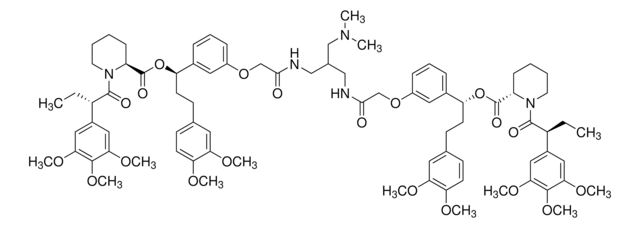
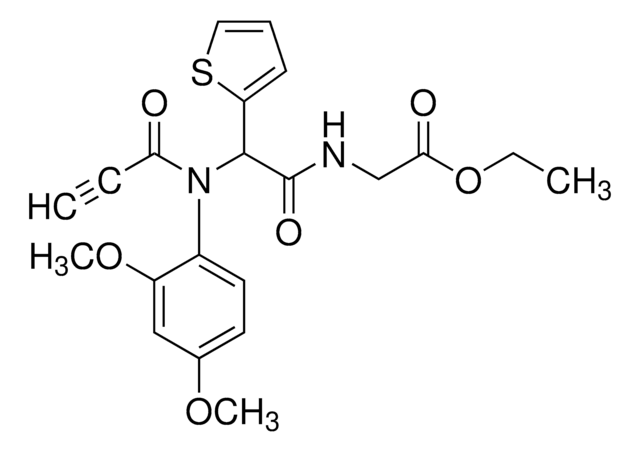
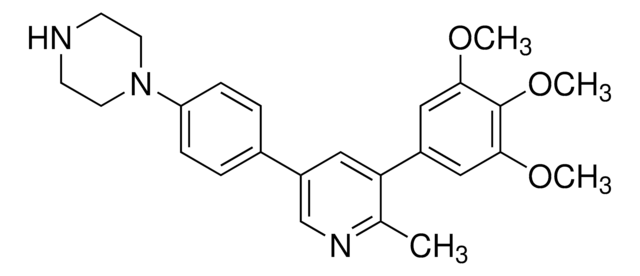
| assay ≥98% (HPLC) | assay ≥98% (HPLC) | assay ≥98% (HPLC) | assay ≥98% (HPLC) |
| form powder | form powder | form powder | form powder |
| Quality Level 100 | Quality Level 100 | Quality Level 100 | Quality Level 100 |
| storage temp. −20°C | storage temp. −20°C | storage temp. room temp | storage temp. 2-8°C |
| solubility DMSO: 2 mg/mL, clear | solubility DMSO: 2 mg/mL, clear | solubility DMSO: 10 mg/mL, clear (warmed) | solubility DMSO: 10 mg/mL, clear |
| color white to beige | color white to beige | color white to light brown | color white to beige |
Klasa składowania
11 - Combustible Solids
wgk
WGK 3
flash_point_f
Not applicable
flash_point_c
Not applicable
Wybierz jedną z najnowszych wersji:
Masz już ten produkt?
Dokumenty związane z niedawno zakupionymi produktami zostały zamieszczone w Bibliotece dokumentów.
-
Any idea of the stability of this compound suspended in DMSO at 500uM?
1 answer-
Helpful?
-