


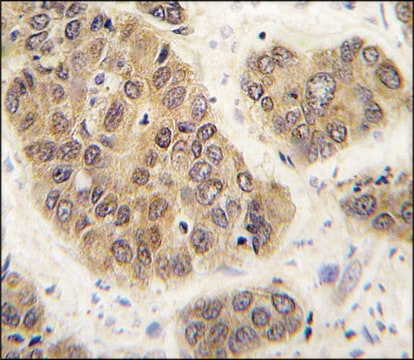
SUMO protease recognizes the tertiary structure of the Ubiquitin-like SUMO domain, hydrolyzing the peptide bond in the x–Gly–Gly–x sequence after the Gly-Gly bond, at the C-terminus of the SUMO domain. This protease will work with whichever species such a situation appears. While this product is not tested specifically for this application, product S0439, a recombinant SUMO-1 product, has been recommended for use as a positive control substrate. This enzyme is expected to be suitable for use in Human SUMO studies.
Przejdź do
SAE0067

SUMO Protease
His tagged recombinant protein, lyophilized powder
SUMO Protease
1 of 1 reviewers received a sample product or took part in a promotion
Synonim(y):
Small Ubiquitin-like Modifier Protease, ULP, Ubiquitin like protease, Ubiquitin-homology domain protein PIC1, Ubl-specific protease 1
, aby wyświetlić ceny organizacyjne i kontraktowe.
Wybierz wielkość
Zmień widok
| Do Państwa/SKU | Dostępność | Cena netto |
|---|---|---|
2500 units | Skontaktuj się z Obsługą Klienta, aby uzyskać informacje na temat dostępności | 2780,00 zł |
Informacje o tej pozycji
NACRES:
NA.54
UNSPSC Code:
12352204
Form:
lyophilized powder
Assay:
≥95% (SDS-PAGE)
Recombinant:
expressed in E. coli
Mol wt:
27 kDa
2780,00 zł
Skontaktuj się z Obsługą Klienta, aby uzyskać informacje na temat dostępności
Pomoc techniczna
Potrzebujesz pomocy? Nasz zespół doświadczonych naukowców chętnie Ci pomoże.
Pozwól nam pomócrecombinant
expressed in E. coli
Quality Segment
assay
≥95% (SDS-PAGE)
form
lyophilized powder
mol wt
27 kDa
shipped in
ambient
storage temp.
−20°C
General description
SUMO proteases are a general class of enzymes that specifically remove the post-translational protein modification (PTM) known as small ubiquitin-related modifier (SUMO), which falls into the PTM class of ubiquitin and/or ubiquitin-like proteins (UBL). The enzyme commonly referred to as ‘SUMO protease′ is the Ubl-specific protease 1 (Ulp1) from Saccharomyces cerevisiae. This was the first of this class of enzymes to be isolated. SUMO protease specifically cleaves the SUMO moiety in a ‘scarless′ manner. SUMO protease recognizes the tertiary structure of the Ubiquitin-like SUMO domain and hydrolyzes the peptide bond in the x–Gly–Gly–x sequence after the Gly-Gly bond, at the C-terminus of the SUMO domain. In addition to cleavage of natural SUMO-modified proteins, SUMO protease is used to cleave recombinant SUMO fusion proteins. The SUMO domain is a known solubility-enhancing fusion tag used in recombinant protein expression. A histidine tag can also be added at the N-terminus of the SUMO domain as a purification tag. This SUMO protease product carries a 6x histidine tag. Thus it can be easily removed together with the cleaved SUMO domain, following the digestion reaction
SUMO protease is active over a wide range of temperatures (2–30 °C), ionic strengths (0–400 mM NaCl), and pH ranges (6–8.5). However, its activity may vary depending on the substrate and conditions. Researchers will need to optimize their specific reaction conditions. As an initial suggestion, 20 units of SUMO protease can be used per mg of target protein for 1 hour at 30 °C, or overnight at 2–8 °C. The cleavage efficiency can then be estimated by SDS-PAGE. If necessary, the amount of SUMO protease can then be adjusted. SUMO protease works better in the presence of reducing agents, e.g., 0.5–2 mM DTT. DTT in the reaction mixture can significantly enhance cleavage efficiency, especially during longer incubations
Store the reconstituted product at –20 °C. It is recommended to reconstitute the enzyme in 100 μL of either water or 50% glycerol (v/v), supplemented with 1 mM DTT. Solutions in water/DTT should be stored in frozen aliquots to avoid freeze-thaw cycles, which can adversely affect the protease activity.
SUMO protease is active over a wide range of temperatures (2–30 °C), ionic strengths (0–400 mM NaCl), and pH ranges (6–8.5). However, its activity may vary depending on the substrate and conditions. Researchers will need to optimize their specific reaction conditions. As an initial suggestion, 20 units of SUMO protease can be used per mg of target protein for 1 hour at 30 °C, or overnight at 2–8 °C. The cleavage efficiency can then be estimated by SDS-PAGE. If necessary, the amount of SUMO protease can then be adjusted. SUMO protease works better in the presence of reducing agents, e.g., 0.5–2 mM DTT. DTT in the reaction mixture can significantly enhance cleavage efficiency, especially during longer incubations
Store the reconstituted product at –20 °C. It is recommended to reconstitute the enzyme in 100 μL of either water or 50% glycerol (v/v), supplemented with 1 mM DTT. Solutions in water/DTT should be stored in frozen aliquots to avoid freeze-thaw cycles, which can adversely affect the protease activity.
Other Notes
One enzyme unit is defined as the amount that will cut 90% of 100 pmol of SUMO-GST in 1 hour at 30°C.
Ta strona może zawierać tekst przetłumaczony maszynowo.
1 of 1
Ta pozycja | |||
|---|---|---|---|
| recombinant expressed in E. coli | recombinant expressed in E. coli | recombinant - | recombinant - |
| assay ≥95% (SDS-PAGE) | assay ≥90% (SDS-PAGE) | assay - | assay - |
| mol wt 27 kDa | mol wt 27 kDa | mol wt - | mol wt - |
| form lyophilized powder | form aqueous solution | form buffered aqueous solution | form buffered aqueous solution |
| storage temp. −20°C | storage temp. −20°C | storage temp. −20°C | storage temp. −20°C |
| shipped in ambient | shipped in dry ice | shipped in dry ice | shipped in dry ice |
Klasa składowania
11 - Combustible Solids
flash_point_f
Not applicable
flash_point_c
Not applicable
Wybierz jedną z najnowszych wersji:
Masz już ten produkt?
Dokumenty związane z niedawno zakupionymi produktami zostały zamieszczone w Bibliotece dokumentów.
-
Please state if this protease is specific to cleave off Human SUMO (there are various SUMO proteins used in expression studies).
1 answer-
Helpful?
-