


The end groups are free amino (-NH2) and carboxyl (-COOH). Because this a polydisperse material, it would be difficult to detect distinctive end groups via NMR.
Przejdź do
P4510

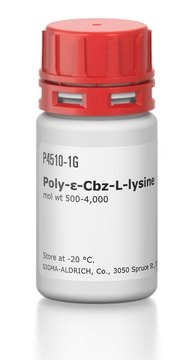
Poly-ε-Cbz-L-lysine
mol wt 500-4,000
Synonim(y):
N6-[(phenylmethoxy)carbonyl]-L-lysine homopolymer
Zaloguj się, aby wyświetlić ceny organizacyjne i kontraktowe.
Wybierz wielkość
Zmień widok
| Do Państwa/SKU | Dostępność | Cena netto |
|---|---|---|
1 g | Skontaktuj się z Obsługą Klienta, aby uzyskać informacje na temat dostępności | 1600,00 zł 1200,00 zł |
Informacje o tej pozycji
1200,00 zł
Cena katalogowa1600,00 złZaoszczędź 25%Skontaktuj się z Obsługą Klienta, aby uzyskać informacje na temat dostępności
Pomoc techniczna
Potrzebujesz pomocy? Nasz zespół doświadczonych naukowców chętnie Ci pomoże.
Pozwól nam pomócform
powder
Quality Segment
mol wt
500-4,000
color
white
storage temp.
−20°C
SMILES string
[N+H3][C@@H](CCCCNC(=O)OCc1ccccc1)C(=O)[O-]
InChI
1S/C14H20N2O4/c15-12(13(17)18)8-4-5-9-16-14(19)20-10-11-6-2-1-3-7-11/h1-3,6-7,12H,4-5,8-10,15H2,(H,16,19)(H,17,18)/t12-/m0/s1
InChI key
CKGCFBNYQJDIGS-LBPRGKRZSA-N
Application
- Transfection by polyethyleneimine-coated microspheres.: This study explores the use of Poly-e-Cbz-L-lysine in coating microspheres with polyethyleneimine for enhanced cell transfection, demonstrating improved efficiency and potential applications in gene therapy (Manuel WS et al., 2001).
- Transfection of cells mediated by biodegradable polymer materials with surface-bound polyethyleneimine.: The research focuses on biodegradable polymer materials, including Poly-e-Cbz-L-lysine, for cell transfection, highlighting their biodegradability and effectiveness in delivering genetic material (Zheng J et al., 2000).
- Production of microspheres with surface amino groups from blends of Poly(Lactide-co-glycolide) and Poly(epsilon-CBZ-L-lysine) and use for encapsulation.: This paper discusses the creation of microspheres with surface amino groups using blends of Poly-e-Cbz-L-lysine, which are then used for encapsulating active agents, indicating applications in drug delivery systems (Zheng J et al., 1999).
- Modification of materials formed from poly(L-lactic acid) to enable covalent binding of biopolymers: application to high-density three-dimensional cell culture in foams with attached collagen.: The study examines the modification of poly(L-lactic acid) materials with Poly-e-Cbz-L-lysine to covalently bind biopolymers, facilitating high-density 3D cell culture applications (Zheng J et al., 1998).
Analysis Note
Molecular weight by Electrospray Mass-Spectrometry
Other Notes
For additional technical information on polyamino acids please visit the Polyamino acid FAQ resource.
Ta strona może zawierać tekst przetłumaczony maszynowo.
1 of 1
Ta pozycja | |||
|---|---|---|---|
| form powder | form powder | form powder | form powder |
| storage temp. −20°C | storage temp. −20°C | storage temp. −20°C | storage temp. −20°C |
| Quality Level 200 | Quality Level 200 | Quality Level 200 | Quality Level 200 |
| color white | color white to off-white | color colorless to white | color white to off-white |
| mol wt 500-4,000 | mol wt 15,000-30,000 by viscosity | mol wt - | mol wt - |
Klasa składowania
11 - Combustible Solids
wgk
WGK 3
flash_point_f
Not applicable
flash_point_c
Not applicable
ppe
Eyeshields, Gloves, type N95 (US)
Wybierz jedną z najnowszych wersji:
Masz już ten produkt?
Dokumenty związane z niedawno zakupionymi produktami zostały zamieszczone w Bibliotece dokumentów.
-
Product P4510, Poly-ε-Cbz-L-lysine has a Cbz (carbobenzoxy) protecting group on the ε-amino group of each lysine. What are the structures of the α-amino-terminus and the carboxy-terminus, and are the end groups detectable by NMR?
1 answer-
Helpful?
-
-
What is the Department of Transportation shipping information for this product?
1 answer-
Transportation information can be found in Section 14 of the product's (M)SDS.To access the shipping information for this material, use the link on the product detail page for the product.
Helpful?
-