
Przejdź do
M5269

Moniliformin sodium salt
from Fusarium proliferatum, tricarboxylic acid (TCA) cycle oxidation inhibitor
Synonim(y):
1-Hydroxycyclobut-1-ene-3,4-dione
Zaloguj się, aby wyświetlić ceny organizacyjne i kontraktowe.
Wybierz wielkość
Zmień widok
| Do Państwa/SKU | Dostępność | Cena netto |
|---|---|---|
1 mg | Skontaktuj się z Obsługą Klienta, aby uzyskać informacje na temat dostępności | 1230,00 zł |
Informacje o tej pozycji
Wzór liniowy:
C4HO3Na
Numer CAS:
Masa cząsteczkowa:
120.04
UNSPSC Code:
12352200
PubChem Substance ID:
NACRES:
NA.77
MDL number:
1230,00 zł
Skontaktuj się z Obsługą Klienta, aby uzyskać informacje na temat dostępności
Pomoc techniczna
Potrzebujesz pomocy? Nasz zespół doświadczonych naukowców chętnie Ci pomoże.
Pozwól nam pomócNazwa produktu
Moniliformin sodium salt from Fusarium proliferatum,
Quality Segment
storage temp.
2-8°C
SMILES string
O=C1C(C=C1[O-])=O.[Na+]
InChI
1S/C4H2O3.Na/c5-2-1-3(6)4(2)7;/h1,5H;/q;+1/p-1
InChI key
FERDNJVXTWPNSA-UHFFFAOYSA-M
General description
Moniliformin (MON), a mycotoxin and small ionic molecule, is present in various Fusarium species including Fusarium avenaceum, Fusarium subglutinans and Fusarium proliferatum. It is present as sodium or potassium salt of semisquaric acid naturally. MON is also present in maize and small-grain cereals.
Application
Biochem/physiol Actions
Moniliformin (MON) is implicated for its toxic potential and may lead to respiratory distress and progressive muscular weakness in rats. It inhibits the tricarboxylic acid (TCA) cycle oxidation step. By acting as a pyruvate substrate, MON effectively inhibits thiamine pyrophosphate cofactor dependant enzymes and blocks the gluconeogenesis pathway. ) Furthermore, MON also inhibits glutathione peroxidase and glutathione reductase leading to oxidative stress in myoblast.
Ta strona może zawierać tekst przetłumaczony maszynowo.
1 of 1
Ta pozycja | |||
|---|---|---|---|
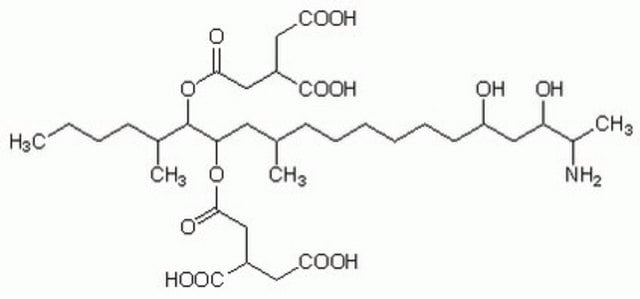
| description - | description - | description ≥98% (HPLC) | description Structural analog of Fumonisin B1 that has higher cytotoxicity and specific binding to primary rat hepatocytes than fumonisin B1. |
| Quality Level 200 | Quality Level 200 | Quality Level 300 | Quality Level 100 |
| storage temp. 2-8°C | storage temp. 2-8°C | storage temp. 2-8°C | storage temp. 2-8°C |



signalword
Danger
hcodes
pcodes
Hazard Classifications
Acute Tox. 3 Oral
Klasa składowania
6.1A - Combustible acute toxic Cat. 1 and 2 / very toxic hazardous materials
wgk
WGK 3
flash_point_f
Not applicable
flash_point_c
Not applicable
ppe
Eyeshields, Faceshields, Gloves, type P2 (EN 143) respirator cartridges
Wybierz jedną z najnowszych wersji:
Masz już ten produkt?
Dokumenty związane z niedawno zakupionymi produktami zostały zamieszczone w Bibliotece dokumentów.