


Unfortunately, Product F0425, Anti-Fibroblast Growth Factor Receptor-3, is not tested for cross reaction with mouse samples.
Przejdź do
F0425

Anti-Fibroblast Growth Factor Receptor-3, Cytoplasmic antibody produced in rabbit
affinity isolated antibody, buffered aqueous solution
Synonim(y):
Anti-FGFR-3
Zaloguj się, aby wyświetlić ceny organizacyjne i kontraktowe.
Wybierz wielkość
Zmień widok
| Do Państwa/SKU | Dostępność | Cena netto |
|---|---|---|
0.5 mL | Skontaktuj się z Obsługą Klienta, aby uzyskać informacje na temat dostępności | 3080,00 zł |
Informacje o tej pozycji
Conjugate:
unconjugated
Clone:
polyclonal
Application:
IHC (p), WB
Citations:
10
3080,00 zł
Skontaktuj się z Obsługą Klienta, aby uzyskać informacje na temat dostępności
Pomoc techniczna
Potrzebujesz pomocy? Nasz zespół doświadczonych naukowców chętnie Ci pomoże.
Pozwól nam pomócbiological source
rabbit
Quality Segment
conjugate
unconjugated
antibody form
affinity isolated antibody
antibody product type
primary antibodies
clone
polyclonal
form
buffered aqueous solution
mol wt
antigen 110-120 kDa (doublet)
species reactivity
human
technique(s)
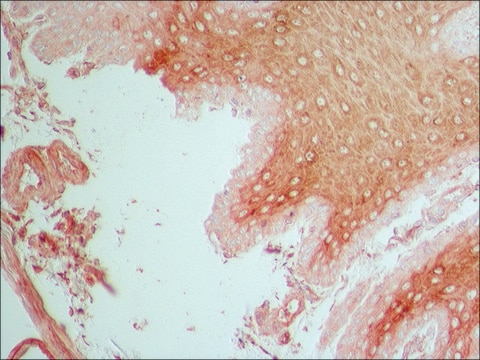
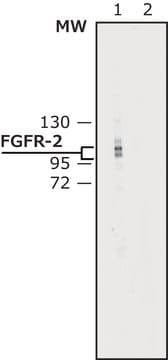
immunohistochemistry (formalin-fixed, paraffin-embedded sections): 1:250 using Trypsin-digested, human and animal tissue sections, western blot: 1:1,000 using whole cell extract of transfected 293T cells expressing recombinant human FGFR-3
UniProt accession no.
shipped in
dry ice
storage temp.
−20°C
target post-translational modification
unmodified
Gene Information
human ... FGFR3(2261)
General description
Fibroblast Growth Factor Receptor-3 (FGFR 3) is a protein that belongs to Tyr protein kinase family and is expressed in various fetal and adult human and animal tissues. It plays a vital role in inducing apoptosis in chondrogenic ATDC5 cells. It also facilitates cell proliferation and differentiation.
Immunogen
synthetic peptide corresponding to amino acids 792-806 of the cytoplasmic region of human FGFR-3 with N-terminal added lysine.
Application
Anti-Fibroblast Growth Factor Receptor-3, cytoplasmic antibody can be used in immunohistochemistry (diluted 1:250) using Trypsin-digested, human and animal tissue sections for identification of FGFR-3. It can also be used in immunoprecipitation.
Applications in which this antibody has been used successfully, and the associated peer-reviewed papers, are given below.
Immunohistochemistry (1 paper)
Western Blotting (1 paper)
Immunohistochemistry (1 paper)
Western Blotting (1 paper)
Biochem/physiol Actions
Fibroblast Growth Factor Receptor-3 (FGFR-3) plays a vital role in inducing apoptosis in chondrogenic ATDC5 cells. It also facilitates cell proliferation and differentiation. Mutations in the FGFR-3 gene leads to Wolf-Hirshhorn syndrome (growth failure, mental retardation, cardiac and bone malformations) and achondroplasia.
The antibody reacts specifically with FGFR-3 in lysates of transfected cells. No reaction with FGFR-1 and FGFR-2 is detected.
Physical form
Solution in 0.01 M phosphate buffered saline, pH 7.4, containing 1% bovine serum albumin and 15 mM sodium azide.
Disclaimer
Unless otherwise stated in our catalog or other company documentation accompanying the product(s), our products are intended for research use only and are not to be used for any other purpose, which includes but is not limited to, unauthorized commercial uses, in vitro diagnostic uses, ex vivo or in vivo therapeutic uses or any type of consumption or application to humans or animals.
Ta strona może zawierać tekst przetłumaczony maszynowo.
1 of 1
Ta pozycja | |||
|---|---|---|---|
| antibody form affinity isolated antibody | antibody form affinity isolated antibody | antibody form affinity isolated antibody | antibody form purified immunoglobulin |
| conjugate unconjugated | conjugate unconjugated | conjugate unconjugated | conjugate unconjugated |
| biological source rabbit | biological source rabbit | biological source rabbit | biological source mouse |
| Quality Level 200 | Quality Level 200 | Quality Level 200 | Quality Level 200 |
| technique(s) immunohistochemistry (formalin-fixed, paraffin-embedded sections): 1:250 using Trypsin-digested, human and animal tissue sections, western blot: 1:1,000 using whole cell extract of transfected 293T cells expressing recombinant human FGFR-3 | technique(s) immunohistochemistry (formalin-fixed, paraffin-embedded sections): 1:200 using trypsin-digested human and animal tissue sections, immunoprecipitation (IP): suitable, western blot: 1:400 using an extract of FGFR-1 transfected cells | technique(s) immunohistochemistry (formalin-fixed, paraffin-embedded sections): 2-4 μg/mL using trypsin-digested, human tissue sections, western blot: 0.25-0.5 μg/mL using extracts/lysates of FGFR-2 transfected cells | technique(s) dot blot: suitable, indirect ELISA: suitable, neutralization: 5 μg/mL using 1 unit recombinant human FGF2 in mouse 3T3 cells, radioimmunoassay: suitable, western blot: suitable |
| Gene Information human ... FGFR3(2261) | Gene Information human ... FGFR1(2260) | Gene Information human ... FGFR2(2263) | Gene Information human ... FGF2(2247) |
Still not finding the right product?
Wypróbuj nasze narzędzie Narzędzie selektora produktów, aby zawęzić opcje.
Klasa składowania
10 - Combustible liquids
wgk
WGK 2
flash_point_f
Not applicable
flash_point_c
Not applicable
ppe
Eyeshields, Gloves, multi-purpose combination respirator cartridge (US)
Wybierz jedną z najnowszych wersji:
Masz już ten produkt?
Dokumenty związane z niedawno zakupionymi produktami zostały zamieszczone w Bibliotece dokumentów.
-
Est-ce que cet anticorps cross-réagit sur des épitopes de souris ?
1 answer-
Helpful?
-