Przejdź do zawartości
Merck

C2581

Anti-Cholecystokinin (26-33) (CCK-8) antibody produced in rabbit

whole antiserum

Synonim(y):

CCK Antibody - Anti-Cholecystokinin (26-33) (CCK-8) antibody produced in rabbit, Cck Antibody

Zaloguj się, aby wyświetlić ceny organizacyjne i kontraktowe.

Wybierz wielkość

25 μL

764,00 zł

0.2 ML

2190,00 zł

764,00 zł


Skontaktuj się z Obsługą Klienta, aby uzyskać informacje na temat dostępności

Zamów zamówienie zbiorcze

Informacje o tej pozycji

UNSPSC Code:
12352203
NACRES:
NA.41
MDL number:
Conjugate:
unconjugated
Clone:
polyclonal
Application:
IHC (p), competitive inhibition ELISA
Citations:
56

Przejdź do

Pomoc techniczna
Potrzebujesz pomocy? Nasz zespół doświadczonych naukowców chętnie Ci pomoże.
Pozwól nam pomóc

biological source

rabbit

Quality Level

conjugate

unconjugated

antibody form

whole antiserum

antibody product type

primary antibodies

clone

polyclonal

contains

15 mM sodium azide

species reactivity

human

packaging

antibody small pack of 25 μL

technique(s)

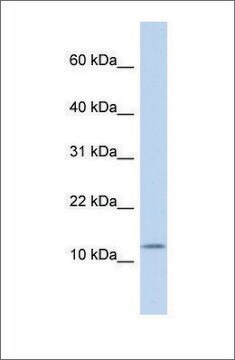
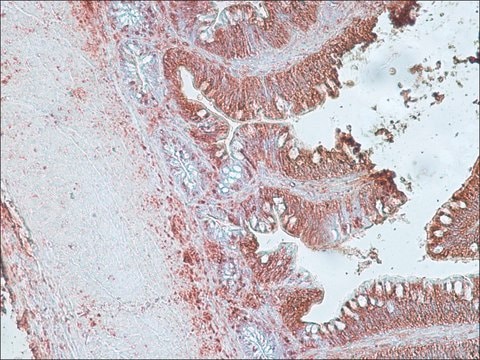
competitive inhibition ELISA: 1:1000-1:2000, immunohistochemistry (formalin-fixed, paraffin-embedded sections): 1:8,000 using indirect immunoperoxidase staining of human stomach

UniProt accession no.

shipped in

dry ice

storage temp.

−20°C

target post-translational modification

unmodified

Gene Information

human ... CCK(885)

Porównaj podobne pozycje

Wyświetl pełne porównanie

Pokaż różnice

1 of 4

Ta pozycja
SAB2100357C8198C5348
Quality Level

200

Quality Level

100

Quality Level

200

Quality Level

200

conjugate

unconjugated

conjugate

unconjugated

conjugate

unconjugated

conjugate

unconjugated

biological source

rabbit

biological source

rabbit

biological source

rabbit

biological source

rabbit

antibody form

whole antiserum

antibody form

affinity isolated antibody

antibody form

whole antiserum

antibody form

IgG fraction of antiserum

clone

polyclonal

clone

polyclonal

clone

polyclonal

clone

polyclonal

species reactivity

human

species reactivity

human

species reactivity

rat

species reactivity

frog, canine, sheep, rat, human, mouse, pig, bovine

General description

Cholecystokinin (CCK) belongs to gastrointestinal hormone family is a neuropeptide hormone and neurotransmitter usually present in gastrointestinal (GI) tract and the central nervous system (CNS). CCK functions include enzyme secretion from pancreas, gall bladder contraction, intestinal motility; CCK will also inhibit gastrin induced acid secretion . This product is also useful for the study of mode of action, differential tissue expression and intracellular and subcellular localization of CCK in CNS and in neuroendocrine cells of digestive system. Anti-CCK-8 reacts specifically with sulfated CCK-8 and shows cross reactivity with unsulfated CCK-8 and Big Gastrin I.
Cholecystokinin (CCK) is a neuropeptide hormone and neurotransmitter widely distributed throughout the gastrointestinal (GI) tract and the central nervous system (CNS). CCK, Big Gastrin I, and vasoactive intestinal peptide (VIP) belong to the gastrin/cholcystokinin family. hormone family. CCK has a biologically active C-terminal pentapeptide. CCK exists as a larger precursor hormone, preproCCK (114 amino acids), from which several smaller fragments are derived, sharing a C-terminal tetrapeptide and a sulfated tyrosine residue. Sulfated CCK (26-33) amide (CCK-8) is the major and the most potent CCK form in the brain and periphery. CCK is widely distributed in several brain regions, including the cerebral cortex, hippocampus, amygdala nuclei, and the hypothalamus. In the periphery, CCK is localized mainly in nerve fibers in the myenteric and submucosal ganglia, as well as in endocrine cells of the gastrointestinal tract.

Immunogen

Synthetic sulfated CCK-8 conjugated to KLH.

Application

Anti-Cholecystokinin (26-33) (CCK-8) has been used in

  • immunohistochemistry
  • double-label immunofluorescence staining
  • immunocytochemistry
  • ELISA immunoassay
Anti-cholecystokinin (26-33) (CCK-8) antibody can be used to detect CCK peptide in pancreatic cancer cells by immunocytochemistry. It may also be used for ELISA immunoassay.
Anti-cholecystokinin (26-33) (CCK-8) antibody can be used to detect CCK peptide in pancreatic cancer cells by immunocytochemistry. It may also be used for dot blot immunoassay.

Biochem/physiol Actions

Cholecystokinin (CCK) stimulates enzyme secretion from the pancreas, gall bladder contraction, and intestinal motility and it inhibits gastrin-induced acid secretion. CCK may be involved in several physiological and behavioral functions such as satiety, anxiety, memory processes, and analgesia and in disorders such as panic disorder. In the central nervous system (CNS), CCK acts as a neurotransmitter and modulates the action of other neurotransmitters such as dopamine, 5-hydroxytryptamine (5-HT), γ-Aminobutyric acid (GABA) and excitatory amino acids. The multiple biological actions of CCK are mediated by two classes of receptors, the peripheral/brain CCK-A receptors and the brain CCK-B receptors.

Disclaimer

Unless otherwise stated in our catalog or other company documentation accompanying the product(s), our products are intended for research use only and are not to be used for any other purpose, which includes but is not limited to, unauthorized commercial uses, in vitro diagnostic uses, ex vivo or in vivo therapeutic uses or any type of consumption or application to humans or animals.
Ta strona może zawierać tekst przetłumaczony maszynowo.

Nie możesz znaleźć właściwego produktu?  

Wypróbuj nasz Narzędzie selektora produktów.

flash_point_f

Not applicable

flash_point_c

Not applicable

Klasa składowania

12 - Non Combustible Liquids


Wybierz jedną z najnowszych wersji:

Certyfikaty analizy (CoA)

Lot/Batch Number

Nie widzisz odpowiedniej wersji?

Jeśli potrzebujesz konkretnej wersji, możesz wyszukać konkretny certyfikat według numeru partii lub serii.

Masz już ten produkt?

Dokumenty związane z niedawno zakupionymi produktami zostały zamieszczone w Bibliotece dokumentów.

Odwiedź Bibliotekę dokumentów

An introduction to neuronal cholecystokinin
Beinfeld MC
Peptides, 22(8), 1197-1200 (2001)
Role of endogenous cholecystokinin on growth of human pancreatic cancer
Matters G L, et al.
International journal of oncology, 38(3), 593-601 (2011)
Hiroo Takahashi et al.
The Journal of neuroscience : the official journal of the Society for Neuroscience, 36(31), 8210-8227 (2016-08-05)
Neural circuits that undergo reorganization by newborn interneurons in the olfactory bulb (OB) are necessary for odor detection and discrimination, olfactory memory, and innate olfactory responses, including predator avoidance and sexual behaviors. The OB possesses many interneurons, including various types
CCK in anxiety and cognitive processes
Dauge V and Lena I.
Neuroscience and Biobehavioral Reviews, 22(6), 815-825 (1998)
Cholecystokinin and gastrin receptors
Dufresne M, et al.
Physiological Reviews, 86(3), 805-847 (2006)

Numer pozycji handlu globalnego

SKUNUMER GTIN
C2581-25UL04061838702685
C2581-.2ML04061833484241

Questions

Reviews

No rating value

Active Filters

Nasz zespół naukowców ma doświadczenie we wszystkich obszarach badań, w tym w naukach przyrodniczych, materiałoznawstwie, syntezie chemicznej, chromatografii, analityce i wielu innych dziedzinach.

Skontaktuj się z zespołem ds. pomocy technicznej