
ABS1064-I

Anti-Hypusine
Synonim(y):
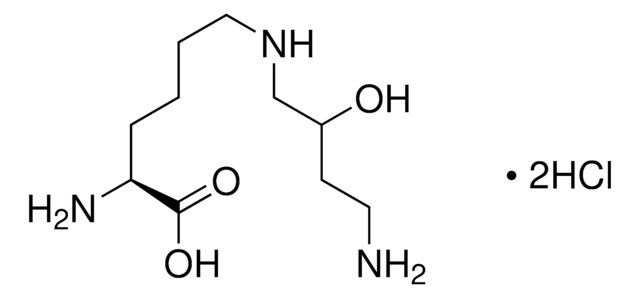
N -4-amino-2-hydroxybutyl(lysine)
Zaloguj się, aby wyświetlić ceny organizacyjne i kontraktowe.
Wybierz wielkość
Zmień widok
| Do Państwa/SKU | Dostępność | Cena netto |
|---|---|---|
25 μL | Sprawdź dostępność w koszyku | 731,00 zł |
100 μL | Sprawdź dostępność w koszyku | 1870,00 zł |
Informacje o tej pozycji
NACRES:
NA.41
UNSPSC Code:
12352203
Clone:
polyclonal
Species reactivity:
human
Application:
—
Citations:
-
Pomoc techniczna
Potrzebujesz pomocy? Nasz zespół doświadczonych naukowców chętnie Ci pomoże.
Pozwól nam pomócbiological source
rabbit
antibody form
serum
antibody product type
primary antibodies
clone
polyclonal
mol wt
observed mol wt ~45 kDa (Uncharacterized bands may be observed in some lysate(s).)
species reactivity
human
species reactivity (predicted by homology)
mammals
isotype
IgG
shipped in
ambient
storage temp.
−20°C
target post-translational modification
unmodified
Gene Information
human ... DOHH(83475)
General description
Hypusine (N -4-amino-2-hydroxybutyl(lysine)) is derived by a post-translational modification of lysine. It is found in all eukaryotes and in certain archaea, but not in eubacteria. Currently, eukaryotic translation initiation factor5A (eIF-5A) is the only protein that has been reported to contain hypusine. This modification of elF-5A involves two reactions where in the first reaction deoxyhypusine synthase (DHS) transfers the butylamine moiety of spermidine to the -amino group of a specific lysine residue of eIF-5A resulting in the formation of deoxy-hypusine. This is followed by a hydroxylation reaction catalyzed by deoxyhypusine hydroxylase. This modification appears to be irreversible. The hypusinated form of elF-5A is reported to be the active form that is involved in translational elongation, RNA binding, and ribosome association. Hypusinated eIF5A is shown to be essential for cellular proliferation and responses to extracellular stressors. In the absence of an active hypusine cell proliferation is inhibited and Inhibition of hypusine formation is shown to confer cellular survival in certain stress states, such as infections, carcinogenesis, and obesity. (Ref.: Park, MH., and Wolff, EC. (2018). J. Biol. Chem. 293(48) 18710-18718; Nishiki, Y., et al. (2013). Springerplus. 2;421; Zhai, Q., et al. (2016). J. Mol. Biol. 428(3);603-617).
Immunogen
Synthetic hypusine-containing peptide C-Ahx-STSKTG[hypusine]HGHAKV-amide.
Biochem/physiol Actions
This rabbit polyclonal antibody specifically detects hypusinated form of elF-5A.
Physical form
Rabbit polyclonal antiserum with 0.02% sodium azide.
Preparation Note
Please refer to lot specific datasheet.
Stable for 1 year at -20°C from date of receipt. Handling Recommendations: Upon receipt and prior to removing the cap, centrifuge the vial and gently mix the solution. Aliquot into microcentrifuge tubes and store at -20°C. Avoid repeated freeze/thaw cycles, which may damage IgG and affect product performance.
Disclaimer
Unless otherwise stated in our catalog or other company documentation accompanying the product(s), our products are intended for research use only and are not to be used for any other purpose, which includes but is not limited to, unauthorized commercial uses, in vitro diagnostic uses, ex vivo or in vivo therapeutic uses or any type of consumption or application to humans or animals.
Ta strona może zawierać tekst przetłumaczony maszynowo.
1 of 1
Ta pozycja | |||
|---|---|---|---|
| biological source rabbit | biological source - | biological source - | biological source - |
| antibody form serum | antibody form - | antibody form - | antibody form - |
| storage temp. −20°C | storage temp. −20°C | storage temp. −20°C | storage temp. - |
| mol wt observed mol wt ~45 kDa (Uncharacterized bands may be observed in some lysate(s).) | mol wt - | mol wt - | mol wt - |
| clone polyclonal | clone - | clone - | clone - |
| shipped in ambient | shipped in - | shipped in - | shipped in - |

Still not finding the right product?
Wypróbuj nasze narzędzie Narzędzie selektora produktów, aby zawęzić opcje.
Certyfikaty analizy (CoA)
Poszukaj Certyfikaty analizy (CoA), wpisując numer partii/serii produktów. Numery serii i partii można znaleźć na etykiecie produktu po słowach „seria” lub „partia”.
Masz już ten produkt?
Dokumenty związane z niedawno zakupionymi produktami zostały zamieszczone w Bibliotece dokumentów.