Zaloguj się, aby wyświetlić ceny organizacyjne i kontraktowe.
Wybierz wielkość
Informacje o tej pozycji
UNSPSC Code:
12352203
NACRES:
NA.41
eCl@ss:
32160702
Conjugate:
ALEXA FLUOR™ 488
Clone:
polyclonal
Application:
ICC, IF, IHC
Citations:
2
Pomoc techniczna
Potrzebujesz pomocy? Nasz zespół doświadczonych naukowców chętnie Ci pomoże.
Pozwól nam pomócPomoc techniczna
Potrzebujesz pomocy? Nasz zespół doświadczonych naukowców chętnie Ci pomoże.
Pozwól nam pomócbiological source
rabbit
Quality Level
conjugate
ALEXA FLUOR™ 488
clone
polyclonal
species reactivity
mouse, rat
manufacturer/tradename
Neuro-Chrom
technique(s)
immunocytochemistry: suitable, immunofluorescence: suitable, immunohistochemistry: suitable
shipped in
wet ice
target post-translational modification
unmodified
General description
Antibodies to neuronal proteins have become critical tools for identifying neurons and discerning morphological characteristics in culture and complex tissue. While the labeling from classic histological techniques such as Golgi staining and modern molecular approaches such as GFP constructs yield excellent cytoarchitectural detail, these approaches are technically challenging and impractical for many neuroscience research needs. Neuron-specific antibodies are convenient precision tools useful in revealing cytoarchitecture, but are limited to the protein target distribution within the neuron, which may differ greatly from nucleus to soma to dendrite and axon. To achieve as complete a morphological staining as possible across all parts of neurons, Millipore has developed a polyclonal antibody blend that reacts against key somatic, nuclear, dendritic, and axonal proteins distributed across the pan-neuronal architecture that can then be detected by a single secondary antibody. This antibody cocktail has been validated in diverse methods, cell culture and immuno-histochemistry, giving researchers a convenient and specific qualitative and quantitative tool for studying neuronal morphology.
Immunogen
Epitope: Whole Neuron Marker
Application
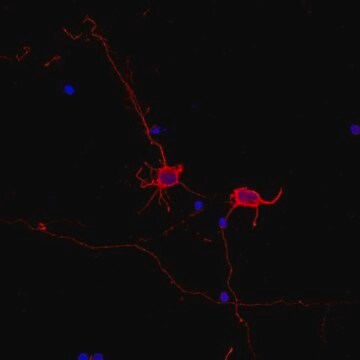
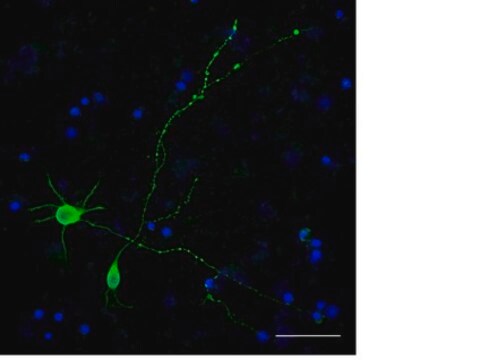
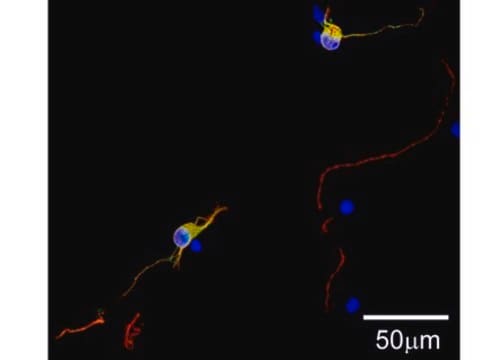
Neuro-Chrom Pan Neuronal Marker-Rabbit, Alexa488 conjugate is an antibody targeting the Pan Neuronal Marker protein, validated for use in ICC, IHC & IF.
Research Category
Neuroscience
Neuroscience
Research Sub Category
Neuronal & Glial Markers
Biochem/physiol Actions
Cat. # ABN2300A4 is specific to axons (neurites), dendrites, nucleus, and the cell body of neurons.
Reactivity with other species has not been determined.
Physical form
Polyclonal antibody cocktail blend conjugated to Alexa Fluor™ 488 in PBS buffer with 15mg/mL BSA and 0.05% NaN3
Preparation Note
Maintain at 2-8°C for up to 1 year from date of receipt.
Analysis Note
Control
Rat E18 cortex primary neuron cell culture or mouse adult brain cryosections.
Routinely tested Rat E18 cortex primary neurons in Immunocytochemistry.
Legal Information
ALEXA FLUOR is a trademark of Life Technologies
Disclaimer
Unless otherwise stated in our catalog or other company documentation accompanying the product(s), our products are intended for research use only and are not to be used for any other purpose, which includes but is not limited to, unauthorized commercial uses, in vitro diagnostic uses, ex vivo or in vivo therapeutic uses or any type of consumption or application to humans or animals.
Ta strona może zawierać tekst przetłumaczony maszynowo.
Klasa składowania
12 - Non Combustible Liquids
wgk
WGK 2
flash_point_f
Not applicable
flash_point_c
Not applicable
Certyfikaty analizy (CoA)
Poszukaj Certyfikaty analizy (CoA), wpisując numer partii/serii produktów. Numery serii i partii można znaleźć na etykiecie produktu po słowach „seria” lub „partia”.
Masz już ten produkt?
Dokumenty związane z niedawno zakupionymi produktami zostały zamieszczone w Bibliotece dokumentów.
Xinhua Zhan et al.
Neurology, 87(22), 2324-2332 (2016-10-28)
We determined whether Gram-negative bacterial molecules are associated with Alzheimer disease (AD) neuropathology given that previous studies demonstrate Gram-negative Escherichia coli bacteria can form extracellular amyloid and Gram-negative bacteria have been reported as the predominant bacteria found in normal human
Andreas C Woerner et al.
Science (New York, N.Y.), 351(6269), 173-176 (2015-12-05)
Amyloid-like protein aggregation is associated with neurodegeneration and other pathologies. The nature of the toxic aggregate species and their mechanism of action remain elusive. Here, we analyzed the compartment specificity of aggregate toxicity using artificial β-sheet proteins, as well as
Numer pozycji handlu globalnego
| SKU | NUMER GTIN |
|---|---|
| ABN2300A4 | 04053252592386 |
Nasz zespół naukowców ma doświadczenie we wszystkich obszarach badań, w tym w naukach przyrodniczych, materiałoznawstwie, syntezie chemicznej, chromatografii, analityce i wielu innych dziedzinach.
Skontaktuj się z zespołem ds. pomocy technicznej