
Przejdź do
794236

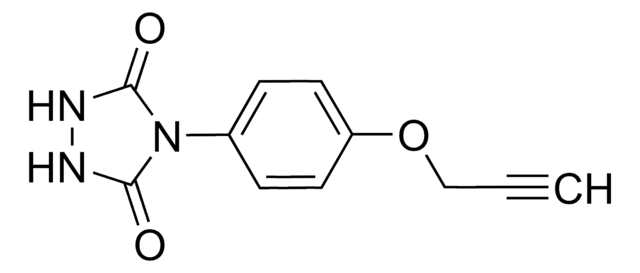
PTAD-Alkyne
97%
Synonim(y):
4-(4-(Prop-2-yn-1-yloxy)phenyl)-1,2,4-triazolidine-3,5-dione
Zaloguj się, aby wyświetlić ceny organizacyjne i kontraktowe.
Wybierz wielkość
Zmień widok
| Rozmiar/SKU | Dostępność | Cena netto |
|---|---|---|
500 mg | Skontaktuj się z Obsługą Klienta, aby uzyskać informacje na temat dostępności | 1790,00 zł |
Informacje o tej pozycji
Wzór empiryczny (zapis Hilla):
C11H9N3O3
Numer CAS:
Masa cząsteczkowa:
231.21
NACRES:
NA.22
PubChem Substance ID:
UNSPSC Code:
12352106
MDL number:
1790,00 zł
Skontaktuj się z Obsługą Klienta, aby uzyskać informacje na temat dostępności
Pomoc techniczna
Potrzebujesz pomocy? Nasz zespół doświadczonych naukowców chętnie Ci pomoże.
Pozwól nam pomócQuality Segment
assay
97%
form
solid
mp
176-181 °C
storage temp.
2-8°C
SMILES string
O=C1NNC(=O)N1c2ccc(OCC#C)cc2
InChI
1S/C11H9N3O3/c1-2-7-17-9-5-3-8(4-6-9)14-10(15)12-13-11(14)16/h1,3-6H,7H2,(H,12,15)(H,13,16)
InChI key
IHJYYZNVZZKSCU-UHFFFAOYSA-N
General description
PTAD-Alkyne is a selective bioconjugation reagent for the modification of tyrosine residues with a terminal alkyne. Subsequent modification can then be afforded via the copper catalyzed azide/alkyne click chemistry reaction with an azide containing compound or biomolecule. This reagent has been shown to selectively introduce poly(ethylene glycol) or PEG chains onto proteins with surface exposed tyrosine residues. PTAD-Alkyne has also been used in the formation of antibody-drug conjugates. This reagent is compatible with different buffer systems such as PBS, Tris and mixed PBS/Tris buffer (preferred). The linkage with tyrosine has been shown to be stable to pH and temperature extremes as well as blood plasma.
Application
Note: PTAD-Alkyne must be first activated by stirring in a 1:0.98 molar ratio with 1,3-dibromo-5,5-dimethylhydantoin (product # 157902). Activation is evident upon solution color change from colorless to deep red and the activated reagent should be used immediately.
General Procedure for Protein Modification with PTAD.
Part 1: PTAD activation
Mix together 1:0.98 molar equivalents of unactivated PTAD to 1,3-dibromo-5,5-dimethylhydantoin (product # 157902) in organic solvent (preferred solvents are DMF or acetonitrile; avoid using DMSO)
Color change is observed from colorless/pale yellow to deep red (approximately 5 min of mixing).
After the solution turns red, store the now activated reagent on ice and use for protein modification within 30 min.
Part 2: Protein modification
Add protein solution in mixed phosphate/Tris buffer or Tris buffer (pH should be 6 - 9) to the eppendorf tube (or other vial) containing the activated PTAD reagent prepared above and mix gently at room temperature for up to 30 min. Preferably use 10-fold molar excess of reagent relative to protein. Use protein at a minimum concentration of 1 mg/ml (higher concentrations are preferred for enhanced labeling).
Remove excess unreacted PTAD by gel filtration.
General Procedure for Protein Modification with PTAD.
Part 1: PTAD activation
Mix together 1:0.98 molar equivalents of unactivated PTAD to 1,3-dibromo-5,5-dimethylhydantoin (product # 157902) in organic solvent (preferred solvents are DMF or acetonitrile; avoid using DMSO)
Color change is observed from colorless/pale yellow to deep red (approximately 5 min of mixing).
After the solution turns red, store the now activated reagent on ice and use for protein modification within 30 min.
Part 2: Protein modification
Add protein solution in mixed phosphate/Tris buffer or Tris buffer (pH should be 6 - 9) to the eppendorf tube (or other vial) containing the activated PTAD reagent prepared above and mix gently at room temperature for up to 30 min. Preferably use 10-fold molar excess of reagent relative to protein. Use protein at a minimum concentration of 1 mg/ml (higher concentrations are preferred for enhanced labeling).
Remove excess unreacted PTAD by gel filtration.
Ta strona może zawierać tekst przetłumaczony maszynowo.
1 of 1
Ta pozycja | |||
|---|---|---|---|
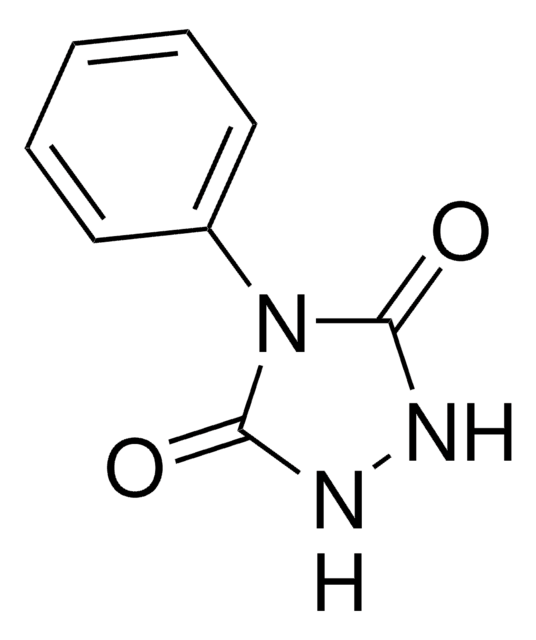
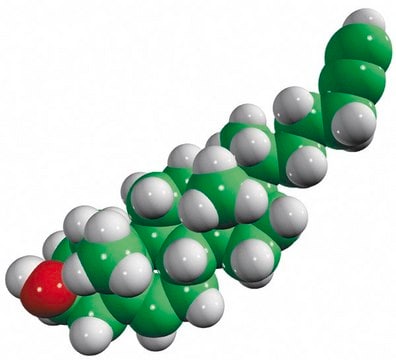
| description 97% | description 98% | description - | description 27-norcholest-5-en-25-yn-3β-ol, powder |
| form solid | form - | form powder or crystals | form powder |
| Quality Level 100 | Quality Level 100 | Quality Level 100 | Quality Level - |
| storage temp. 2-8°C | storage temp. - | storage temp. −20°C | storage temp. −20°C |
| assay 97% | assay 98% | assay - | assay >99% (TLC) |
| mp 176-181 °C | mp 207-209 °C (lit.) | mp - | mp - |

Klasa składowania
11 - Combustible Solids
Co się dzieje?
WGK 3
Temperatura zapłonu (°F)
Not applicable
Temperatura zapłonu (°C)
Not applicable
Wybierz jedną z najnowszych wersji:
Masz już ten produkt?
Dokumenty związane z niedawno zakupionymi produktami zostały zamieszczone w Bibliotece dokumentów.