
P3775

Anti-Protein A antibody produced in rabbit
fractionated antiserum, lyophilized powder
Synonym(s):
Anti-Protein A
Sign In to View Organizational & Contract Pricing.
Select a Size
Change View
| Pack Size | SKU | Availability | Price |
|---|---|---|---|
| 1 vial | Please contact Customer Service for Availability | PLN 1,020.00 |
About This Item
Conjugate:
unconjugated
Clone:
polyclonal
Application:
ELISA (i)
Citations:
82
biological source
rabbit
Quality Level
conjugate
unconjugated
antibody form
fractionated antiserum
antibody product type
primary antibodies
clone
polyclonal
form
lyophilized powder
packaging
vial of 2 mL lyophilized antiserum
technique(s)
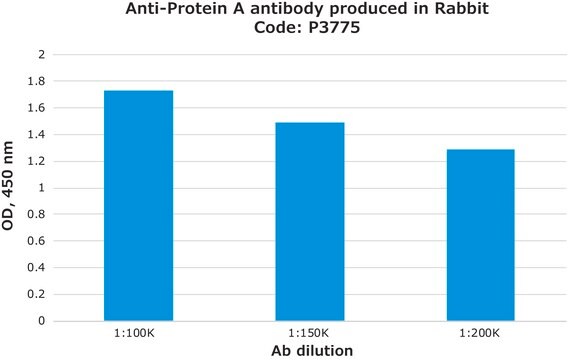
indirect ELISA: 1:100,000
storage temp.
2-8°C
target post-translational modification
unmodified
General description
Protein A is a 42 kDa bacterial protein. It is isolated from the cell wall of Staphylococcus aureus.
The fractionation procedure yields primarily the immunoglobulin fraction of antiserum. To ensure specificity the fractionated antiserum is adsorbed using solid phase techniques, if necessary. Rabbit Anti-Protein A is lyophilized from 0.01 M phosphate buffered saline, pH 7.2, to which no preservatives have been added. Identity and purity of the antibody is established by immunoelectrophoresis. Electrophoresis of the antibody preparation followed by diffusion versus anti-rabbit IgG results in a single arc of precipitation and versus anti-rabbit whole serum results in multiple arcs of precipitation.
Immunogen
Protein A from Staphylococcus aureus
Application
Anti-Protein A antibody produced in rabbit has been used in immunoblotting.
Protein A may be used as in immunoblotting with a minimum dilution of 1:50,000.
Biochem/physiol Actions
Protein A has an ability to bind Fc region of immunoglobulins from several species. It is used as a “universal tracer” and it facilitate the segregation of bound and free ligand. Protein A also acts as affinity matrices for antibody (IgG) purification.
Physical form
Lyophilized from 0.01M phosphate buffered saline, pH 7.2
Preparation Note
Reconstitute with 2 ml deionized water.
Disclaimer
Unless otherwise stated in our catalog or other company documentation accompanying the product(s), our products are intended for research use only and are not to be used for any other purpose, which includes but is not limited to, unauthorized commercial uses, in vitro diagnostic uses, ex vivo or in vivo therapeutic uses or any type of consumption or application to humans or animals.
1 of 1
This Item | |||
|---|---|---|---|
| biological source rabbit | biological source mouse | biological source rabbit | biological source rabbit |
| conjugate unconjugated | conjugate unconjugated | conjugate unconjugated | conjugate unconjugated |
| Quality Level 200 | Quality Level 200 | Quality Level 200 | Quality Level 200 |
| antibody form fractionated antiserum | antibody form ascites fluid | antibody form fractionated antiserum | antibody form fractionated antiserum |
| clone polyclonal | clone SPA-27, monoclonal | clone polyclonal | clone polyclonal |
| storage temp. 2-8°C | storage temp. −20°C | storage temp. 2-8°C | storage temp. 2-8°C |


Still not finding the right product?
Try our Product Selector Tool to narrow your options
Storage Class
11 - Combustible Solids
wgk
WGK 3
flash_point_f
Not applicable
flash_point_c
Not applicable
ppe
Eyeshields, Gloves, type N95 (US)
Choose from one of the most recent versions:
Already Own This Product?
Find documentation for the products that you have recently purchased in the Document Library.
Related Content
Datasheet
Instructions
Regulation of yeast G protein signaling by the kinases that activate the AMPK homolog Snf1
Clement ST, et al.
Science Signaling, 6(291), ra78-ra78 (2013)
Ritu Gupta et al.
PloS one, 10(7), e0132350-e0132350 (2015-07-07)
Saccharomyces cerevisiae Sub1 is involved in several cellular processes such as, transcription initiation, elongation, mRNA processing and DNA repair. It has also been reported to provide cellular resistance during conditions of oxidative DNA damage and osmotic stress. Here, we report
Radioimmunoassay
Immunoassay, 269-285 (1996)
Global Trade Item Number
| SKU | GTIN |
|---|---|
| P3775-1VL | 04061834372967 |