Skip to Content
Merck

Skip To

P0874

Anti-Potassium Channel KIR6.1 antibody produced in rabbit

affinity isolated antibody, lyophilized powder

Synonym(s):

Anti-KATP Inward Rectifier K+ Channel 4, Anti-KCNJ8

Sign In to View Organizational & Contract Pricing.

Select a Size

Change View
Pack SizeSKUAvailabilityPrice

About This Item

UNSPSC Code:
12352203
NACRES:
NA.41
MDL number:
Conjugate:
unconjugated
Clone:
polyclonal
Application:
WB
Citations:
3
To inquire about this product P0874, please contact your local Merck office or dealer. Contact Technical Service
Technical Service
Need help? Our team of experienced scientists is here for you.
Let Us Assist


biological source

rabbit

Quality Level

conjugate

unconjugated

antibody form

affinity isolated antibody

antibody product type

primary antibodies

clone

polyclonal

form

lyophilized powder

species reactivity

rat

technique(s)

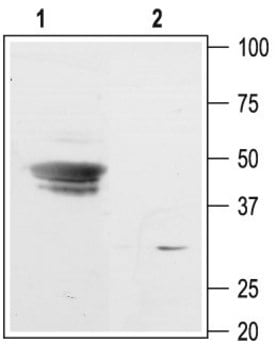
western blot: 1:200 using rat heart membranes

UniProt accession no.

shipped in

wet ice

storage temp.

−20°C

target post-translational modification

unmodified

Gene Information

human ... KCNJ8(3764)
mouse ... Kcnj8(16523)
rat ... Kcnj8(25472)

Immunogen

peptide, (C)KRNSMRRNNSMRRSN, corresponding to amino acid residues 382-396 of rat KIR6.1. This sequence has 15/16 residues identical in human, pig, rabbit, and mouse.

Biochem/physiol Actions

Specific for KIR6.1; does not cross react with KIR6.2.

Physical form

Lyophilized from phosphate buffered saline containing 1% bovine serum albumin and 0.025% sodium azide.

Disclaimer

Unless otherwise stated in our catalog or other company documentation accompanying the product(s), our products are intended for research use only and are not to be used for any other purpose, which includes but is not limited to, unauthorized commercial uses, in vitro diagnostic uses, ex vivo or in vivo therapeutic uses or any type of consumption or application to humans or animals.

Compare Similar Items

View Full Comparison

Show Differences

1 of 1

This Item
P8247SAB4501635HPA024231
conjugate

unconjugated

conjugate

unconjugated

conjugate

unconjugated

conjugate

unconjugated

Quality Level

200

Quality Level

200

Quality Level

-

Quality Level

100

biological source

rabbit

biological source

rabbit

biological source

rabbit

biological source

rabbit

antibody form

affinity isolated antibody

antibody form

affinity isolated antibody

antibody form

affinity isolated antibody

antibody form

affinity isolated antibody

technique(s)

western blot: 1:200 using rat heart membranes

technique(s)

western blot: 1:200 using rat brain membranes

technique(s)

ELISA: 1:10000, immunofluorescence: 1:100-1:500, immunohistochemistry: 1:50-1:100, western blot: 1:500-1:1000

technique(s)

immunohistochemistry: 1:500- 1:1000

clone

polyclonal

clone

polyclonal

clone

polyclonal

clone

polyclonal


Still not finding the right product?

Try our Product Selector Tool to narrow your options


Storage Class

11 - Combustible Solids

wgk

WGK 2

flash_point_f

Not applicable

flash_point_c

Not applicable


Choose from one of the most recent versions:

Certificates of Analysis (COA)

Lot/Batch Number

Don't see the Right Version?

If you require a particular version, you can look up a specific certificate by the Lot or Batch number.

Already Own This Product?

Find documentation for the products that you have recently purchased in the Document Library.

Visit the Document Library


Related Content


Wengeng Zhang et al.
Precision clinical medicine, 3(1), 22-33 (2020-04-08)
Ion channels are a large family of transmembrane proteins, accessible by soluble membrane-impermeable molecules, and thus are targets for development of therapeutic drugs. Ion channels are the second most common target for existing drugs, after G protein-coupled receptors, and are
Maria Consiglia Trotta et al.
Frontiers in physiology, 9, 1475-1475 (2018-11-13)
The study explored the anti-hypertrophic effect of the melanocortin MC5R stimulation in H9c2 cardiac myocytes exposed to high glucose. This has been done by using α-MSH and selective MC5R agonists and assessing the expression of GLUT4 and GLUT1 transporters, miR-133
Wengeng Zhang et al.
Wound repair and regeneration : official publication of the Wound Healing Society [and] the European Tissue Repair Society, 23(6), 797-806 (2015-07-30)
Previous studies indicate that ion channels are mediators of bioelectricity promoting wound closure/regeneration in nonmammalian, lower vertebrate systems. The role of ion channels however in regeneration of wounds in mammalian systems that do not regenerate as adults is not yet


Global Trade Item Number

SKUGTIN
P0874-200UL04061837813498
P0874-50UL04061837813504

Questions

Reviews

No rating value

Active Filters