Skip to Content
Merck

Skip To

M8069

Monoclonal Anti-Mad1 antibody produced in mouse

~2 mg/mL, clone 9B10, purified immunoglobulin, buffered aqueous solution

Synonym(s):

Anti-Mitotic Arrest Deficient

Sign In to View Organizational & Contract Pricing.

About This Item

UNSPSC Code:
12352203
NACRES:
NA.41
MDL number:
Conjugate:
unconjugated
Clone:
9B10, monoclonal
Application:
ARR, ICC, IP
Citations:
6


biological source

mouse

Quality Level

conjugate

unconjugated

antibody form

purified immunoglobulin

antibody product type

primary antibodies

clone

9B10, monoclonal

form

buffered aqueous solution

mol wt

antigen ~85 kDa

species reactivity

human

concentration

~2 mg/mL

technique(s)

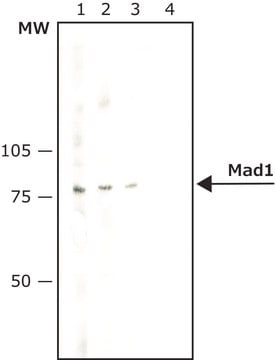
immunocytochemistry: 10-20 μg/mL using HeLa cells, immunoprecipitation (IP): suitable, microarray: suitable

isotype

IgG2b

UniProt accession no.

shipped in

dry ice

storage temp.

−20°C

target post-translational modification

unmodified

Gene Information

human ... MAD1L1(8379)

General description

Mitotic arrest deficient-like 1 (MAD1) is part of the cell-cycle checkpoint.
Monoclonal Anti-Mad1 (mouse IgG2b isotype) is derived from the hybridoma 9B10 produced by the fusion of mouse myeloma cells (SP2/0 cells) and splenocytes from BALB/c mice immunized with human recombinant Mad1 protein.

Immunogen

recombinant human Mad1 protein.

Application

Monoclonal Anti-Mad1 antibody produced in mouse has been used in
  • immunoblotting
  • immunoprecipitation
  • immunocytochemistry

Biochem/physiol Actions

Mitotic arrest deficient-like 1 (MAD1) functions as a regulator in the segregation of chromosomes during mitosis. It recruits mitotic arrest deficient-like 2 (MAD2) to kinetochores and directs it to function as an inhibitor. MAD1 also helps MAD2 to associate with translocated promoter region (TPr).

Physical form

Solution in 0.01 M phosphae buffered saline, pH 7.4, containing 15 mM sodium azide.

Disclaimer

Unless otherwise stated in our catalog or other company documentation accompanying the product(s), our products are intended for research use only and are not to be used for any other purpose, which includes but is not limited to, unauthorized commercial uses, in vitro diagnostic uses, ex vivo or in vivo therapeutic uses or any type of consumption or application to humans or animals.

Compare Similar Items

View Full Comparison

Show Differences

1 of 1

This Item
MABE867SAB4503302M7194
clone

9B10, monoclonal

clone

BB3-8, monoclonal

clone

polyclonal

clone

MEKK4-338, monoclonal

biological source

mouse

biological source

mouse

biological source

rabbit

biological source

mouse

Gene Information

human ... MAD1L1(8379)

Gene Information

human ... MAD1L1(8379)

Gene Information

human ... MAD1L1(8379)

Gene Information

human ... MAP3K4(4216)
mouse ... Map3k4(26407)
rat ... Map3k4(308106)

conjugate

unconjugated

conjugate

unconjugated

conjugate

unconjugated

conjugate

unconjugated

antibody form

purified immunoglobulin

antibody form

purified immunoglobulin

antibody form

affinity isolated antibody

antibody form

purified immunoglobulin

species reactivity

human

species reactivity

human

species reactivity

human

species reactivity

human, rat, mouse


Still not finding the right product?

Try our Product Selector Tool to narrow your options


Storage Class

10 - Combustible liquids

wgk

WGK 3

flash_point_f

Not applicable

flash_point_c

Not applicable


Choose from one of the most recent versions:

Certificates of Analysis (COA)

Lot/Batch Number

Don't see the Right Version?

If you require a particular version, you can look up a specific certificate by the Lot or Batch number.

Already Own This Product?

Find documentation for the products that you have recently purchased in the Document Library.

Visit the Document Library


Related Content


Timo E F Kuijt et al.
Chromosoma, 123(5), 471-480 (2014-04-04)
Fidelity of chromosome segregation is monitored by the spindle assembly checkpoint (SAC). Key components of the SAC include MAD1, MAD2, BUB1, BUB3, BUBR1, and MPS1. These proteins accumulate on kinetochores in early prometaphase but are displaced when chromosomes attach to
Garry G Sedgwick et al.
mAbs, 8(4), 689-697 (2016-03-18)
The spindle assembly checkpoint (SAC) ensures accurate chromosome segregation during mitosis by delaying the activation of the anaphase-promoting complex/cyclosome (APC/C) in response to unattached kinetochores. The Mad2 protein is essential for a functional checkpoint because it binds directly to Cdc20
Gang Zhang et al.
The EMBO journal, 38(7) (2019-02-21)
Kinetochore localized Mad1 is essential for generating a "wait anaphase" signal during mitosis, hereby ensuring accurate chromosome segregation. Inconsistent models for the function and quantitative contribution of the two mammalian Mad1 kinetochore receptors: Bub1 and the Rod-Zw10-Zwilch (RZZ) complex exist.


Global Trade Item Number

SKUGTIN
M8069-200UL04061837868146

Questions

Reviews

No rating value

Active Filters