Skip to Content
Merck

E2906

Anti-dEGF Receptor, Extracellular Domain antibody, Mouse monoclonal

clone C-273, purified from hybridoma cell culture

Synonym(s):

Anti-Drosophila Epidermal Growth Factor Receptor, Anti-dEGFR

Sign In to View Organizational & Contract Pricing.

Select a Size

200 μL

PLN 2,465.00

PLN 2,465.00

List PricePLN 2,900.00Save 15%

Please contact Customer Service for Availability

Request a Bulk Order

About This Item

UNSPSC Code:
12352203
NACRES:
NA.41
MDL number:
Conjugate:
unconjugated
Clone:
C-273, monoclonal
Application:
ELISA (i), IHC, WB
Citations:
15

Skip To

Technical Service
Need help? Our team of experienced scientists is here for you.
Let Us Assist

biological source

mouse

Quality Level

conjugate

unconjugated

antibody form

purified immunoglobulin

antibody product type

primary antibodies

clone

C-273, monoclonal

form

buffered aqueous solution

species reactivity

Drosophila

concentration

~1.2 mg/mL

technique(s)

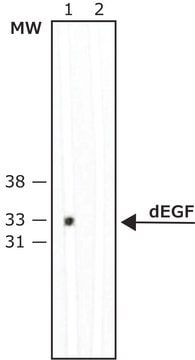
immunohistochemistry: suitable, indirect ELISA: suitable, western blot: 0.25-0.5 μg/mL using recombinant protein representing amino acids 299-359 of the Drosophila EGFR extracellular domain

isotype

IgG1

shipped in

dry ice

storage temp.

−20°C

target post-translational modification

unmodified

Gene Information

Drosophila melanogaster ... Egfr(37455)

Compare Similar Items

View Full Comparison

Show Differences

1 of 4

This Item
E2520E3138WH0001956M2
clone

C-273, monoclonal

clone

EGF-10, monoclonal

clone

F4, monoclonal

clone

4H2, monoclonal

biological source

mouse

biological source

mouse

biological source

mouse

biological source

mouse

Gene Information

Drosophila melanogaster ... Egfr(37455)

Gene Information

human ... EGF(1950)

Gene Information

human ... EGFR(1956)

Gene Information

human ... EGFR(1956)

conjugate

unconjugated

conjugate

unconjugated

conjugate

unconjugated

conjugate

unconjugated

antibody form

purified immunoglobulin

antibody form

purified from hybridoma cell culture

antibody form

ascites fluid

antibody form

purified immunoglobulin

species reactivity

Drosophila

species reactivity

human

species reactivity

human

species reactivity

human

General description

Anti-dEGF Receptor, Extracellular Domain antibody, Mouse monoclonal (mouse IgG1 isotype) is derived from the hybridoma C-273 produced by the fusion of mouse myeloma cells (NS1 cells) and splenocytes from BALB/c mice immunized with a recombinant protein encoding at the extracellular portion of Drosophila epidermal growth factor receptor (EGFR). Drosophila EGF receptor, also known as Torpedo or DER has four ligands: Gurken, Spitz (the principle ligand), Vein and Argos. Two accessory proteins modulate its signalling: Rhomboid and Star.

Application

Suitable for the following:
  • Immunohistochemistry
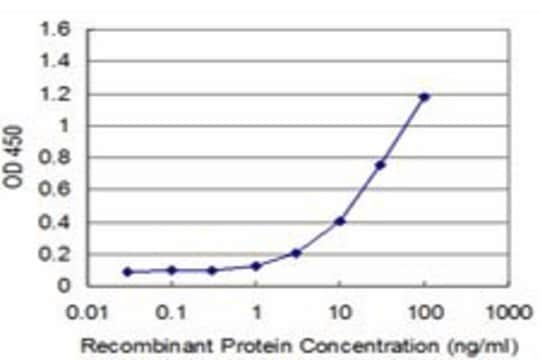
  • Indirect ELISA
  • Western blotting at a concentration of 0.25-0.5μg/mL using recombinant protein representing amino acids 299-359 of the Drosophila EGFR extracellular domain

Biochem/physiol Actions

Drosophila epidermal growth factor receptor (EGFR) is involved in many developmental processes such as: egg polarity, cell identity in the ventral ectoderm, neurogenesis, development of the Malpighian tubules, and larval eye and wing development. The downstream signalling molecules that are activated by the Drosophila EGF receptor include: Src homology (Shc), DRK (a homolog of mammalian Grb2), a guanine nucleotide exchange factor (SOS) activated by DRK, and downstream targets including orthologs of Ras, Raf, and Rolled (MAP Kinase).
The epidermal growth factor receptor (EGFR) binds to its cognate ligands that lead to autophosphorylation of receptor tyrosine kinase and subsequent activation of signal transduction pathways that are involved in regulating cellular proliferation, differentiation and survival. EGFR is overexpressed in tumor cell lines and is associated with poor prognosis leading to decreased survival. Its activation also plays a role in resistance to chemotherapy and radiation treatment in tumor cells. EGFR tyrosine kinase inhibitors (TKIs) may act as a new treatment option for advanced lung adenocarcinoma. Its ligands function in the Drosophila CNS and maintains glial survival. Drosophila EGF receptor plays a critical role during the development of Drosophila retina.

Physical form

Solution in 0.01 M phosphate buffered saline containing 15 mM sodium azide.

Disclaimer

Unless otherwise stated in our catalog or other company documentation accompanying the product(s), our products are intended for research use only and are not to be used for any other purpose, which includes but is not limited to, unauthorized commercial uses, in vitro diagnostic uses, ex vivo or in vivo therapeutic uses or any type of consumption or application to humans or animals.

Not finding the right product?  

Try our Product Selector Tool.

Storage Class

10 - Combustible liquids

wgk

WGK 3

flash_point_f

Not applicable

flash_point_c

Not applicable


Choose from one of the most recent versions:

Certificates of Analysis (COA)

Lot/Batch Number

Don't see the Right Version?

If you require a particular version, you can look up a specific certificate by the Lot or Batch number.

Already Own This Product?

Find documentation for the products that you have recently purchased in the Document Library.

Visit the Document Library

Regulating the dynamics of EGF receptor signaling in space and time
Shilo BZ
Development, 132(18), 4017-4027 (2005)
Josefa Steinhauer et al.
Journal of cell science, 126(Pt 19), 4469-4478 (2013-08-02)
Epidermal growth factor receptor (EGFR) ligands undergo a complex series of processing events during their maturation to active signaling proteins. Like its mammalian homologs, the predominant Drosophila EGFR ligand Spitz is produced as a transmembrane pro-protein. In the secretory pathway
Rebecca P Kim-Yip et al.
Development (Cambridge, England), 145(23) (2018-11-06)
Adult stem cell niche boundaries must be precisely maintained to facilitate the segregation of stem cell and daughter cell fates. However, the mechanisms that govern this process in epithelial tissues are not fully understood. In this study, we investigated the
Roy S Herbst
International journal of radiation oncology, biology, physics, 59(2 Suppl), 21-26 (2004-05-15)
The epidermal growth factor receptor (EGFR) is a transmembrane glycoprotein that constitutes one of four members of the erbB family of tyrosine kinase receptors. Binding of EGFR to its cognate ligands leads to autophosphorylation of receptor tyrosine kinase and subsequent
Shiue-Wei Lai et al.
Journal of B.U.ON. : official journal of the Balkan Union of Oncology, 19(2), 459-465 (2014-06-27)
Epidermal growth factor receptor (EGFR) tyrosine kinase inhibitors (TKIs) represent a new treatment option for patients with advanced lung adenocarcinoma. In this article we assessed the treatment response and tried to identify prognostic factors which may provide some information different

Related Content

Instructions

Global Trade Item Number

SKUGTIN
E2906-200UL04061837794094

Our team of scientists has experience in all areas of research including Life Science, Material Science, Chemical Synthesis, Chromatography, Analytical and many others.

Contact Technical Service