Skip to Content
Merck

44977

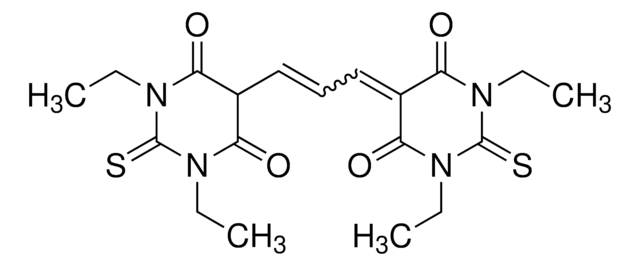
DISBAC2(3), Voltage Sensitive Probe

≥98% (HPLC)

Synonym(s):

5-[3-(1,3-Diethylhexahydro-4,6-dioxo-2-thioxo-5-pyrimidinyl)-2-propen-1-ylidene]-1,3-diethyldihydro-2-thioxo-4,6(1H,5H)-pyrimidinedione, Bis(1,3-diethylthiobarbituric acid)trimethine oxonol

Sign In to View Organizational & Contract Pricing.

Select a Size


About This Item

Empirical Formula (Hill Notation):
C19H24N4O4S2
CAS Number:
Molecular Weight:
436.55
UNSPSC Code:
12352108
NACRES:
NA.32
PubChem Substance ID:
EC Number:
256-325-5
Beilstein/REAXYS Number:
1232950
MDL number:
Technical Service
Need help? Our team of experienced scientists is here for you.
Let Us Assist
Technical Service
Need help? Our team of experienced scientists is here for you.
Let Us Assist

Quality Level

assay

≥98% (HPLC)

fluorescence

λex 535 nm; λem 560 nm in DMSO

suitability

complies for Infrared spectrum

storage temp.

−20°C

SMILES string

CCN1C(=O)C(\C=C\C=C2\C(=O)N(CC)C(=S)N(CC)C2=O)C(=O)N(CC)C1=S

InChI

1S/C19H24N4O4S2/c1-5-20-14(24)12(15(25)21(6-2)18(20)28)10-9-11-13-16(26)22(7-3)19(29)23(8-4)17(13)27/h9-12H,5-8H2,1-4H3/b10-9+

InChI key

VJYNRXFXHKIGLT-MDZDMXLPSA-N

Application

DISBAC2(3), Voltage Sensitive Probe is used for single-cell fluorescence imaging of transmembrane conductance and potential change.

Storage Class

11 - Combustible Solids

wgk

WGK 3

flash_point_f

Not applicable

flash_point_c

Not applicable


Choose from one of the most recent versions:

Certificates of Analysis (COA)

Lot/Batch Number

Don't see the Right Version?

If you require a particular version, you can look up a specific certificate by the Lot or Batch number.

Already Own This Product?

Find documentation for the products that you have recently purchased in the Document Library.

Visit the Document Library

In situ study of the membrane potential in microvascular endothelial cells using a fluorescent probe.
K Miao et al.
Microvascular research, 48(1), 135-142 (1994-07-01)
N Minami et al.
Journal of neural transmission. General section, 97(1), 65-72 (1994-01-01)
Effects of cyclic AMP on membrane potentials were examined by measuring the changes of bis-oxonol fluorescence in bovine adrenal medullary chromaffin cells. 8-Bromo cyclic AMP (8Br-cAMP) or forskolin caused a gradual and long lasting increase of the fluorescence intensity. The
Alexander S Tatikolov et al.
Biophysical chemistry, 107(1), 33-49 (2004-02-12)
Non-covalent interactions between polymethine dyes of various types (cationic and anionic thiacarbocyanines as well as anionic oxonols and tetracyanopolymethines) and human serum albumin (HSA) were studied by means of absorption, fluorescence and circular dichroism (CD) spectroscopies. Complexation with the protein
P He et al.
Microvascular research, 50(2), 183-198 (1995-09-01)
The membrane potential is an important modulator of calcium ion flux into endothelial cells of venular microvessels. We developed a method to measure the membrane potential of endothelial cells forming the walls of individually perfused microvessels under the same experimental
M Renier et al.
Human gene therapy, 6(10), 1275-1283 (1995-10-01)
Cystic fibrosis is caused by defects in a chloride-transporting protein termed cystic fibrosis transmembrane conductance regulator (CFTR). This study presents an innovative procedure to evaluate expression of functional CFTR. The technique uses the potential-sensitive probe bis-(1,3-diethylthiobarbituric acid) trimethine oxonol or

Global Trade Item Number

SKUGTIN
44977-1MG04061823367226

Our team of scientists has experience in all areas of research including Life Science, Material Science, Chemical Synthesis, Chromatography, Analytical and many others.

Contact Technical Service