


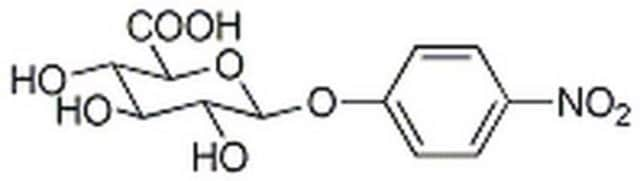


NBT is typically soluble in water at 10 mg/mL. Stock solutions at 10mg/ml in water are stable for 1-2 weeks in the dark at 2-8°C. The material has not been tested for solubility in RPMI, rates may be similar to that of water. This compound is also soluble in 2-methoxyethanol at 20 mg/m and ethanol at 5 mg/mL.
484235

p-Nitroblue Tetrazolium Chloride
≥98% (TLC), crystalline solid, nitric oxide synthase inhibitor, Calbiochem®
Synonym(s):
p-Nitroblue Tetrazolium Chloride, NBT, Nitro BT
Sign In to View Organizational & Contract Pricing.
Select a Size
Change View
| Pack Size | SKU | Availability | Price |
|---|---|---|---|
| 250 mg | Available to ship TODAYfromKuehne + Nagel Sp. z o.o. | PLN 421.00 | |
| 1 g | Available to ship TODAYfromKuehne + Nagel Sp. z o.o. | PLN 1,060.00 | |
| 35 g | Estimated to ship onJuly 20, 2026fromKuehne + Nagel Sp. z o.o. | PLN 51,530.00 |
About This Item
Empirical Formula (Hill Notation):
C40H30Cl2N10O6
CAS Number:
Molecular Weight:
817.64
UNSPSC Code:
12171500
NACRES:
NA.77
MDL number:
Assay:
≥98% (TLC)
Form:
crystalline solid
Storage condition:
OK to freeze, desiccated (hygroscopic), protect from light
Product Name
p-Nitroblue Tetrazolium Chloride, NADPH-diaphorase substrate that competitively inhibits nitric oxide synthase (IC50 = 3-4 µM).
Quality Segment
description
RTECS - XF8045000
assay
≥98% (TLC)
form
crystalline solid
potency
3-4 μM IC50
manufacturer/tradename
Calbiochem®
storage condition
OK to freeze, desiccated (hygroscopic), protect from light
color
yellow
solubility
methanol: soluble, water: soluble
shipped in
ambient
storage temp.
2-8°C
SMILES string
[Cl-].[Cl-].[n+]2([n](nc(n2)c8ccccc8)c3c(cc(cc3)c4cc(c(cc4)[n]5[n+](nc(n5)c7ccccc7)c6ccc(cc6)[N+](=O)[O-])OC)OC)c1ccc(cc1)[N+](=O)[O-]
InChI
1S/C40H30N10O6.2ClH/c1-55-37-25-29(13-23-35(37)47-43-39(27-9-5-3-6-10-27)41-45(47)31-15-19-33(20-16-31)49(51)52)30-14-24-36(38(26-30)56-2)48-44-40(28-11-7-4-8-12-28)42-46(48)32-17-21-34(22-18-32)50(53)54;;/h3-26H,1-2H3;2*1H/q+2;;/p-2
InChI key
FSVCQIDHPKZJSO-UHFFFAOYSA-L
General description
NADPH-diaphorase substrate that competitively inhibits nitric oxide synthase (IC50 = 3-4 µM). A well-known scavenger of superoxide anions. Useful as a substrate for alkaline phosphatase, often in conjunction with BCIP (Cat. No. 203788).
Biochem/physiol Actions
Primary Target
NOS
NOS
Preparation Note
Following reconstitution, aliquot and freeze (-20°C) for long-term storage or refrigerate (4°C) for short-term storage.
Other Notes
Pistelli, A., et al. 1994. Biochem. Pharmacol. 47, 1737.
De la Fuente, M., et al. 1993. Comp. Immunol. Microbiol. Infect. Dis.16, 29.
Libon, C., et al. 1993. J. Leukoc. Biol.53, 93.
Mittal, C.K. 1993. Biochem. Biophys. Res. Commun. 193, 126.
Nichols, K., et al. 1992. Neuroscience51, 791.
Nichols, K., et al. 1992. Neuroscience51, 791.
De la Fuente, M., et al. 1993. Comp. Immunol. Microbiol. Infect. Dis.16, 29.
Libon, C., et al. 1993. J. Leukoc. Biol.53, 93.
Mittal, C.K. 1993. Biochem. Biophys. Res. Commun. 193, 126.
Nichols, K., et al. 1992. Neuroscience51, 791.
Nichols, K., et al. 1992. Neuroscience51, 791.
Legal Information
CALBIOCHEM is a registered trademark of Merck KGaA, Darmstadt, Germany
Disclaimer
Toxicity: Harmful (C)
1 of 1
This Item | |||
|---|---|---|---|
| form crystalline solid | form solid | form solid | form solid |
| assay ≥98% (TLC) | assay ≥98% (TLC) | assay ≥98% (HPLC) | assay ≥98% (HPLC) |
| Quality Level 100 | Quality Level 100 | Quality Level 100 | Quality Level 100 |
| manufacturer/tradename Calbiochem® | manufacturer/tradename Calbiochem® | manufacturer/tradename Calbiochem® | manufacturer/tradename Calbiochem® |
| storage temp. 2-8°C | storage temp. −20°C | storage temp. 2-8°C | storage temp. 2-8°C |
| storage condition OK to freeze, protect from light, desiccated (hygroscopic) | storage condition OK to freeze | storage condition OK to freeze, protect from light | storage condition OK to freeze |
signalword
Warning
hcodes
Hazard Classifications
Acute Tox. 4 Oral - Eye Irrit. 2 - Skin Irrit. 2 - STOT SE 3
target_organs
Respiratory system
Storage Class
11 - Combustible Solids
wgk
WGK 3
flash_point_f
Not applicable
flash_point_c
Not applicable
Certificates of Analysis (COA)
Search for Certificates of Analysis (COA) by entering the products Lot/Batch Number. Lot and Batch Numbers can be found on a product’s label following the words ‘Lot’ or ‘Batch’.
Already Own This Product?
Find documentation for the products that you have recently purchased in the Document Library.
Related Content
"Aging: getting older, exhibiting the signs of age, the decline in the physical (and mental) well-being over time, leading to death. Since the beginning of time, man has been obsessed with trying to slow down, stop, or even reverse the signs of aging. Many have gone as far as experimenting with nutritional regimens, eccentric exercises, fantastic rituals, and naturally occurring or synthetic wonder-elements to evade the signs of normal aging. Biologically speaking, what is aging? And what does the latest research tell us about the possibility of discovering the elusive “fountain of youth”? Many advances in our understanding of aging have come from systematic scientific research, and perhaps it holds the key to immortality. Scientifically, aging can be defined as a systems-wide decline in organismal function that occurs over time. This decline occurs as a result of numerous events in the organism, and these events can be classified into nine “hallmarks” of aging, as proposed by López-Otin et al. (2013). Several of the pathologies associated with aging are a direct result of these events going to extremes and may also involve aberrant activation of proliferation signals or hyperactivity. The hallmarks of aging have been defined based on their fulfillment of specific aging related criteria, such as manifestation during normal aging, acceleration of aging if experimentally induced or aggravated, and retardation of aging if prevented or blocked, resulting in increased lifespan. The nine hallmarks of aging are genomic instability, telomere attrition, epigenetic alterations, loss of proteostasis, deregulated nutrient sensing, mitochondrial dysfunction, cellular senescence, stem cell exhaustion, and altered intercellular communication. The biological processes underlying aging are complex. By understanding the hallmarks in greater detail, we can get closer to developing intervention strategies that can make the aging process less of a decline, and more of a recline."
Global Trade Item Number
| SKU | GTIN |
|---|---|
| 484235-35GM | 04055977200706 |
| 484235-250MG | 04055977200690 |
| 484235-1GM | 07790788054755 |
-
What is the solubility in water and RPMI
1 answer-
Helpful?
-