


The antibody exhibits species cross-reactivity with rat and mouse. It is also predicted to react with human based on 100% sequence homology. Further information may be found in the following citation: Cheong RY, Czieselsky K, Porteous R, Herbison AE. Expression of ESR1 in Glutamatergic and GABAergic Neurons Is Essential for Normal Puberty Onset, Estrogen Feedback, and Fertility in Female Mice. J Neurosci. 2015 Oct 28;35(43):14533-43. doi: 10.1523/JNEUROSCI.1776-15.2015. PMID: 26511244; PMCID: PMC6605465.
06-935

Anti-Estrogen Receptor α Antibody
from rabbit, purified by affinity chromatography
Synonym(s):
ER-alpha, Estradiol receptor, Nuclear receptor subfamily 3 group A member 1
Sign In to View Organizational & Contract Pricing.
Select a Size
Change View
| Size/SKU | Availability | Price |
|---|---|---|
100 μg | Estimated to ship onMay 26, 2026fromKuehne + Nagel Sp. z o.o. | PLN 1,860.00 |
About This Item
UNSPSC Code:
12352203
NACRES:
NA.41
eCl@ss:
32160702
Conjugate:
unconjugated
Clone:
polyclonal
Application:
ICC, IHC, IP, WB
Citations:
152
biological source
rabbit
Quality Segment
conjugate
unconjugated
antibody form
affinity isolated antibody
antibody product type
primary antibodies
clone
polyclonal
purified by
affinity chromatography
species reactivity
human
species reactivity (predicted by homology)
mouse (based on 100% sequence homology), rat (immunogen homology)
technique(s)
immunocytochemistry: suitable, immunohistochemistry: suitable (paraffin), immunoprecipitation (IP): suitable, western blot: suitable
NCBI accession no.
UniProt accession no.
shipped in
wet ice
target post-translational modification
unmodified
Gene Information
human ... ESR1(2099)
mouse ... Esr1(13982)
rat ... Esr1(24890)
General description
Estrogen receptor (UniProt: P06211; also known as ER, ER-alpha, Estradiol receptor, Nuclear receptor subfamily 3 group A member 1) is encoded by the Esr1 (also known as Esr, Estr, Nr3a1) gene (Gene ID: 24890) in rat. Estrogen receptor α is a member of the steroid family of nuclear receptors; a critical nuclear receptor that mediates the physiological effects of estrogens. Estrogen receptor α contains several functional domains, including a ligand-binding domain, DNA-binding domain, and activation functions (AF-1 and AF-2), which regulate transcriptional activity. It is a ligand-activated transcription factor that, when bound to estrogen, induces a conformational change that allows dimerization and binding to estrogen response element sequences. When bound to DNA, Estrogen Receptor α can positively or negatively regulate gene transcription. Estrogen receptor α is expressed in various tissues, including the brain, breast, liver, the cardiovascular system, uterus, and placenta, where it plays roles in development, reproduction, and metabolic regulation. Estrogen receptor α both a nuclear receptor as well as a membrane-associated receptor through post-translational modifications like palmitoylation. This dual localization enables Estrogen receptor α to participate in both genomic and non-genomic signaling pathways, such as interactions with the PI3K/AKT and MAPK/ERK pathways, and activation of endothelial nitric oxide synthase (eNOS). Protein-protein interactions involving Estrogen receptor α include binding to transcription factors like AP-1 and SP-1, as well as interaction with caveolin-1 at the membrane. Dysregulation of Estrogen receptor α signaling is implicated in various diseases, including hormone-dependent cancers (e.g., breast cancer) and metabolic disorders. (Ref.: Ge, Y. et al., (2023). Oncology Letters, 26, 530).
Target molecular weight ~ 58 kDa observed. 67.03 kDa calculated. Uncharacterized bands may be observed in some lysate(s).
Immunogen
KLH-conjugated linear peptide corresponding to 15 amino acids from the C-terminal region of rat Estrogen Receptor α.
Epitope: C-terminus.
Application
Evaluated by Western Blotting in MCF7 cell lysate.
Western Blotting Analysis: A 1:1,000 dilution of this antibody detected Estrogen receptor α in MCF7 cell lysate.
Tested Applications
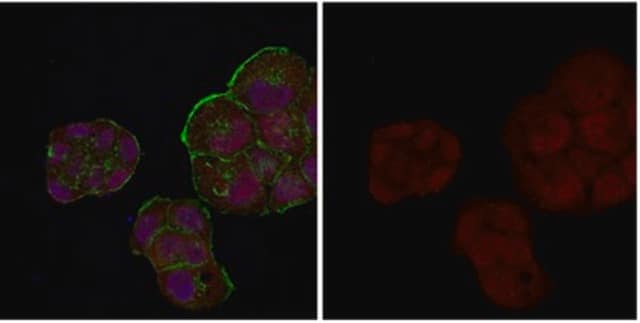
Immunocytochemistry Analysis: A 1:500 dilution of this antibody detected Estrogen Receptor α in MCF7 cells.
Immunohistochemistry (Paraffin) Analysis: A 1:1,000 dilution from a representative lot detected Estrogen receptor α in human breast cancer and uterine cancer tissue sections and a 1:500 dilution in human cervical cancer tissue sections.
Immunoprecipitation Analysis: 4 µg from a representative lot immunoprecipitated Estrogen receptor α from MCF7 cell lysate.
Note: Actual optimal working dilutions must be determined by end user as specimens, and experimental conditions may vary with the end user.
Western Blotting Analysis: A 1:1,000 dilution of this antibody detected Estrogen receptor α in MCF7 cell lysate.
Tested Applications
Immunocytochemistry Analysis: A 1:500 dilution of this antibody detected Estrogen Receptor α in MCF7 cells.
Immunohistochemistry (Paraffin) Analysis: A 1:1,000 dilution from a representative lot detected Estrogen receptor α in human breast cancer and uterine cancer tissue sections and a 1:500 dilution in human cervical cancer tissue sections.
Immunoprecipitation Analysis: 4 µg from a representative lot immunoprecipitated Estrogen receptor α from MCF7 cell lysate.
Note: Actual optimal working dilutions must be determined by end user as specimens, and experimental conditions may vary with the end user.
Anti-Estrogen Receptor , Cat. No. 06-935, is a rabbit polyclonal antibody that detects Estrogen Receptor and is tested for use in Western Blotting, Immunocytochemistry, Immunoprecipitation, and Immunohistochemistry (Paraffin).
Research Category
Epigenetics & Nuclear Function
Epigenetics & Nuclear Function
Research Sub Category
Hormones & Receptors
Hormones & Receptors
Biochem/physiol Actions
This rabbit polyclonal antibody detects rat Estrogen Receptor α. It targets an epitope within 15 amino acids from the C-terminal region.
Physical form
Purified rabbit polyclonal antibody in buffer containing 0.1 M Tris-Glycine (pH 7.4), 150 mM NaCl with 0.05% sodium azide.
Affinity purified
Preparation Note
Recommended storage: +2°C to +8°C.
Analysis Note
Control
MCF7 cell lysate
MCF7 cell lysate
Evaluated by Western Blotting in MCF-7 cell lysate. Western Blotting Analysis: A 1:1,000 dilution of this antibody detected Estrogen Receptor in MCF-7 cell lysate.
Other Notes
Concentration: Please refer to the Certificate of Analysis for the lot-specific concentration.
Disclaimer
Unless otherwise stated in our catalog or other company documentation accompanying the product(s), our products are intended for research use only and are not to be used for any other purpose, which includes but is not limited to, unauthorized commercial uses, in vitro diagnostic uses, ex vivo or in vivo therapeutic uses or any type of consumption or application to humans or animals.
1 of 1
This Item | |||
|---|---|---|---|
| biological source rabbit | biological source mouse | biological source rabbit | biological source rabbit |
| species reactivity human | species reactivity rat, human, mouse | species reactivity rat, pig, mouse, human, bovine | species reactivity human, rat |
| antibody form affinity isolated antibody | antibody form ascites fluid | antibody form culture supernatant | antibody form affinity isolated antibody |
| conjugate unconjugated | conjugate unconjugated | conjugate unconjugated | conjugate ALEXA FLUOR™ 555 |
| clone polyclonal | clone F3-A, monoclonal | clone 60C, monoclonal | clone polyclonal |
| technique(s) immunocytochemistry: suitable, immunoprecipitation (IP): suitable, immunohistochemistry: suitable (paraffin), western blot: suitable | technique(s) immunocytochemistry: suitable, western blot: suitable | technique(s) immunoprecipitation (IP): suitable, western blot: suitable | technique(s) immunocytochemistry: suitable |
Still not finding the right product?
Try our Product Selector Tool to narrow your options
Storage Class
12 - Non Combustible Liquids
wgk
WGK 1
flash_point_f
Not applicable
flash_point_c
Not applicable
Certificates of Analysis (COA)
Search for Certificates of Analysis (COA) by entering the products Lot/Batch Number. Lot and Batch Numbers can be found on a product’s label following the words ‘Lot’ or ‘Batch’.
Already Own This Product?
Find documentation for the products that you have recently purchased in the Document Library.
-
Will the antibody 06-935, which is listed as having human reactivity in the website information, be suitable for staining in mouse tissue?
1 answer-
Helpful?
-