Skip to Content
Merck

Skip To

04-486

Anti-RhoG Antibody, clone 1F3 B3 E5

clone 1F3 B3 E5, Upstate®, from mouse

Synonym(s):

ARHG, RHOG ras homolog gene family, member G (rho G), MGC125835, MGC125836

Sign In to View Organizational & Contract Pricing.

Select a Size

Change View
Pack SizeSKUAvailabilityPrice
100 μg

Available to ship TODAYfromKuehne + Nagel Sp. z o.o.

PLN 1,820.00

About This Item

UNSPSC Code:
12352203
NACRES:
NA.41
eCl@ss:
32160702
Conjugate:
unconjugated
Clone:
1F3 B3 E5, monoclonal
Application:
WB
Citations:
4

PLN 1,820.00


Available to ship TODAYDetails


Request a Bulk Order
Technical Service
Need help? Our team of experienced scientists is here for you.
Let Us Assist


biological source

mouse

Quality Level

conjugate

unconjugated

antibody form

purified antibody

antibody product type

primary antibodies

clone

1F3 B3 E5, monoclonal

species reactivity

mouse, rat, human

manufacturer/tradename

Upstate®

technique(s)

western blot: suitable

isotype

IgG2bκ

NCBI accession no.

UniProt accession no.

shipped in

wet ice

target post-translational modification

unmodified

Gene Information

human ... RHOG(391)

General description

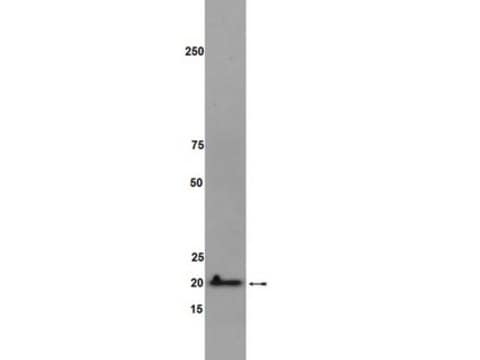
21 kDa
RhoG (ARGH) is a member of the Ras super-family of small G-proteins and a member of the Rac subfamily of Rho Family of GTPases. RhoG is a small G-protein (GTPase) who is activated by a GEF (guanine nucleotide exchange factor). The GEF displaces GDP from the binding site of RhoG and allows GTP to bind in it place rendering the protein active. This active RhoG binds downstream effector molecules that include ELMO and DOCK180. RhoG then cleaves GTP to GDP making it inactive. RhoG is believed to be crucial for integrin-mediated Rac activation and cell spreading. RhoG is believed to be active upstream of Rac and work independently of Rac.

Immunogen

KLH synthetic peptide encompassing amino acids CQQDGVKEVFAEAVRAVLNPT (RhoG 160-180)

Application

Anti-RhoG Antibody, clone 1F3 B3 E5 is an antibody against RhoG for use in WB.

Biochem/physiol Actions

Recognizes RhoG

Physical form

Format: Purified
Purified mouse monoclonal IgG2b in storage buffer containing PBS with 0.05% sodium azide.

Analysis Note

Routinely evaluated by western blot on NIH/3T3 cell lysate.

Other Notes

Concentration: Please refer to the Certificate of Analysis for the lot-specific concentration.

Legal Information

UPSTATE is a registered trademark of Merck KGaA, Darmstadt, Germany

Compare Similar Items

View Full Comparison

Show Differences

1 of 1

This Item
05-72305-778ABS1848
clone

1F3 B3 E5, monoclonal

clone

4, monoclonal

clone

55, monoclonal

clone

polyclonal

antibody form

purified antibody

antibody form

ascites fluid

antibody form

purified immunoglobulin

antibody form

affinity isolated antibody

species reactivity

mouse, rat, human

species reactivity

mouse, human

species reactivity

human, mouse, rat

species reactivity

human

conjugate

unconjugated

conjugate

unconjugated

conjugate

unconjugated

conjugate

unconjugated

biological source

mouse

biological source

mouse

biological source

mouse

biological source

rabbit

technique(s)

western blot: suitable

technique(s)

immunocytochemistry: suitable, western blot: suitable

technique(s)

immunocytochemistry: suitable, western blot: suitable

technique(s)

western blot: suitable


Still not finding the right product?

Try our Product Selector Tool to narrow your options


Storage Class

12 - Non Combustible Liquids

wgk

WGK 1

flash_point_f

Not applicable

flash_point_c

Not applicable


Certificates of Analysis (COA)

Search for Certificates of Analysis (COA) by entering the products Lot/Batch Number. Lot and Batch Numbers can be found on a product’s label following the words ‘Lot’ or ‘Batch’.

Already Own This Product?

Find documentation for the products that you have recently purchased in the Document Library.

Visit the Document Library


A Trio-Rac1-Pak1 signalling axis drives invadopodia disassembly.
Moshfegh, Y; Bravo-Cordero, JJ; Miskolci, V; Condeelis, J; Hodgson, L
Nature Cell Biology null
Aneta Kwiatkowska et al.
Molecular cancer, 11, 65-65 (2012-09-13)
The invasion of glioblastoma cells into regions of the normal brain is a critical factor that limits current therapies for malignant astrocytomas. Previous work has identified roles for the Rho family guanine nucleotide exchange factors Trio and Vav3 in glioblastoma
Sergi Marco et al.
Nature communications, 12(1), 6829-6829 (2021-11-26)
Signals are relayed from receptor tyrosine kinases (RTKs) at the cell surface to effector systems in the cytoplasm and nucleus, and coordination of this process is important for the execution of migratory phenotypes, such as cell scattering and invasion. The


Questions

Reviews

No rating value

Active Filters