Direkt zum Inhalt
Merck

C8114

Anti-α-E-Catenin antibody produced in rabbit

IgG fraction of antiserum, buffered aqueous solution

Anmelden zur Ansicht der Organisations- und Vertragspreise.

Größe auswählen

Ansicht ändern

Über diesen Artikel

UNSPSC Code:
12352203
NACRES:
NA.41
MDL number:
Conjugate:
unconjugated
Clone:
polyclonal
Application:
ARR, ICC, WB
Citations:
12
Technischer Dienst
Benötigen Sie Hilfe? Unser Team von erfahrenen Wissenschaftlern ist für Sie da.
Unterstützung erhalten


biological source

rabbit

conjugate

unconjugated

antibody form

IgG fraction of antiserum

antibody product type

primary antibodies

clone

polyclonal

form

buffered aqueous solution

mol wt

antigen 102 kDa

species reactivity

rat, human, canine

technique(s)

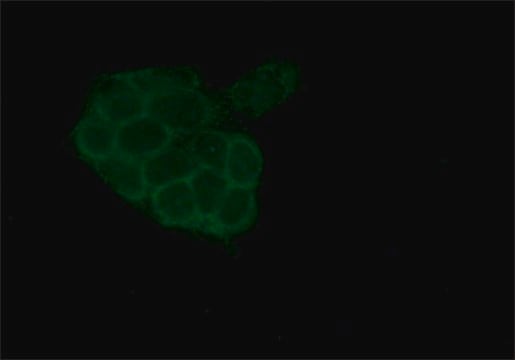
immunocytochemistry: 1:200 using methanol-fixed, dog MDCK and human MCF7 cellc, microarray: suitable, western blot: 1:1,000 using whole cell extract of human epidermal carcinoma A431 cell line and cytosolic fraction of rat embryonic brain.

UniProt accession no.

shipped in

dry ice

storage temp.

−20°C

target post-translational modification

unmodified

Gene Information

human ... CTNNA1(1495)
rat ... Ctnna1(307505)

General description

α-E-Catenin is a predominant subtype of α-catenin. It is widely expressed but at low levels in the nervous system. Alternative spliced variants of α-E-Catenin include α1- and α2-E-catenin.
The catenins (α, β, γ) are cytoplasmic proteins found in varying abundance in many developing and adult tissues.

Immunogen

synthetic peptide corresponding to a region located near the C-terminus of human α-E-catenin (amino acids 873-887). This sequence is identical in mouse and Xenopus α-E-catenin. It is not found in α-N-catenin, β-catenin, and γ-catenin.

Application

Anti-α-E-Catenin antibody produced in rabbit has been used in western blotting and immunocytochemistry.

Biochem/physiol Actions

Catenins bind directly or indirectly to the conserved cytoplasmic tail domain of the cell adhesion adherins. The association of catenins to cadherins produces a complex, which is linked to the actin filament network. Catenins/cadherin complexes play an important role in mediating cell adhesion, transduction of cell-cell contact positional signals to the cell interior, and may play a crucial role in cell differentiation. The linkage of the epithelial cadherin /uvomorulin to actin is essential for the cell binding function of this cadherin. α-Catenin (CAP102, 102 kDa), originally described as an E-cadherin associated protein, has been shown to associate with other members of the cadherin family members, N-cadherin and P-cadherin. Within its conserved region α-catenin shows 30% identity to vinculin.

Physical form

Solution in 0.01 M phosphate buffered saline, pH 7.4, containing 15 mM sodium azide.

Disclaimer

Unless otherwise stated in our catalog or other company documentation accompanying the product(s), our products are intended for research use only and are not to be used for any other purpose, which includes but is not limited to, unauthorized commercial uses, in vitro diagnostic uses, ex vivo or in vivo therapeutic uses or any type of consumption or application to humans or animals.


Still not finding the right product?

Probieren Sie unser Produkt-Auswahlhilfe, um Ihre Auswahl einzugrenzen


Lagerklasse

10 - Combustible liquids

wgk

WGK 2

flash_point_f

Not applicable

flash_point_c

Not applicable

ppe

Eyeshields, Gloves, multi-purpose combination respirator cartridge (US)


Hier finden Sie alle aktuellen Versionen:

Analysenzertifikate (COA)

Lot/Batch Number

Die passende Version wird nicht angezeigt?

Wenn Sie eine bestimmte Version benötigen, können Sie anhand der Lot- oder Chargennummer nach einem spezifischen Zertifikat suchen.

Besitzen Sie dieses Produkt bereits?

In der Dokumentenbibliothek finden Sie die Dokumentation zu den Produkten, die Sie kürzlich erworben haben.

Die Dokumentenbibliothek aufrufen


Verwandter Inhalt


Evolving form to fit function: cardiomyocyte intercalated disc and transverse-tubule membranes
Current Topics in Membranes, 72, 121-158 (2013)
Arad Soffer et al.
PLoS biology, 20(8), e3001756-e3001756 (2022-08-16)
Mitotic spindle orientation (SO) is a conserved mechanism that governs cell fate and tissue morphogenesis. In the developing epidermis, a balance between self-renewing symmetric divisions and differentiative asymmetric divisions is necessary for normal development. While the cellular machinery that executes
p120 catenin is required for normal renal tubulogenesis and glomerulogenesis
Marciano DK, et al.
Development, 138(10), 2099-2109 (2011)


Global Trade Item Number

SKUGTIN
C8114-200UL04061837873256