
SML0339

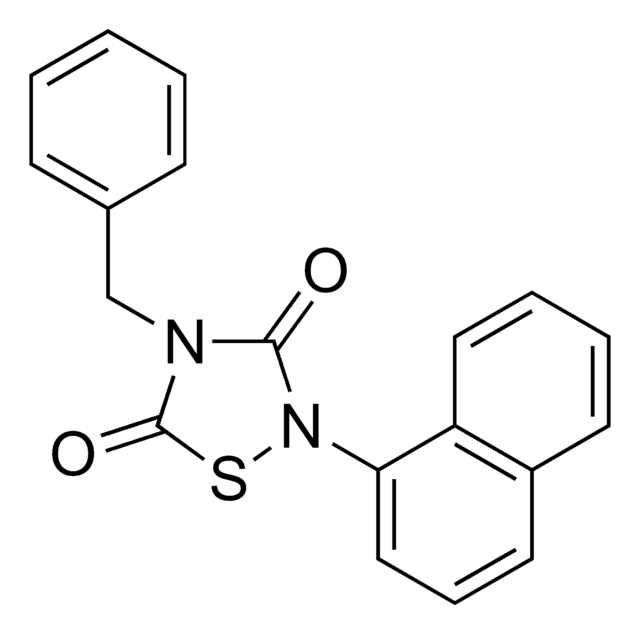
Tideglusib
≥98% (HPLC), glycogen synthase kinase-3 inhibitor, powder
Synonym(s):
4-Benzyl-2-(naphthalen-1-yl)-[1,2,4]thiadiazolidine-3,5-dione, NP-12, NP031112
Select a Size
| Size/SKU | Availability | Price |
|---|
About This Item
Product Name
Tideglusib, ≥98% (HPLC)
Quality Segment
assay
≥98% (HPLC)
form
powder
color
white to beige
solubility
DMSO: >15 mg/mL
storage temp.
2-8°C
SMILES string
O=C1SN(C(=O)N1Cc2ccccc2)c3cccc4ccccc34
InChI
1S/C19H14N2O2S/c22-18-20(13-14-7-2-1-3-8-14)19(23)24-21(18)17-12-6-10-15-9-4-5-11-16(15)17/h1-12H,13H2
InChI key
PMJIHLSCWIDGMD-UHFFFAOYSA-N
Gene Information
human ... GSK3B(2932)
Application
- as a reference compound in ADP-GloTM Kinase assay
- as an allosteric inhibitor of GSK-3β to study its effects on myocardial remodeling and angiogenesis
- as a differentiation agent (specifically a glycogen synthase kinase (GSK)-3β inhibitor) to convert fibroblast cells into octamer-binding transcription factor-4 (OCT4)+ and vascular endothelial growth factor receptor-2 (VEGFR-2/fetal liver kinase-1 (FLK1)+ cells
Biochem/physiol Actions
Features and Benefits
1 of 1
This Item | |||
|---|---|---|---|
| description ≥98% (HPLC) | description - | description ≥98% (HPLC), from Fusarium sp. | description - |
| assay ≥98% (HPLC) | assay - | assay ≥98% (HPLC) | assay - |
| form powder | form buffered aqueous solution | form powder | form buffered aqueous solution |
| Quality Level 100 | Quality Level 100 | Quality Level 200 | Quality Level 100 |
| storage temp. 2-8°C | storage temp. −20°C | storage temp. −20°C | storage temp. −20°C |
| solubility DMSO: >15 mg/mL | solubility - | solubility DMSO: soluble, acetone: soluble, H2O: insoluble, chloroform: soluble, ethyl acetate: soluble | solubility - |
| color white to beige | color - | color - | color - |
Storage Class
11 - Combustible Solids
WGK
WGK 3
Flash Point (°F)
Not applicable
Flash Point (°C)
Not applicable
Choose from one of the most recent versions:
Already Own This Product?
Find documentation for the products that you have recently purchased in the Document Library.