

EC11303 is a non-pathogenic, facultative anaerobic flora present in the human intestine. It is supplied as lyophilized cells, not intended for starter culture, and is non-sterile. It has been used for isolation of DNA, preparation of crude cell lysate for protein purification, and as a test proteome for comparative electrophoresis.
For differences between EC11303 (Strain B) and K-12: Strain B and K-12 are distinct laboratory strains of E. coli with different genetic backgrounds. For specific genetic or metabolic differences, refer to ATCC or strain-specific documentation.
EC11303

Escherichia coli
Strain B, lyophilized cells
Sinonimo/i:
E. coli
Autenticati per visualizzare i prezzi organizzativi e contrattuali.
Scegli un formato
Cambia visualizzazione
| Voi/SKU | Disponibilità | Prezzo |
|---|---|---|
10 g | Disponibile per la spedizione OGGIdaSchnelldorf Distribution | 279,00 € |
25 g | Disponibile per la spedizione OGGIdaSchnelldorf Distribution | 611,00 € |
Informazioni su questo articolo
279,00 €
Disponibile per la spedizione OGGIDettagli
Servizio Tecnico
Hai bisogno di aiuto? Il nostro team di scienziati qualificati è a tua disposizione.
Permettici di aiutartiQuality Segment
sterility
non-sterile (not processed or packaged aseptically)
form
lyophilized cells
suitability
not intended for starter culture
storage temp.
−20°C
General description
Escherichia coli is a non-pathogenic, facultative anaerobic flora present in the intestine of human. It belongs to the genus, Escherichia, which consists of motile gram-negative bacilli.
Application
Escherichia coli has been used:
- in the isolation of DNA from lyophilized cell
- in the preparation of crude cell lysate for developing scalable purification method for recombinant protein A
- as test proteome for comparative electrophoresis
1 of 1
Questo articolo | |||
|---|---|---|---|
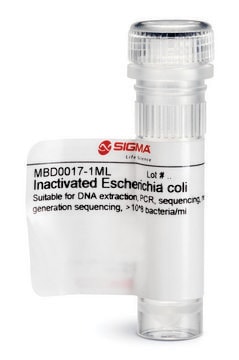
| description Strain B, lyophilized cells | description Strain K12, lyophilized cells | description Suitable for DNA extraction, PCR, sequencing, next generation sequencing, >10^8 bacteria/ml | description aqueous glycerol solution |
| storage temp. −20°C | storage temp. −20°C | storage temp. −20°C | storage temp. −70°C |
| Quality Level 200 | Quality Level 200 | Quality Level 200 | Quality Level 200 |
| form lyophilized cells | form lyophilized cells | form liquid | form aqueous glycerol solution |
| suitability not intended for starter culture | suitability not intended for starter culture | suitability suitable for restriction endonuclease digests, PCR amplification, Southern blots, and sequencing reactions | suitability - |
| sterility non-sterile (not processed or packaged aseptically) | sterility non-sterile (not processed or packaged aseptically) | sterility - | sterility - |
Still not finding the right product?
Explore all of our products under Escherichia coli
Classe di stoccaggio
11 - Combustible Solids
Che succede?
WGK 3
Punto di infiammabilità (°F)
Not applicable
Punto di infiammabilità (°C)
Not applicable
DPI (dispositivi di protezione individuale)
Eyeshields, Gloves, type N95 (US)
Scegli una delle versioni più recenti:
Possiedi già questo prodotto?
I documenti relativi ai prodotti acquistati recentemente sono disponibili nell’Archivio dei documenti.
-
I would like to know if this E. coli strain can be successfully grown in an overnight culture . I understand that the product is not intended for sterile culture use. Also how is it different from the K12 strain of e.coli??
1 risposta-
Utile?
-
-
Are these lyophilled cells viable? ie: they can be grown and fermented
1 risposta-
The cells in this product are expected to be viable and may grow in culture, but it's important to note that the product is not intended for culture use. The material is not handled aseptically during manufacturing, so it is likely that other organisms would be present. The main purpose of this product is to serve as a biomass, specifically for the extraction of biomolecules such as DNA and lipids. It's important to understand that there is no guarantee of viability or purity. If the end user wishes to reconstitute the product for culture, they should add 0.3 to 0.4 ml of suitable liquid medium/broth to the freeze-dried material and mix it well. Then, they should transfer the total mixture to a culture tube or plate containing 5 - 6 mL medium/broth. It's worth noting that there is no cell count estimate available for this product.
Utile?
-
-
Could you provide the reconstitution method and concentration for product EC11303 under the brand SIGMA?
1 risposta-
The cells in this product are expected to be viable and may grow in culture, but it's important to note that the product is not intended for culture use. The material is not handled aseptically during manufacturing, so it is likely that other organisms would be present. The main purpose of this product is to serve as a biomass, specifically for the extraction of biomolecules such as DNA and lipids. It's important to understand that there is no guarantee of viability or purity. If the end user wishes to reconstitute the product for culture, they should add 0.3 to 0.4 ml of suitable liquid medium/broth to the freeze-dried material and mix it well. Then, they should transfer the total mixture to a culture tube or plate containing 5 - 6 mL medium/broth. It's worth noting that there is no cell count estimate available for this product.
Utile?
-
-
What is the method of reconstitution for this product and what is the concentration?
1 risposta-
These cells are expected to be viable and may grow in culture. However, the product is not intended for culture use. The material is not handled aseptically during manufacturing, therefore other organisms would likely be present. The product is intended to serve as a biomass, i.e., for the extraction of biomolecules such as DNA and lipids. There is no guarantee of viability or purity. Should the end user wish to reconstitute the product for culture, add to the freeze-dried material 0.3 to 0.4 ml of suitable liquid medium/broth and mix well. Transfer the total mixture to a culture tube or plate containing 5 - 6 mL medium/broth. There is no cell count estimate available.
Utile?
-